
• Skip to main content
Daily Citizen
  • Subscribe
  • Categories
    • Culture
    • Life
    • Religious Freedom
    • Sexuality
  • Parenting Resources
    • LGBT Pride
    • Homosexuality
    • Sexuality/Marriage
    • Transgender
  • About
    • Contributors
    • Contact
  • Donate

research

Apr 01 2026

Research Shows Young Men Want Marriage Yet Lack Confidence in Dating

An important new survey from the Institute for Family Studies (IFS) on the marital and fatherhood interests of young men in America tell us that only 6% of those age 18 through 23 are married and just 25% of those between 24 and 29-years of age have a wedding ring on their finger. And less than one-third of unmarried men are currently in a romantic relationship. For those young men who do marry, most of them marry after age 30 as the average age of first marriage for men is 30.2.

As IFS notes, “Young men, in sum, are having a hard time in matters of love.”

So, are young men even interested in marriage and fatherhood? That is an extremely important question for the family formation prospects in the United States, and the news might be better than most imagine.

This new IFS data indicates that young men still have a high interest in marrying with 68% saying a definite “yes” while only 21% are “not sure” for various reasons and only 11% express no desire to marry at all. Conservatives are notably more likely than moderates or liberals to indicate an interest in marriage, as well as those currently in a relationship.

Religious young men are notably more likely to show an interest in marriage over their secular or nominally religious peers. The differentials are 88%, 60% and 71% respectively.
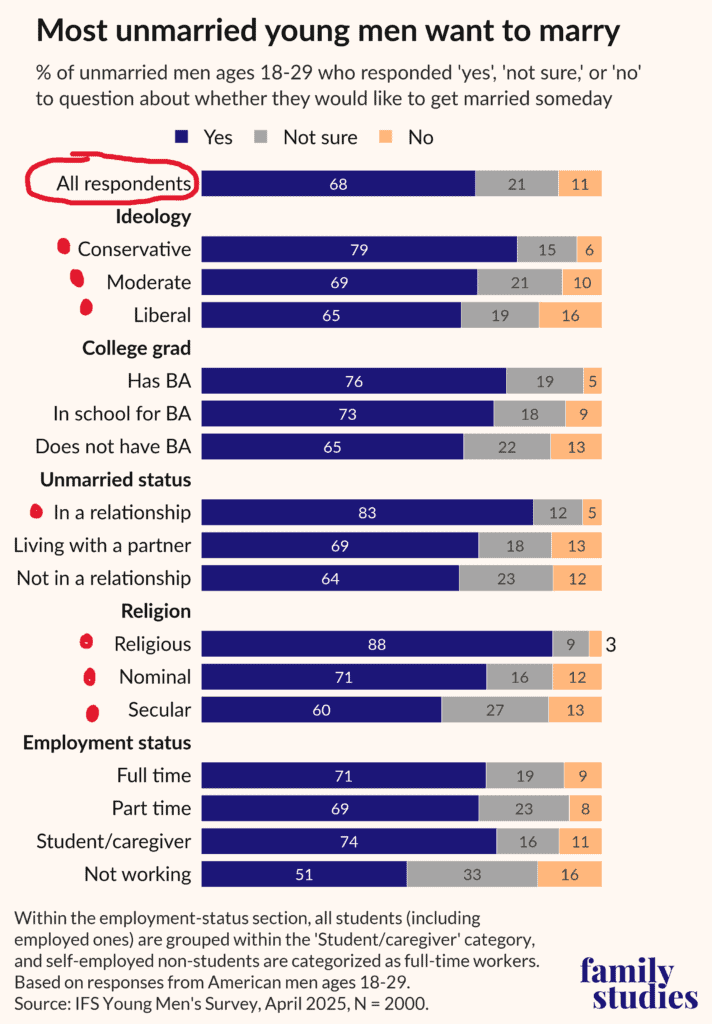
Those who have earned or are pursuing a college education are more likely to be interested in marrying. Not surprisingly, those who are not currently working are much more likely to be unsure or not interested in marrying. This is significant as the number of young men classified as NEET – not employed, pursuing any education or training – has increased, doubling since 1990.

For the minority of men who are not sure or not planning to marry, the leading reasons given were “hard to find the right person” (44%), “other life priorities” (40%), “unnecessary” (38%), and “not ready to make a commitment” at 36%. Only 32% listed finances as a leading hinderance.

Desire to be Dads

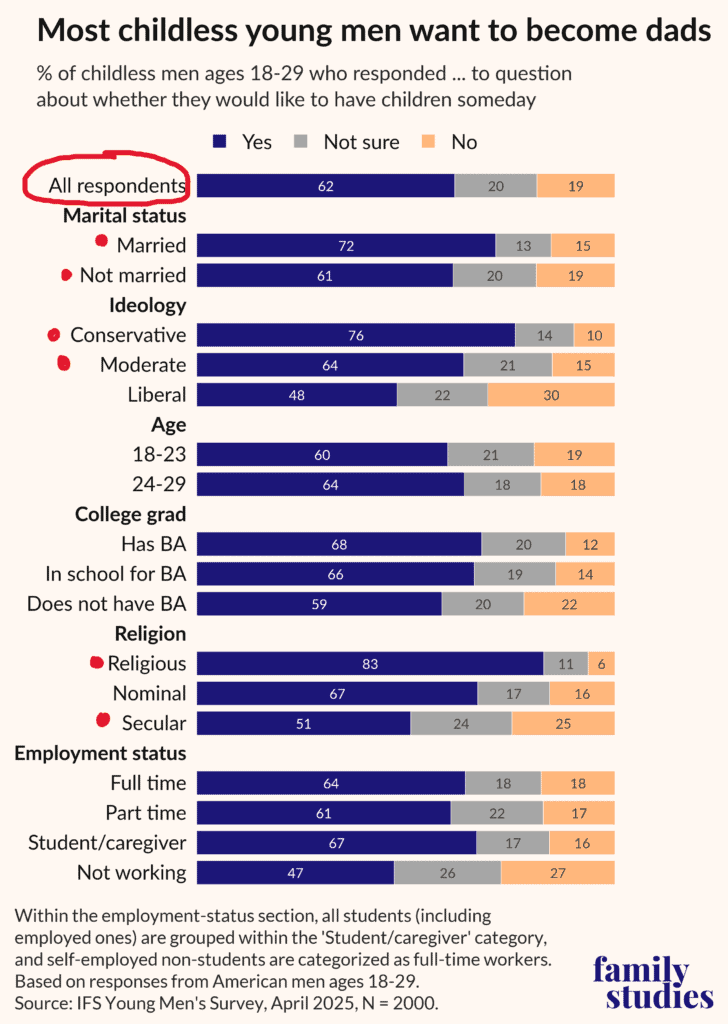
A strong majority of young American men (62%) say they would like to have children one day. Only 19% said they definitely would not, while 20% said they were not sure. Married men were more likely to say they wanted children (76% vs 61% for unmarried), once again showing that marriage is one of the greatest promoters of national fertility.

Conservative-leaning men are the most likely to say they want children at 76%, while only 48% of liberal men said they definitely want children. Just 10% of conservative men said they were sure they did not want children, while 30% of liberal and 15% of moderate-leaning men said they did not.

Like marriage, religion is a very positive factor driving greater interest in fatherhood. Eighty-three percent of religious men said they wanted to become fathers with only 6% of them saying they had no interest. In fact, religion was the most powerful differential followed by conservatism. Only 51% of secular men desire to be fathers, while a quarter said they did not desire this and 24% were “not sure.” Nominal believers fell right in the middle between these two.
The Dating Hurdle

Of course, young men cannot get married and become married fathers if they never meet the girl who will become their wives. There is a very real dating drought in America. 

Yet this new IFS data tells us that young single men are very interested (74%) in dating and religious (82%) and conservative men (80%) are far more likely to be interested in dating than their secular (71%) and liberal (71%) peers. Full-time employed and college students were highly likely to be interested in dating as well, at 77% and 79%.

So, what is keeping these men from getting out there and meeting their romantic interest? IFS explains, “About half indicate that it has been difficult to find someone who will go out with them, and nearly 6 in 10 report that that the fear of being turned down makes them reluctant to ask.” This matches with a recent IFS report that said 29% of men reported feeling “confident when approaching someone I’m interested in.” Only 39% of young men believe, “I am attractive to potential dating partners.”

A mere third of men confessed they were good at picking up on social cues on a date, while 42% said they were “good at managing my emotions when on a date.” And just 39% of men said, “I trust my judgement when it comes to choosing a romantic partner.” Sadly, only 31% of men were able to stay positive after a bad date or a relationship setback. These are very sad findings.

So, the real problems facing men meeting their future wife and mother of their children is not one of desire or interest. It is a lack of confidence in one’s potential as a desirable partner and ability to be an interesting, poised date.

This is hopeful news because the desire for dating, marriage and fatherhood is clearly present in young men. We just need to help them build the confidence and skills needed to meet, propose to, and marry the woman who will be their future wife. Family formation in America rests on us doing a better job at helping these young men develop these basic adult skills. We must get busy coming up with sure ways to build this confidence in young men. This polling data reveals they are asking for that help!

Related Articles and Resources: 

The American Dating Drought and Hope for Fixing It

New Study: Online Dating Produces Fewer Healthy Relationships

Young Person Explains Why Young People Aren’t Getting Married

Who Falls in Love Faster, Men or Women?

Make Dating for Marriage Great Again

Don’t Believe the Modern Myth. Marriage Remains Good for Men

Important New Research on How Married Parents Improve Child Well-Being

How Marriage Fights Against Deaths of Despair

New Research: Marriage Still Provides Major Happiness Premium

Harvard Evolutionary Biologist Brilliantly Explains Necessity of Monogamous Marriage
Written by Glenn T. Stanton · Categorized: Marriage · Tagged: culture, dating, research

Mar 24 2026

How Evangelical Conviction Is Standing Strong Against Evil

What is the church’s actual effect in the world today?

Jesus taught us in Matthew 13:33 and Luke 13:20-21 that His kingdom in the world is like leaven that quietly but powerfully enlivens a whole loaf. We don’t always notice its influence while it is working, but it is there. Jesus also said faithful Christians in the world are salt and light. As salt, we preserve and season the culture in life-giving ways. Sometimes we add flavor and other times we sting. We also illuminate, helping the world see the truth and beauty of God’s design.

Some new sociology of religion data from Ryan Burge, a statistician and professor at Washington University in St. Louis, demonstrates the church’s essential role in the world. His findings are notable as they lie in stark contrast to new Pew Research Center data on what Americans think is moral and immoral. 

The Pew numbers are not encouraging. Only…

• 39% of Americans believe homosexuality is morally wrong.

• 52% believe viewing pornography is corrupting.

• 47% hold that getting an abortion is morally wrong.

• 35% believe ending one’s life with the help of a doctor is wrong.

• 29% think gambling is wrong.

• A meager 23% believe getting a divorce is morally unjustified.

Americans increasingly approve of things which reduce human well-being. But evangelicals are different, and that is good. 

Professor Burge’s data demonstrates that, when it comes to convictions on abortion, redefining marriage and family and acceptance of homosexuality and transgenderism, evangelicals are clearly distinct from the larger culture — and by strong margins.

When compared to those who hold no faith, or call themselves mainline protestants, Catholic or black protestants, evangelicals are dramatically less likely to support any of these things.

Evangelicals are the only religious group where a majority do not agree with these 3 statements:

Abortion should be legal
Gay and lesbian people should be allowed to marry
Homosexuality should be accepted by society pic.twitter.com/dl33PdVplB

— Ryan Burge 📊 (@ryanburge) March 22, 2026

It is still a very real problem that 33% of people who identify as “evangelical” believe abortion should be legal, that 36% believe homosexuality and same-sex “marriage” are fine, and that 18% believe transgender ideology is good for society. However, evangelicals are clearly an important stopgap against American culture fully accepting and endorsing these dangerous ideas.

Professor Burge has additional data demonstrating it is not just an evangelical identity that galvanizes against increasing moral relativism. It is the actual practice of evangelical faith, demonstrating that evangelicals who attend church weekly are more than half as likely to disapprove of abortion, gay “marriage,” homosexuality and transgenderism compared with evangelicals who seldom or never attend.

Majorities of weekly attending Catholics and mainline Protestants agree that:

Gay and Lesbian people should be allowed to marry
Homosexuality should be accepted by society

Majorities of weekly attending mainline and Black Protestants agree that:

Abortion should be legal pic.twitter.com/8BjZYaC0a9

— Ryan Burge 📊 (@ryanburge) March 23, 2026

Hearing God’s word taught weekly by faithful, bible-believing pastors makes a strong difference in how we view important moral topics. Weekly attendance also made dramatic, positive differences for Catholic and black protestant Christians — but not as strongly as it did among evangelicals.

Biblically Faithful Christianity is Growing

When we look at what forms of Christianity are growing and shrinking in America and across the world, the distinctions are clear. 

Liberal mainline churches are dying a welcome death. They are running out of pastors and people at a brisk clip. But conservative Christianity, which is essentially evangelicalism and certain faithful strains of Catholicism and Orthodoxy, are rebounding. So much so, that even The New York Times had to take notice. Just months ago, they observed,

But predictions that the Christian right would be moribund with Gen Z-ers have proved false. In the aftermath of Covid – and amid the longing for purpose, community and transcendence that many Gen Z-ers feel – a sizable minority of them have found their answer in conservative Christianity, fueling both a religious and a political revival among these young Americans.

In 2024, the Times also noted how growing numbers of young men attending biblically faithful evangelical churches in larger numbers than their female peers – a clear reversal over decades past – “has the potential to reshape both politics and family life.” As a South Waco, Texas pastor marveled, “What’s the Lord doing? Why is he sending us all of these young men?”

The fact is that Christianity is growing moderately in America, with evangelicals being among the strongest with a 1.47% annual growth rate. It has grown by 150 million adherents since 2000 and is expected to expand by another 200 million by 2050.

Add to that Pew Research Center’s report from late last year that “more Americans express a positive view of religion’s role in society.” By “religion” they mean Christianity, which is clearly America’s most dominant faith practice. And evangelicalism is the largest Christian identity in America.

But the really good news is how Christianity is experiencing very robust growth around the world. Christianity’s global growth rate of 0.98% outpaces the annual 0.88% growth of the world’s population. It is growing by even greater margins in Asia and Africa, by remarkable 1.6% and 2.59% growth rates, respectively. Atheism, by contrast, is declining by 0.2% annually.Those who say they have no faith are leveling off, and will soon start declining.

Evangelicals truly are the preserving salt and illuminating light of the earth’s culture, the active leaven that enlivens the whole loaf. And their influence is growing. We must remember, the same Holy Spirit that empowered the Church at Pentecost is the same power increasing Christ’s Church today. 

The Holy Spirit has not grown tired or ineffectual. He cannot. He’s God.

Related Articles and Resources:

Which Pastors Would Perform Same-Sex ‘Weddings’ If They Could?

Data Shows Democrats Are Increasingly Secular

Is Religious Faith Gaining Influence in America?

How Big is Your View of the Gospel?

The Cultural Paradox of Following Jesus Christ

The Church’s Lane is the Whole Cosmos

Appreciating the Full Scope of the Lordship of Christ – and the Gospel Itself

As Secularists Prep for the Apocalypse, Christians Must Have Strong Kingdom Theology

In Our Troubled World, Take Heart and Remember That Christ is King

Written by Glenn T. Stanton · Categorized: Culture · Tagged: research

Feb 03 2026

Close Family Relationships Offer Long-Term Social Benefits, Study Finds

Humans are social creatures. Our success as adult citizens rests largely in the vibrancy and size of our social networks. After all, the unapologetically Christian poet, John Donne properly noted, “No man is an island, Entire of itself.”

A new study published in JAMA Pediatrics documents how important close family relationships in adolescence are in helping our children develop robust and meaningful social connections throughout adulthood. The four Columbia University researchers who conducted this study explain, “Higher family connection in adolescence was significantly associated with a greater prevalence of high social connection in adulthood.”

As well, they state, “These findings suggest that safe, stable, and nurturing family relationships during adolescence may contribute to greater relational well-being in adulthood, potentially reducing social disconnection.”

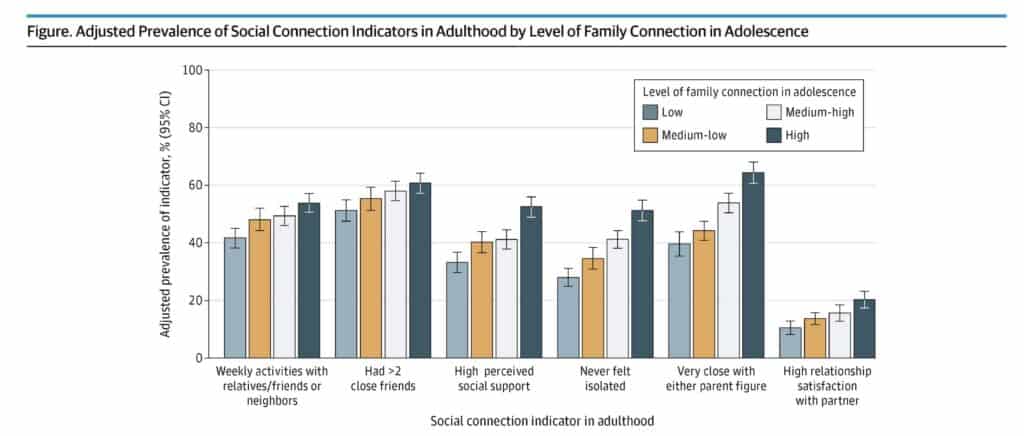
Specifically, this research team reported that high levels of meaningful social connection were“more than twice as common” for adults who had “high” levels of family connectedness as adolescents compared to peers who grew up with the lowest levels of family connectedness.  

Closer connections in one’s family of origin contributed not only to more social relationships, but also higher quality community friendships compared with those who grew up without close family ties. 

Young adults with high levels of family relatedness in adolescence were consistently shown to have higher levels of weekly connection with friends and neighbors, and to have two or more close friends. 

They also benefit from high social support, feel very close with both parents, never report feelings of isolation, and enjoy higher relational satisfaction with a spouse or romantic partner. You can see how consistently this finding demonstrated itself in this chart from the published study. Individuals with high family connectedness are shown in dark green.

This research was conducted over two decades with a nationally representative, racially diverse sample of more than 7,000 adults who joined the study as adolescents. The authors explain that their data is corroborated by additional U.S. and international research.

It is interesting when reading research articles like this to see how academics couch and contort their language for their colleagues. These Columbia University researchers did not disappoint, as their final line demonstrates,

However, efforts to increase the exposure of adolescents to safe, stable, and nurturing relationships at home are unlikely to cause harm and may contribute to their capacity as adults to create and maintain social connection, thereby addressing the increasing prevalence of loneliness and social isolation.

A very curious way to phrase their findings indeed. Even The New York Times, in reporting on this study, observed, “Researchers have long known that a strong parent-child relationship correlates with well-being in adulthood, but most studies have focused on internal measures like self-acceptance or a sense of purpose, rather than external dimensions such as satisfaction with relationships.”

Common sense does tell us, and scholars often stumble upon this truth, that close family relationships with one’s own married mother and father translate into strong, positive outcomes for children as they move into adulthood.

Related Articles and Resources

New Family Study Shows Importance of Married Parenting

Important New Research on How Married Parents Improve Child Well-Being

New Research Shows Married Families Matter More Than Ever

Why You Should Care About the Growing Positive Power of Marriage

Research Shows Marriage Boosts Well Being

New Research Shows Marriage and Fatherhood Regulate Male Sexual Energy

New Research: Marriage Still Provides Major Happiness Premium

Cohabitation Still Harmful – Even as Stigma Disappears

Don’t Believe the Modern Myth. Marriage Remains Good for Women

Don’t Believe the Modern Myth. Marriage Remains Good for Men.

Yes, Married Mothers Really Are Happier Than Unmarried and Childless Women

Marriage and the Public Good: A New Manifesto of Policy Proposals

Written by Glenn T. Stanton · Categorized: Family · Tagged: parenting, relationships, research

Privacy Policy and Terms of Use | Privacy Policy and Terms of Use | © 2026 Focus on the Family. All rights reserved.

  • Cookie Policy