• Skip to main content
Daily Citizen
  • Subscribe
  • Categories
    • Culture
    • Life
    • Religious Freedom
    • Sexuality
  • Parenting Resources
    • LGBT Pride
    • Homosexuality
    • Sexuality/Marriage
    • Transgender
  • About
    • Contributors
    • Contact
  • Donate

Children

Jun 16 2026

Feds Invest in Identifying Victims of Child Sex Abuse

The federal government committed to spend nearly $110 million on identifying unknown victims of child sexual abuse last week through the Secure America Act.

President Donald Trump signed the $70 billion Secure America Act on June 10 to fund Immigration and Customs Enforcement (ICE) and Border Patrol through 2028.

But the mega-bill also includes important provisions from the Renewed Hope Act, a bipartisan measure to help the Department of Homeland Security (DHS) identify trafficked children.

“[The Renewed Hope Act] ensures that [law enforcement] has the funding and personnel that it needs to help identify children who have been abused and trafficked — the children that we see in child sex abuse materials online,” Congresswoman Laurel Lee (FL), who first introduced the act in September 2024, told LIVE NOW from Fox this week.

The Secure America Act dedicates $108.5 million for ICE’s Homeland Security Investigations (HSI) division to:

  • Hire 40 more forensic analysts and 30 more child exploitation investigators to work at its Child Exploitation Investigation Unit’s Victim Identification Lab.
  • Hire 130 new forensic analysts and child exploitation investigators to work at its special agents in charge offices.
  • Create a program dedicated to training federal, state and local law enforcement agents to identify and locate child abuse victims.

The expansion represents a 97% increase in DHS’ child abuse identification workforce. According to Senator Josh Hawley (MS), one of the Renewed Hope Act’s biggest supporters, the department currently employs just seven investigators dedicated to identifying unknown victims of child abuse.

The federal government’s investment in combatting child trafficking can’t come a moment too soon. Congresswoman Lee explains:

What we see is that, as the internet has proliferated, as predators have access to more tools, that these children that are being abused, many of them are taken, trafficked, and their images are being put out on the internet.

Heisman trophy winner and child welfare advocate Tim Tebow testified to the severity of the problem before the Senate Judiciary Subcommittee on Crime and Counterterrorism, chaired by Senator Hawley, in March. There, Tebow noted the International Child Sexual Exploitation database currently tracks 89,000 unidentified children portrayed in online child sexual abuse material.

Per Rep. Lee, the number of unknown victims of online child abuse increased to 89,000 from 57,000 in 2024.

In his Senate testimony, Tebow further noted that, between October 2025 and March 2026, the Department of Justice documented nearly 340,000 unique United States IP addresses which downloaded or distributed child rape images.

Representative Lee told Fox the Renewed Hope Act was based, in part, on Operation Renewed Hope I, II and III which were coordinated with help from the Tim Tebow Foundation.

“We’ve done a pilot program of this operation before — the Tim Tebow Foundation has been an incredible partner to us in Washington — and what we saw is that when we have the right experts, Homeland Security Investigations can help find these children, bring them home and bring those perpetrators to justice,” she explained.

The most recent operation, Operation Renewed Hope III, occurred from February 24 to March 7, 2025. HSI led the investigation in conjunction with the National and International Center for Missing and Exploited Children, the Tim Tebow Foundation and four other U.S. law enforcement agencies; 26 foreign and international law enforcement agencies; and 28 victim identification specialists from 21 countries.

The operation yielded the identification of 36 victims and generated leads on 380 more victims.

Tebow celebrated the passage of the Renewed Hope Act on X last week.

Right now, 89,000 unidentified image series of children being sexually abused have been seen by law enforcement — but these children have yet to be identified and are still waiting to be found due to resource and manpower shortages, every day we don't act is another day they're… pic.twitter.com/raXiofBh6e

— Tim Tebow (@TimTebow) June 10, 2026

“I am grateful to our congressional leaders for getting this lifesaving legislation over the finish line, and to the law enforcement [agents] who never stop fighting for these kids,” he wrote.

“My prayer is that hope is renewed for many more boys and girls, and that their stories will be different because of this legislation.”

The Daily Citizen thanks Tim Tebow , his foundation, Congresswoman Lee, Senator Hawley and all other legislators involved in authoring and passing provisions of the Renewed Hope Act — a measurable legislative change with the potential to save and redeem thousands of children’s lives.

Additional Articles and Resources

Tim Tebow to Parents: ‘Please Be the Protectors You’re Called to Be’

Feds Convict First Person for Crimes Under ‘Take It Down’ Act

Zuckerberg, Grok, Messaging Platforms Dominate 2026 Dirty Dozen List

X’s ‘Grok’ Generates Pornographic Images of Real People on Demand

Pornhub’s Parent Company Settles With Feds Over CSAM Complaint

Porn Companies Condition Viewers to Desire Illegal and Abusive Content
Written by Emily Washburn · Categorized: Government Updates · Tagged: Children

Mar 18 2026

‘Protect Kids Colorado’ Qualifies Three Child Safety Ballot Measures for November

Protect Kids Colorado announced that all three of its state ballot measures to safeguard children qualified for the November ballot. 

In an entirely grassroots effort, the child safety and parental rights advocacy group gathered more than 500,000 total signatures for the initiatives.

The first measure, Initiative 108, would give predators convicted of trafficking children a life sentence; Initiative 109 would prevent males from participating in girls sports; while Initiative 110 would prohibit irreversible “transgender” surgeries for minors.

Protect Kids Colorado Executive Director Erin Lee announced the victory in a post on X, acknowledging the enormous effort from supporters: 

All 3 @ProtectKidsCO measures are officially ON THE BALLOT! 

# 108: The Children Are Not For Sale Act 

# 109: The Protect Girls’ Sports Act 

# 110: The Protect Kids from Irreversible Sex-Rejecting Surgeries Act 

People from every walk of life stepped up, sacrificed, and continue to fight for what matters. And because of ALL of you, the people will have a voice. 

🔥 HUGE NEWS 🔥

All 3 @ProtectKidsCO measures are officially ON THE BALLOT! 🗳️

# 108: The Children Are Not For Sale Act
# 109: The Protect Girls’ Sports Act
# 110: The Protect Kids from Irreversible Sex-Rejecting Surgeries Act

This didn’t happen because it was easy — it… pic.twitter.com/ZW5VHMnC8K

— Erin for Parental Rights (@Erin4Parents) March 17, 2026

In an email, Lee thanked volunteers who spent six months collecting signatures at hundreds of churches, grocery stores, ministries, colleges and signing events around the state: 

This is more than a milestone – it’s a historic, grassroots achievement powered by people across Colorado. What many said was impossible, you made a reality.
More than 3,300 petition carriers, 1,900+ notaries, hundreds of churches, and so many supporters stepped up – getting signatures, giving, sharing and showing up day after day. Every conversation, signature, and hour mattered.

Some volunteers faced anger and vitriol from transgender activists and their allies as they explained the ballot measures to registered voters. 

Collecting more than 165,000 signatures for each measure on a shoestring budget really was an extraordinary achievement. The Rocky Mountain Voice reported that Protect Kids Colorado raised $220,000 to fund the drive to place all three measures on the ballot.

By way of comparison, Let’s Go Washington spent almost $4.4 million to place two citizen-initiated measures, protecting girls sports and parental rights in education, on the November ballot. 

The notoriously radical Colorado Legislature considered three bills that would have done exactly what the ballot measures do – but each piece of legislation was voted down along party lines in House committees. 

The Children are Not for Sale Act, which would have given life sentences to those who traffic children, was defeated in the Judiciary Committee in a 4-7 vote. The Protect Female Sports Act was killed in the State, Civic, Military & Veterans Affairs Committee with a 3-8 vote. And a measure to Safeguard Minors from Sex-Altering Interventions failed to move forward, losing a 5-7 vote in the Health & Human Services Committee. 

So now, it’s up to Colorado voters to do what the Legislature would not: Give those convicted of trafficking minors a life sentence without parole; protect girls sports – and their privacy and safety – from male athletes; and protect minors from irreversible, body damaging transgender surgeries. 

Related articles and resources: 

‘Art Club’ Documentary — One Family’s Escape from Gender Ideology, and the Bigger Trend Sweeping the Nation

Athletes Rally at Supreme Court to Keep Boys Out of Girls Sports

Colorado Committee Kills ‘Children Are Not for Sale Bill’

Exclusive Interview: Colorado Parents Expose ‘Gender Cult’ at Public School in New Documentary

One Mom’s Journey Advocating for Children and Parental Rights

Protect Kids Colorado

Sign These Three Ballot Petitions to Protect Kids and Parental Rights in Colorado

Supreme Court to Hear Title IX Girls Sports Case

Protect Kids Colorado

Top 5 Moments From Supreme Court Arguments Over Girls Sports

Washington State Citizens Fight for Parents’ Rights, Girls Sports

Written by Jeff Johnston · Categorized: Culture · Tagged: Children, LGBT, parental rights, transgender

Mar 17 2026

Is America Growing More or Less Pro-Life?

One of the primary marks of a nation is how it cares for its most vulnerable. Few are more vulnerable and helpless than the preborn. Every child in a mother’s womb is humanity’s tomorrow. That is, after all, how each of us started. Those tiny humans demand our care and protection.

So how are we doing as a country in protecting human life in the womb? For all the seriously heroic pro-life efforts going on across the nation, are our fellow citizens’ views on abortion moving in a positive direction?

New polling data from the Pew Research Center paints a good news/bad news story.

Some good news is that among white evangelicals, 74% say abortion should be illegal in all or most cases. This is up from 62% who said this in 2008. (Pew provided no data for black or Hispanic evangelicals.)

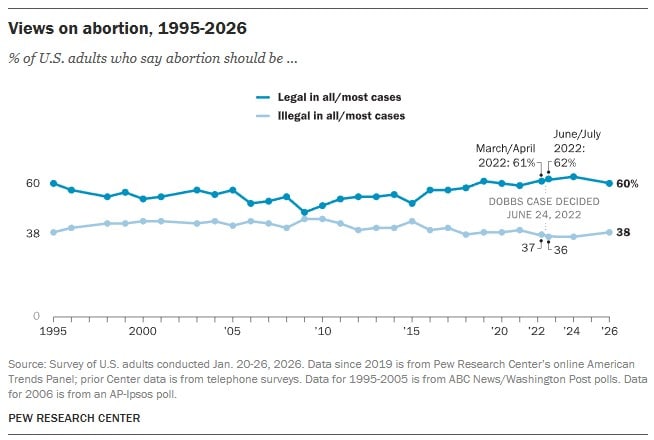
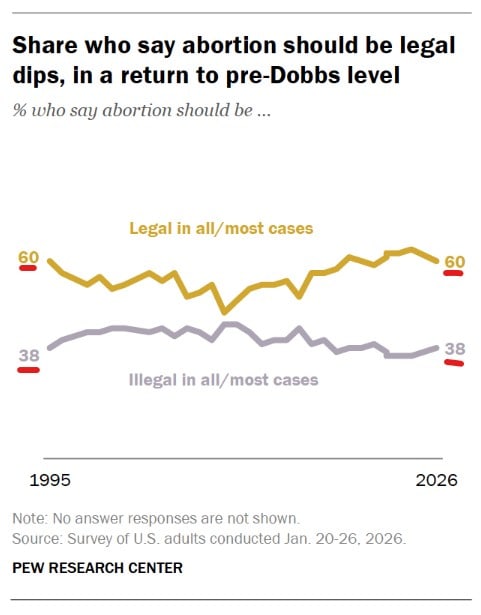
The bad news is that in the long run, convictions appear to have not really moved much in the past 30 years. In fact, Pew’s data show the number of Americans who say abortion should be legal/illegal in “all/most cases” is precisely the same today as it was 31 years ago in 1995, as this graph shows.

But there is also good news here. As this chart indicates, there have been recent marked declines in the number of Americans who support abortion and increases in those who want to see it significantly restricted. Pew’s data tells us that in 2024, 63% of Americans thought abortion should be legal in “all/most cases” and that number has now declined to 60%. On the pro-life side, those numbers have shifted from 36% in 2024, up to 38% today. Yet they were exactly as they are today — 60 versus 38% — as they were in 2020 and 1995.

You see a slightly different perspective on the overall consistency from this long trendline:

The year these two conflicting views closed the narrowest gap was in 2009 when 47% of Americans believed abortion should be protected and 44% believed it should be substantially restricted. The highest point the pro-life view reached since 1995 when Pew started tracking this question was 44% in 2009 and 2010. It nearly regained that height with 43% in 2015. The peak for the pro-abortion view was 63% in 2024, and it only hit the low 60s in 1995, 2019 (61%), 2020 (60%), 2022 (62%), and 2026.

Additional good news is that Pew finds a full 76% of Americans believe there should be at least some legal limits on abortion. This is contrary to what pro-abortion activists advocate for and have successfully passed in a great many states in the U.S. When asked, their leaders are not inclined to mention any limitations they favor. In fact, they typically resist basic medical health and safety standards being applied to abortion businesses.

Of this new Pew data, Professor Michael New of the Catholic University of America and the Charlotte Lozier Institute in Washington DC wrote over at National Review,

This Pew poll provides welcome news. Some recent polls, including the Knights of Columbus/Marist poll found that the pro-life position was losing ground in the court of public opinion. However, this poll shows that after a slight dip post-Dobbs, pro-life sentiment is rebounding — good news as pro-lifers continue the effort to build a culture of life.

Abortion by Politics

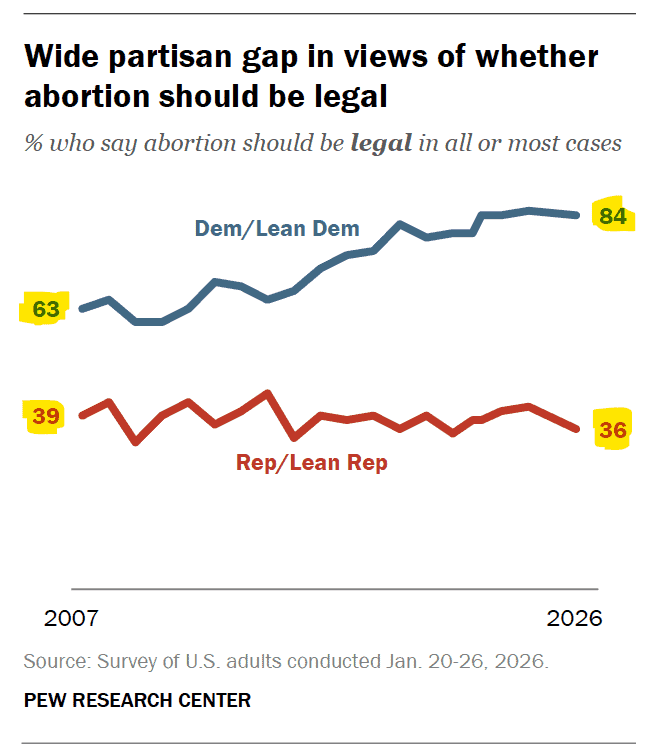
Finally, Pew documents how abortion has been faring among the two major parties in the U.S. Support for abortion has increased among Republicans and Democrats, yet to very differing degrees.

The Republican party removed “right to life” convictions from its party platform in 2024 and 41% of GOPers supported the full legality of abortion that year. Yet Pew notes a decline since then in the number of Republican or Republican-leaning citizens who believe abortion should be legal in all or most cases down to 36%. Although that conviction has remained pretty steady over the last twenty years.

However, Democrat and Democrat-leaning voters favoring no or few limitations on abortion have risen dramatically from 63% in 2007 to 84% in 2026.

This is a 48-point difference between the two parties on the need to protect preborn life. In 2007, they shared a 24-point gulf. 

We should celebrate the good news here and be sobered by the bad. But we must also realize we still have much work to do to recover a nation that values all life, no matter how young. The collective work of this very vibrant pro-life movement must continue — and grow!

Written by Glenn T. Stanton · Categorized: Life · Tagged: abortion, Children

Feb 06 2026

Why Adoption is Beautiful and Surrogacy Isn’t

The launch of the Greater Than campaign, “[a] coalition of parents, students, researchers, think tanks, influencers, and citizens aimed at ending same-sex marriage in America,” elicited a spectrum of reactions. A common response is to simply deny that children need, deserve, and have a right to their mother and father, or that same-sex “marriage” poses any risks to their health and well-being. Another response is to proclaim the issue “settled” because of the Obergefell Supreme Court decision (apparently by those unaware of the history of the Supreme Court and the story of Roe v. Wade).  

Tennis great Martina Navratilova, an advocate of women’s rights and vocal opponent of transgender ideology, condemned the Greater Than coalition: 

Speaking of evil. Or, at least vile. According to these people, our relationships, our families and most of all, our kids, DO NOT COUNT. What is it to them? How I, a woman, married to a woman, affect people I never met just because I don’t have a husband? MYOB!!! 

However, her comments, posted on X, reinforce the basic argument the coalition is making: that same-sex “marriage” is about the desires of adults, not what’s best for children. 

The claim that our social policies should align with what is true, that children deserve to be raised in a home with a married, biological, mom and dad, also brought questions from those who care deeply about children; so much so, in fact, that they are adoptive parents. What does the reasoning about God’s created intent for family structure mean for adoption?  

It’s a good question; and like what follows when a similar critique is made of surrogacy. It is no accident that the legalization of same-sex “marriage” has increased demand for the legalization of surrogacy. Having chosen an inherently sterile union, many same-sex couples demand children. Acquiring children requires a technological workaround like IVF and surrogacy. In the process, a child is created and immediately robbed of either its mother or father or both.  

So, if children have a right to their married, biological mom and dad, are the implications for adoption the same as for surrogacy, sperm donors, or redefining marriage? Not at all. 

God’s design for the family is that a man and wife become one flesh and raise children together. The Fall frustrates this design in different ways. Families break. Couples find that their sexual union is infertile. Biological parents find themselves unable to care for their children for various reasons. A sexual act, disordered toward illegitimate pleasure or even selfish violence, produces a life unintended and unexpected. 

Whatever the brokenness, adoption offers a means of restoration. Implicitly, the act of adoption recognizes that something is not as it should be, whether or not someone is morally culpable. Through adoption, the brokenness is addressed and restored by a new family.  

In these ways, adoption portrays God’s relationship with us. Adoption is among the many marriage-and-family metaphors used in Scripture to describe how God relates to His people. Paul, in Ephesians, calls Christians “adopted” sons and daughters of God through Jesus Christ. The fracture created in the Garden and extended by our own brokenness is repaired by Jesus. As a result, we are adopted children of God, with all the rights and benefits and status involved. 

Some question whether a woman’s relationship to a child that she bears in pregnancy is important. Are not adoptive moms just as emotionally and spiritually connected to their children as a biological mother could be? Yes, but it is also true that there is an inherent connection for the child to the woman who bears him or her. This is true whether she is a surrogate or enters an adoption contract. A mom that relinquishes her right to raise a child is still a mom. Adoption recognizes the reality that she has done what is best for her child and, at some level, brings redemption to the brokenness. Surrogacy intentionally creates the brokenness. In the case of surrogacy, the mother-child relationship is created only to be knowingly and intentionally severed. 

In adoption, a woman who did not bear the child becomes a mother. In surrogacy, a mother is treated as less than a whole person, wanted for her procreational parts that are treated as consumer products, especially as commercial surrogacy becomes more common. Surrogacy also treats the child as a consumer product, instead of as a gift. 

According to a Williams Institute study, the majority of same-sex couples prefer technologies such as insemination, surrogacy, and IVF, to adoption as a means to acquire children. Studies indicate that up to 40% of all surrogate pregnancies are commissioned by gay couples. Of course, even in adoption a same sex couple further deprives a child of either a mother or father.  

Unfortunately, same sex “marriage” and surrogacy have become so normalized that, even in the Christian world, speaking against either is considered controversial. It should not be. In our fallen world, families break, but we should never break them on purpose.

Written by John Stonestreet · Categorized: Family · Tagged: Children, parenting

Feb 03 2026

Choosing Truth Over Secrecy: Trey Carlock and the Moral Case for Trey’s Law

From the outside looking in, Raymon “Trey” Carlock enjoyed a happy and wholesome adolescence and professional rise — but not everything is always as it appears.

Studying at Cistercian Preparatory School and Highland Park High School in Dallas, Trey was an Eagle Scout and also studied in Greece, Switzerland and Zambia. He played tennis, football, lacrosse and ran cross country.  He graduated with honors from Harding University in Arkansas.

But through many of those adventures and accomplishments, Trey was carrying a dark and evil burden. He had been sexually abused at summer camp as a young boy by a pedophile who eventually pleaded guilty to not only abusing him, but also many others.

As part of a settlement, Trey signed a “Non-Disclosure Agreement” — a legally binding contract that prohibits signatories from sharing specific details about a particular incident.

Over the years, many organizations and institutions, including the Catholic Church and Boy Scouts, have used NDAs as a means to maintain secrecy regarding sensitive, controversial and damaging information.

Trey Carlock’s family has said the pain and anguish he was dealing with was only exacerbated by not being able to talk publicly about the crime. He died by suicide in 2019.

NDAs are a staple in corporate America, regularly used to protect confidential or proprietary information, including intellectual property. Companies and organizations may also use them to avoid litigation or bad public relations. We’ve all read and seen news stories when a subject declines to talk or go into detail. In many cases, it’s because they’ve received compensation in exchange for their silence.

Understandably, there’s a rising chorus of people and individuals opposing the use of NDAs to silence victims of sexual abuse. This is the energy and origin behind “Trey’s Law” — a national movement designed to protect survivors’ voices and ban the use of these agreements in instances where organizations or businesses would prefer victims not publicly discuss what happened to them.

Spearheaded by Elizabeth Carlock Phillips, Trey’s sister, the group’s mission states:

Survivors of child sexual abuse and trafficking should never be silenced, anywhere. Through advocacy, education, and legislative action, we’re working to expand Trey’s Law in every state–ensuring survivors have the freedom to share their own stories, hold bad actors accountable, and prevent further harm. This is an urgent matter of public safety.

This is more than policy reform — it’s a promise to stand on the side of victims, not predators.

To date, four states — California, Missouri, Tennessee and Texas — have passed “Trey’s Law.” While other states have enacted versions of such bans for agreements going forward, what’s distinct about this effort is that the Trey’s legislation allows victims who have previously been silenced to now speak out.

Focus on the Family strongly supports this effort. We grieve the abuse, evil and wickedness that victims of abuse have been forced to endure. The Apostle Paul wrote to believers in Ephesus that, “It is shameful even to mention what the disobedient do in secret” (5:12), but NDAs in this context do not serve or protect individuals or families.

To make informed decisions, moms and dads and children need to know what’s going on and where — especially when it comes to choosing a summer camp for their children.

Written by Paul Batura · Categorized: Culture · Tagged: abuse, Children

  • Page 1
  • Page 2
  • Go to Next Page »

Privacy Policy and Terms of Use | Privacy Policy and Terms of Use | © 2026 Focus on the Family. All rights reserved.

  • Cookie Policy