• Skip to main content
Daily Citizen
  • Subscribe
  • Categories
    • Culture
    • Life
    • Religious Freedom
    • Sexuality
  • Parenting Resources
    • LGBT Pride
    • Homosexuality
    • Sexuality/Marriage
    • Transgender
  • About
    • Contributors
    • Contact
  • Donate

Life

Oct 09 2026

Canada Won’t Allow Euthanasia Solely for Mental Illness, But Will for Dementia

Editorial note: The terms euthanasia and physician-assisted suicide are often used interchangeably and will be in this article. Euthanasia refers to a healthcare worker intentionally and directly administering drugs to kill a patient. Physician-assisted suicide refers to a healthcare worker prescribing drugs for a patient to self-administer to end their own life. Canada allows both forms.

The Canadian government won’t allow elderly and infirm individuals to be approved for euthanasia solely for reason of mental illness.

After years of delay, Canada – which already has one of the most permissive euthanasia regimes in the world – will indefinitely bar individuals from being killed through euthanasia solely for receiving a mental illness diagnosis. The nation has already killed over 100,000 of its citizens since legalizing physician-assisted suicide in 2016.

Canadian Justice Minister Sean Fraser, citing a lack of consensus among physicians about whether mental illness is irremediable, said Wednesday, “While there is not a perfect consensus on this issue, we believe this is the correct approach at this particular time.”

The development comes as Bill C-218, which would have amended the Canadian Criminal Code to permanently prevent euthanasia for mental illness as a sole criterion, was unfortunately defeated in the Canadian Parliament by a vote of 187 to 141 on October 7.

Alex Schadenberg, executive director of the Euthanasia Prevention Coalition, held a press conference ahead of the vote, alongside Dr. Laurence Normand-Rivest, Dr. Paul Saba and Odile Marcotte, a retired professor.

“Euthanasia based on a mental illness should never be approved,” Schadenberg said. “The law requires that a person have an ‘irremediable medical condition.’ That’s what the law requires [for a person] to be approved.”

“And yet, experts, for the most part, agree that it’s impossible to determine for which patients it’s irremediable, and which ones will get better,” Schadenberg explained.

According to Schadenberg, Bill C-218’s defeat was “directly related” to the justice minister’s declaration; it went down just three and a half hours after the announcement.

In 2021, the country expanded its euthanasia regime by enacting Bill C-7, which broadened individuals’ eligibility for euthanasia for serious and incurable medical conditions, even when their death is not reasonably foreseeable.

Bill C-7 also permitted euthanasia for mental illness alone, but the government delayed the provision for two years. The provision was delayed three times, and was set to be implemented on March 17, 2027, before Wednesday’s announcement.

Dr. Saba explained at the press conference, “A Harvard School of Public Health study found that nine out of ten people who attempted suicide but survived did not die by suicide after receiving treatment.”

“With proper care, the desire for suicide often disappears,” Saba continued. “Euthanasia of those with mental disorders is not mercy. It is murder masquerading as compassion.”

Today, Canada permits euthanasia for those with “grievous and irremediable medical conditions” under two different tracks: Track 1 and Track 2.

Under Track 1 (which represents around 96% of euthanasia cases), a person must have a “reasonably foreseeable” natural death, while those approved for euthanasia under Track 2 (around 4% of cases) do not have to have a “reasonably foreseeable” natural death.

Hundreds of Canadians are euthanized each year (732 in 2024) who have potentially many years of life left.

Additionally, since the law allows individual physicians to determine what constitutes a “grievous and irremediable medical condition,” many Canadians are approved for euthanasia despite having very treatable and manageable conditions.

The most common medical conditions cited for euthanasia include more serious diagnoses like cancer, neurological conditions, respiratory diseases and cardiovascular conditions. But the nation also allows individuals to be approved for minor conditions including diabetes, frailty, autoimmune conditions, chronic pain, joint, bone and muscle issues, and hearing and visual issues.

While every case of euthanasia is a tragic violation of an individual’s right to life, Canada’s permissive laws lead to even more grave cases of abuse, like for patient Alan Nichols, who physicians killed for the sole diagnosis of hearing loss.

Despite the Canadian government’s announcement it will bar individuals from being euthanized solely for mental illness, it also announced it will permit individuals to be killed by “advance request.”

Legislation will be introduced later this fall to change the Criminal Code to permit physicians to kill patients based on their advance request, even if they later lose the capacity to consent.

For example, someone in the early stages of Alzheimer’s disease could request and be approved for euthanasia by advance request and then be killed later after their condition deteriorates and they can no longer agree to be killed.

Schadenberg cautioned the development is extremely concerning and invites further abuse of the Canadian system.

“Euthanasia by advanced request is a very dangerous concept as it permits doctors and nurse practitioners to kill someone who has become incompetent,” Schadenberg warned. “Therefore euthanasia by advance request is euthanasia without consent.”

Canada’s continued descent into darkness should serve as a warning to the world about the dire problems that result from legalizing euthanasia.

Every human being has dignity and value because all humans are made in the image of God.

As euthanasia continues to spread across the West, Christians must reaffirm each person’s dignity and worth and argue against euthanasia’s legalization and acceptance. Remember:

  1. Opponents of euthanasia oppose killing innocent people.
  2. Euthanasia corrupts the medical profession and violates the Hippocratic Oath.
  3. Euthanasia is essentially never necessary to control pain or suffering at the end of life.
  4. Euthanasia can transform the “right to die” into a “duty to die” by the state.
  5. Suffering, while never an intrinsic good, can serve a redemptive purpose.

“Every life is valuable and worth fighting for,” Dr. Saba added. “True compassion means supporting people through their dark times, not ending their lives.”

Focus on the Family offers a one-time complimentary consultation with our ministry’s professionally trained counselors. To reach Focus on the Family’s counseling service by phone, call 1-855-771-HELP (4357) weekdays 6:00 a.m. to 8:00 p.m. (Mountain Time). Alternatively, you can fill out our Counseling Consultation Request Form.

Related articles and resources:

Mental Health Resources

Physician-Assisted Suicide

Understanding God’s Plan for the End of Life

A Godly Perspective on End-of-Life Decisions

Aging Loved Ones and Physician-Assisted Suicide

Answers to Common Questions About Physician-Assisted Suicide

The Problem With Ending It All: A Response to Physician-Assisted Suicide

Disturbing Report Tells Story of Toddler Euthanized in the Netherlands

As Euthanasia Expands in the West, Here’s How Christians Can Respond

Anglican Church of Canada Launches ‘Pastoral Liturgy’ for Medically-Assisted Suicide

Canada to Report Killing Over 100,000 People With Physician-Assisted Suicide

Photo from Shutterstock.
Written by Zachary Mettler · Categorized: Government Updates, Life · Tagged: Euthanasia, Life

Oct 02 2026

Pope Leo’s Pro-Life and Pro-Family Journey to France

Pope Leo XIV recently concluded a historic four-day visit to France, the first papal visit to the country, often called “the eldest daughter of the Church,” since Pope Benedict XVI’s visit in 2008.

The theme for Pope Leo’s trip was based on Jesus’ words in John 10:10: “So that the world may have life.”

Throughout the trip, the pope repeatedly emphasized the importance of protecting the sanctity of human life and providing real care for the most vulnerable – including those with disabilities and the elderly.

The pope’s trip comes at a dire time in the life of France as it – like many other European nations – is becoming increasingly secular and liberal. Only five percent of French people say they attend church regularly.

Earlier this year, France became the most recent Western nation to legalize euthanasia, permitting doctors to kill the nation’s elderly and infirm.

In 2024, France became the first nation in the world to enshrine abortion as a “right” in its constitution, an action celebrated by French President Emmanuel Macron, and cheered by abortion activists who celebrated as the Eiffel Tower displayed the message “MyBodyMyChoice.”

And who can forget that Jesus’ Last Supper was mocked during the opening ceremonies of the 2024 Paris Olympics, where anti-Christian contempt was present and proudly displayed.

In contrast to all this, and in courageous fashion, Pope Leo came to France with a message of faith, hope and a firm rebuke to the nation’s governing elite and declining morals.

In an address on September 25 before President Macron at Elysée Palace in Paris, Pope Leo reminded the nation that “France is a land with deep Christian roots.”

In the past, France’s Christian identity fostered a “constant focus on the dignity inherent in every person” which is “echoed in your national motto,” Pope Leo said. But France has recently failed to live up to this identity and its ideal of “Liberty, Equality, Fraternity.”

“I ‘firmly reiterate that the protection of the right to life constitutes the indispensable foundation of every other human right,’” the pope insisted.

“Nowadays there is a temptation to expect science to eliminate or alleviate every form of suffering,” he added, denouncing “genetic manipulation, surrogacy, the trade in human organs or the possibility of arranging one’s own death” as medical practices that depart from the “greater good to which [science and technology] aspire.”

“Let us not forget that mutual respect and the protection of every human life is a duty incumbent upon each and every one of us,” he pressed.

At the conclusion of his speech, Pope Leo looked directly at the French president and urged him to remember that “a President of the Republic who claims to be uninterested in the Church and in Catholics would be failing in his duty.”

The same day, Pope Leo visited the United Nations Educational, Scientific and Cultural Organization (UNESCO) headquarters and again defended the sanctity of human life.

“[Too often] life is no longer understood as a gift, but as a commodity. It is no longer viewed as a summons to care and responsibility, but as a product to be exploited,” the pope said.

“[Human dignity] remains undiminished even in the most vulnerable circumstances, even to death itself,” Pope Leo taught, denouncing euthanasia. “Our dignity is not destroyed by illness or suffering, nor is it dependent upon our abilities. Rather, it calls for loving care at every stage of life.”

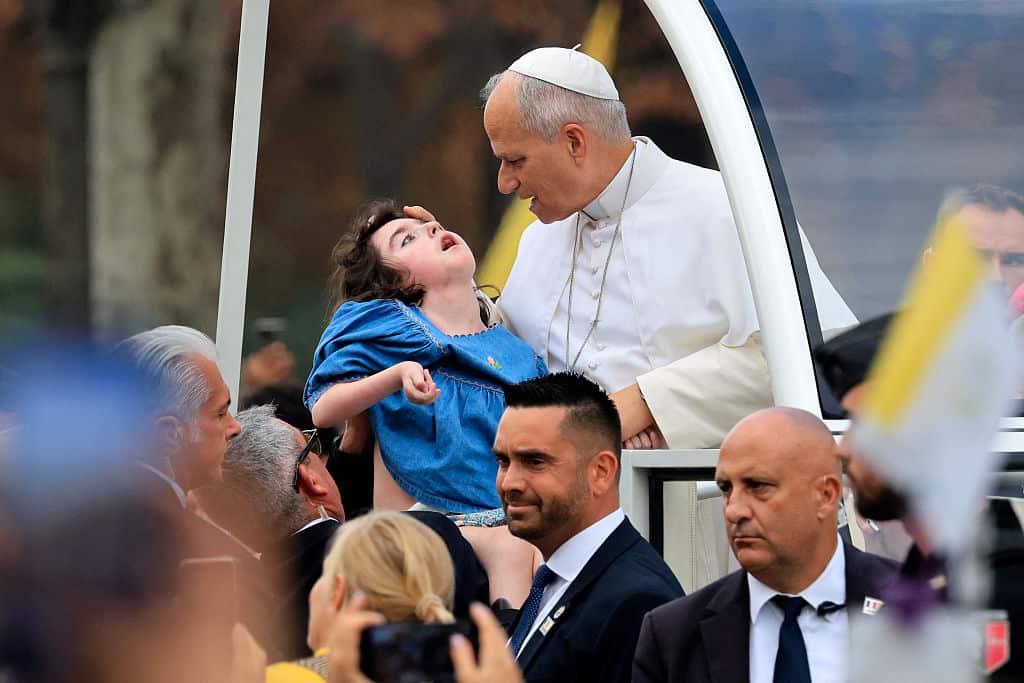
On September 26, as Pope Leo rode down the Champs-Elysees Avenue on his way to the Place de la Concorde, central Paris, the pope blessed Marie-Garance Noël, a child with multiple disabilities.

TOPSHOT – Pope Leo XIV blesses Marie-Garance Noel, a child with multiple disabilities, as he rides down the Champs-Elysees Avenue in the Papamobile (popemobile) on his way to the Place de la Concorde, central Paris, on September 26, 2026, to celebrate a solemn outdoor mass, on the second day of his visit to France. (Photo by Ludovic MARIN / AFP via Getty Images)

Marie-Garance was adopted by a French Catholic family known for caring for children with disabilities. Clotilde and Nicolas Noël are parents to six biological children and three adopted children with disabilities: Marie, who has Down syndrome; Marie-Garance, who has multiple disabilities; and Frédéric-Moïse, who has a cerebellar disorder.

The moment served as a beautiful witness to life, and in stark contrast to Netherlands doctor’s recent decision to legally euthanize a two-year-old child purely because of his disabilities.

Pope Leo also chose six boys with Down syndrome to serve as altar servers while he celebrated Mass at Place de la Concorde. Rachel Campos-Duffy, co-host of “Fox and Friends Weekend,” commended the move.

Thank you Pope Leo for honoring our children with #DownSyndrome & reminding the world of their humanity & right to life. God does not make mistakes. Your efforts will help end the 90% abortion rate for children diagnosed with DS in the womb.🙏🙏🙏 pic.twitter.com/3r1DKlekxx

— Rachel Campos-Duffy (@RCamposDuffy) September 26, 2026

Then on September 27, Pope Leo spoke in Lourdes, France, where many Catholics go on pilgrimage to seek healing of physical maladies.

Addressing the staff and sick community at Lourdes’ Accueil Notre Dame, Pope Leo again denounced euthanasia as “false compassion”:

I know that for some of you, because of particular illnesses and, at times, terrible pain, your horizon may appear dark, uncertain and without hope. But no human law should ever make you lose the certainty of your dignity.
On the contrary, it is precisely in the name of this inalienable dignity of the human person that we must reject the temptation to cause death under the guise of false compassion. It is impossible to regard causing death as something normal. What is legal is not necessarily moral.

He also decried abortion, saying, “No one ever has the right … to decide the life of a given embryo or elderly person! Medicine must never become the servant of programmed death!”

On the flight back to Rome, Pope Leo addressed criticism from some that his journey became “political.” He emphasized that his goal was not to be “political,” but to share the Gospel, and its implications for the most important moral issues of our time.

“When the Church speaks about defending life … we are not entering into politics, we are applying the Gospel to people’s lives,” Pope Leo explained. “The defense of life is something that, as you all know, the Church teaches and believes very deeply. … So, I would say that if that is considered politics, then I did it.”

Pope Leo’s historic visit to France will be remembered as a significant moment in the defense of human life at all stages and in all circumstances.

Hopefully the French people, the French government and the nations of the world, will take the pope’s paternal correction to heart.

Related articles and resources:

Pope Leo Warns Technology Must Serve Human Dignity

Vatican Reaffirms: Marriage is Between One Man and One Woman

Pope Leo XIV Warns of ‘Crisis of the Family’ in First Homily

Robert Cardinal Prevost Elected as Pope Leo XIV: Five Things You Should Know

Notre Dame Cathedral Reopens, Reminding Us of Western Civilization’s Christian Heritage

Photo from Getty Images.

Written by Zachary Mettler · Categorized: Life · Tagged: Life

Sep 30 2026

Pray for an End to Abortion

How often do you pray for an end to abortion and that every human life is respected? If the answer is, “Not enough,” now is your chance.

October is Respect Life Month, giving pro-life supporters the opportunity to deepen their understanding of, and take action to support, the sanctity of human life.

One way pro-life supporters can get more involved is through 40 Days for Life, an impactful pro-life organization founded by Shawn Carney.

The organization began in 2004 with four individuals from Bryan/College Station, Texas, who launched the very first 40-day prayer campaign outside the city’s local Planned Parenthood.

The group committed to pray and fast, engage in community outreach, and run a peaceful, constant vigil outside the Planned Parenthood building to publicly pray for an end to abortion.

The four volunteers quickly became 1,000 pro-life prayer warriors who covered all 960 hours of the vigil. Since many abortion-minded women who see individuals praying outside abortion clinics think twice about aborting their child, the campaign caused the local abortion rate to drop by 28%.

In 2007, the four individuals began the first ever nationally coordinated 40 Days for Life campaign across 89 cities in 33 states.

Today, the organization runs 40-day prayer campaigns twice per year, the centerpiece of which is the focused, 40-day, round-the-clock prayer vigils outside Planned Parenthood clinics and other abortion businesses in communities across the nation.

Volunteers pray publicly for an end to abortion, for human life to be respected, for the closing of abortion businesses and for abortion workers to repent and end their participation in the evil of abortion.

The newest prayer vigil campaign runs from September 23 to November 1. Participants can sign up to pray for one hour per week (or more) outside their local abortion clinic.

The prayer campaigns help individuals put action to their belief in the sanctity of human life.

Since beginning in 2007, the public prayer campaigns have saved at least 26,714 lives from abortion, caused 187 abortion centers to close and 279 abortion workers to quit.

Today, the Planned Parenthood in Bryan/College Station, Texas, which the four prayer warriors originally interceded for, has become 40 Days for Life’s headquarters.

Carney believes prayer is essential to making abortion unthinkable.

“Our culture is starving for God. They’re starving for joy and they’re starving for mercy. And we all need it,” he explained. “But it can’t be witnessed to without prayer, because prayer gives clarity. And it gives clarity to a very confused world.”

You can learn more about 40 Days for Life and sign up to pray outside your local abortion business.

If you are experiencing an unexpected pregnancy and want to learn more about your options, you can visit My Choice Network.

Please considering supporting Focus on the Family’s Option Ultrasound program to place ultrasounds in pregnancy centers around the country. To date, we’ve helped save over 500,000 preborn babies from abortion.

Related articles and resources:

My Choice Network

I’m Pregnant, Now What?

Dealing With Unplanned Pregnancy

Become an Option Ultrasound Life Advocate

How You Can Join the Pro-Life Movement

How To Join The Pro-Life Movement

Scriptures Advocating For The Pre-Born

The History of Christianity and Abortion

Photo from Shutterstock.

Written by Zachary Mettler · Categorized: Culture, Life · Tagged: abortion, Life

Sep 30 2026

Constitutional ‘Right to Abortion’ on Nevada Ballot This Fall

The 2026 midterm elections are quickly approaching and voters in four states will have an abortion measure on the ballot. One of those states is Nevada.

Nevada voters will cast a second and final vote on Question 6, the “Right to Abortion Amendment.”

A “Yes” vote creates a constitutional “right” to abortion in the state. A “No” vote would help save babies’ lives.

Nevada law requires voters to approve a citizen-initiated constitutional amendment in two consecutive general elections before it takes effect.

Nevadans approved this language in 2024 by a vote of 64% to 35%. If it passes again on November 3, it becomes part of the Nevada Constitution on November 24, 2026.

If approved, Question 6 would add the following language to the Nevada Constitution:

All individuals shall have a fundamental right to abortion performed or administered by a qualified health care practitioner until fetal viability, or when needed to protect the life or health of the pregnant patient, without interference from the state or its political subdivisions.

The amendment goes on to say that fetal viability, a baby’s ability to survive outside the womb, would be based solely on the judgment of the abortionist. That opens the door to abortions in the second and third trimesters of pregnancy. And because the amendment allows abortion at any point when a provider says it is needed for the woman’s “health,” there is no clear limit at all.

Protect Our Girls, the campaign to defeat Question 6, explains that this amendment would:

  • Allow abortions into the ninth month of pregnancy on healthy babies who feel pain.
  • Eliminate safety standards that protect women from abortion complications.
  • Remove parental notification on abortions for minors, allowing boyfriends and predators to pressure a girl into an abortion.

Pre-born babies can feel pain before viability, at 15 weeks or earlier. Under Question 6, babies who can experience pain would be subjected to painful late-term abortions.

Nevada already has one of the most liberal abortion laws in the nation. State law allows abortion during the first 24 weeks of a preborn baby’s life. Question 6 pushes that limit out even further, based on the abortionist’s judgment.

Supporters will tell voters that since abortion is already legal in Nevada, Question 6 changes little. They’re wrong.

A statute can be debated and improved over time. A constitutional amendment is designed to be permanent, and it would make future protections for babies, women and families much harder to pass or defend.

The campaign behind Question 6 is led by Nevadans for Reproductive Freedom. According to Ballotpedia and The Nevada Independent, supporters include Planned Parenthood Advocates Mar Monte, Reproductive Freedom for All, the ACLU of Nevada, and the Feminist Majority Foundation.

Opposing the measure are two political action committees, Protect Our Girls and Students for Life Action Ballot PAC, along with national pro-life groups Americans United for Life and Priests for Life.

The money gap between the measure’s opponents and supporters is enormous. Ballotpedia reports that supporters poured more than $13.2 million into passing Question 6 in 2024, while no money was reported on the opposing side.

This year, Nevadans for Reproductive Freedom has raised more than $815,000 so far, according to campaign finance reports filed with the Nevada secretary of state.

By comparison, Protect Our Girls has raised $10,000, all from two Carson City donors. Students for Life Action Ballot PAC has raised about $1,700.

The next campaign finance reports are due mid-October.

Bible-believing, pro-life Christians in Nevada cannot sit this one out. We encourage Nevadans to please vote, pray and talk to family, friends and neighbors about this important measure.

Early voting in Nevada begins October 17. Election Day is November 3.

And remember to vote for candidates who align with your Christian values this fall.

Written by Nicole Hunt · Categorized: Life · Tagged: advocacy, Election 2026, Life

Sep 25 2026

Pro-Life Groups Urge FDA to Restore Abortion Pill Safeguards

A coalition of 50 leading pro-life groups has penned a joint letter urging Dr. Heidi Overton, nominee for commissioner of the U.S. Food and Drug Administration (FDA), to commit to restoring safeguards on the abortion pill that the Biden administration removed.

The letter argues relaxing safety restrictions on mifepristone, like removing the in-person dispensing requirement, permitting telehealth prescriptions, and allowing it to be sent through the mail and across state lines, poses significant safety risks to women who take the drug.

Mifepristone is the first drug in a two-drug regimen commonly referred to as the abortion pill.

The signatories include the leaders of Advancing American Freedom, Family Policy Alliance, Them Before Us, Students for Life of America, Ethics and Religious Liberty Commission, Family Research Council, Live Action, Liberty Counsel and others.

“We, the undersigned organizations and individuals, call on FDA Commissioner nominee Dr. Heidi Overton to commit to restoring the safeguards governing mifepristone that existed before the Biden administration while the FDA completes its ongoing review of the drug,” the letter states.

The letter gave three reasons the FDA’s “extremely permissive policy” regarding mifepristone should be reversed. These include:

  • Serious concerns about the safety of the drug.
  • The permissiveness of the current policy increases the risk of abuse, especially by men who seek to force women to have abortions without their consent or knowledge.
  • Mail-order abortion is undermining state laws enacted to protect unborn life and women.

“American mothers and babies need an FDA that defends them both in word and deed,” the letter states.

EF26I103Download

The document was released ahead of Dr. Overton’s confirmation hearing before the Senate Health, Education, Labor and Pensions Committee on Thursday. If confirmed, she will take over the reins at the FDA from Acting Commissioner Kyle Diamantas, who succeeded former Commissioner Marty Makary.

Dr. Overton, who President Donald J. Trump nominated to lead the FDA in August, is widely seen as pro-life. However, she said she couldn’t make a firm commitment regarding mifepristone in Thursday’s hearing.

“I can’t prejudge the determination of the safety review that’s currently ongoing,” Overton told Sen. Tammy Baldwin, after the senator inquired about the abortion pill’s safety.

Likewise, Dr. Overton told Sen. Josh Hawley that a safety review “is ongoing and very important. Women’s health and women’s safety is a critical piece of this.”

Last year, the FDA launched a study into mifepristone’s safety, which was reportedly set to conclude by the end of this month.

The FDA’s investigation came after the Ethics and Public Policy Center (EPPC) released a study finding nearly 11% of all women who abort their children with mifepristone suffer from serious health complications, including sepsis, infection or hemorrhaging.

If the FDA finds anything remotely similar to what the EPPC found, it must immediately crack down on the drug.

The agency should restore mifepristone’s safety guardrails by reinstating the in-person dispensing requirement, prohibiting the pill from being sent through the mail, and eliminating the pharmacy certification process which permits retail pharmacies like Walgreens and CVS to sell the drug.

The letter concluded, “We call on Dr. Heidi Overton and the Trump administration to restore meaningful safeguards for mifepristone immediately while the FDA completes its review, and to end policies that have enabled abortion drugs to be distributed through the mail without adequate medical oversight.”

If you are experiencing an unexpected pregnancy and want to learn more about your options, you can visit My Choice Network.

Please considering supporting Focus on the Family’s Option Ultrasound program to place ultrasounds in pregnancy centers around the country. To date, we’ve helped save over 500,000 preborn babies from abortion.

Related articles and resources:

My Choice Network

I’m Pregnant, Now What?

Dealing With Unplanned Pregnancy

Become an Option Ultrasound Life Advocate

New Insights on the Dangers of the Abortion Pill

Overcoming Abortion and Becoming a Force for Life

How You Can Join the Pro-Life Movement

How To Join The Pro-Life Movement

Scriptures Advocating For The Pre-Born

The History of Christianity and Abortion

Photo from Getty Images.

Written by Zachary Mettler · Categorized: Life · Tagged: Life

  • « Go to Previous Page
  • Page 1
  • Page 2
  • Page 3
  • Page 4
  • Interim pages omitted …
  • Page 15
  • Go to Next Page »

Privacy Policy and Terms of Use | Privacy Policy and Terms of Use | © 2026 Focus on the Family. All rights reserved.

  • Cookie Policy