
• Skip to main content
Daily Citizen
  • Subscribe
  • Categories
    • Culture
    • Life
    • Religious Freedom
    • Sexuality
  • Parenting Resources
    • LGBT Pride
    • Homosexuality
    • Sexuality/Marriage
    • Transgender
  • About
    • Contributors
    • Contact
  • Donate

Random

Dec 03 2025

Advent and the ‘Before Christ’ versus ‘Common Era’ Debate

An excellent history of Christians in the early church has me thinking about how we mark time. This is a very pertinent exercise as we welcome Advent, the four weeks leading up to Christmas day where we celebrate Jesus’ incarnational birth and anticipate His Second Coming at the end of time.

The book is Nadya Williams’ extremely interesting Cultural Christians in the Early Church published by Zondervan Academic in 2023. Studying early church writings is vitally important for Christians as it gives us a very helpful view of those who helped establish our common faith. While celebrating the goodness, fidelity and boldness of early Christians, Williams carefully documents that they were not a golden class of super Christians. Rather, her thesis “argues that cultural Christians were the norm rather than the exception in the early church – from the first century CE to the fifth century CE.”

Later in her book, she observes, “The idealization of the early church, and in general, of the past seems to be a timeless human instinct” as “nostalgia is a powerful force, and it leads us to idealize some of the past as a much better time than the present in which we live.” Williams adds, “But this ideal past when the church was fully holy and blameless is, in fact, a myth.”

This is an essential observation. Many good people do indeed idolize the early years and centuries of the Church. “Why can’t today’s church be more like the early church?” we too often hear. To be sure, there was much there worth valorizing as the book of Acts does. It is one reason why study of the early church is essential.

But it is also true that so much of the New Testament epistles, and even Revelation, highlight serious problems with early believers. Both sin and Christ’s enduring redemption touch every age and location of the Christian church and will continue to do so until His glorious return. As the Nicene Creed tells us, Jesus will “come again in glory to judge the living and the dead and His Kingdom will have no end.”

Advent recalls this: Christ’s return will indeed come and mark a new period of time without end. Thus, it is essential this Advent that we appreciate how Christians mark time. And that brings me to one niggling criticism of William’s book.

That is the use of BCE and CE, rather than the traditional BC and AD.

She employs it in the first sentence of her book, then throughout, and you can see it in the first quote used above. I trust it is used as editorial policy by Zondervan in their academic imprints because this way of noting time has become academically fashionable to show inclusiveness. The same has also happened in academia with replacing sex with gender.

This is an unfortunate development for a Christian publisher. As Francis X. Maier wrote in his very positive review of Williams’ book, this choice is “not a small thing” as “words matter.” He continues,

“Williams is a Christian scholar, writing for a Christian audience and a Christian publisher. If Jesus Christ truly is the center and most important event of human history, why would any Christian author, or any Christian publisher, conform his or her dating of time to the artifice of a neutered academic vocabulary? It’s a needless concession.”

It is indeed.

There is no compelling academic reason to adopt it. It refers to the very same designation of time, centered roughly around the years of Christ. The BCE/CE designation is often adopted as a means of being more inclusive to non-Christian readers and scholars.

Others use it because it has a more academic vibe. But this is an illusion. As Wikipedia, a site edited by many different perspectives, notes, “The expressions ‘2025 CE’ and ‘AD 2025’ each equally describe the current year; ‘400 BCE’ and ‘400 BC’ are the same year too.” There is no objectively compelling reason to replace one with the other, which is why there is an ongoing debate among Wikipedia posters on the use of CE vs. AD. Most of the objections to the traditional before Christ/anno Domini usage are because it favors a Christian perspective.

It is unfortunate that a Christian publisher would not hold to the wholly unobjectionable and traditional usage of Christ’s incarnation as their reasonable marker of time. For that is precisely what gives Christianity, and history, its meaning and purpose.

Image from Shutterstock.
Written by Glenn T. Stanton · Categorized: Culture · Tagged: Christmas, Random

Dec 02 2025

Happily Married Friends and Other Things That Improve Your Marriage

The bad news is that marriage has been declining remarkably over the last seven decades. You can track that decline here, here and here. This means that the share of adults never marrying has reached an all-time high in the United States, documented here.

The good news however, is that those who are getting married seem to be doing better.

First, the divorce rate has been declining since 1980, nearly halving since then.

Second, husbands and wives today appear to be more satisfied than most people would assume. The American Enterprise Institute’s Survey Center on American Life polling found in early 2025 that “roughly eight in ten said they were completely or very satisfied with their marriages” while “only five percent report being dissatisfied.”

A recent study conducted by Focus on the Family on the state of marriage in American found that 74% of U.S. marriages report being “healthy.” Christians who took their faith very seriously in both belief and practice were most likely (82%) to indicate their marriages where healthy. This is similar to a recent Survey Center on American Life study which found that secular spouses were more likely to report having considered divorce in contrast to Christians.

This Survey Center data also showed that the friendships married couples develop drive marital success or decline. They explain a basic sociological truism that “our social environment – the people we hang around – profoundly influences our behavior.”

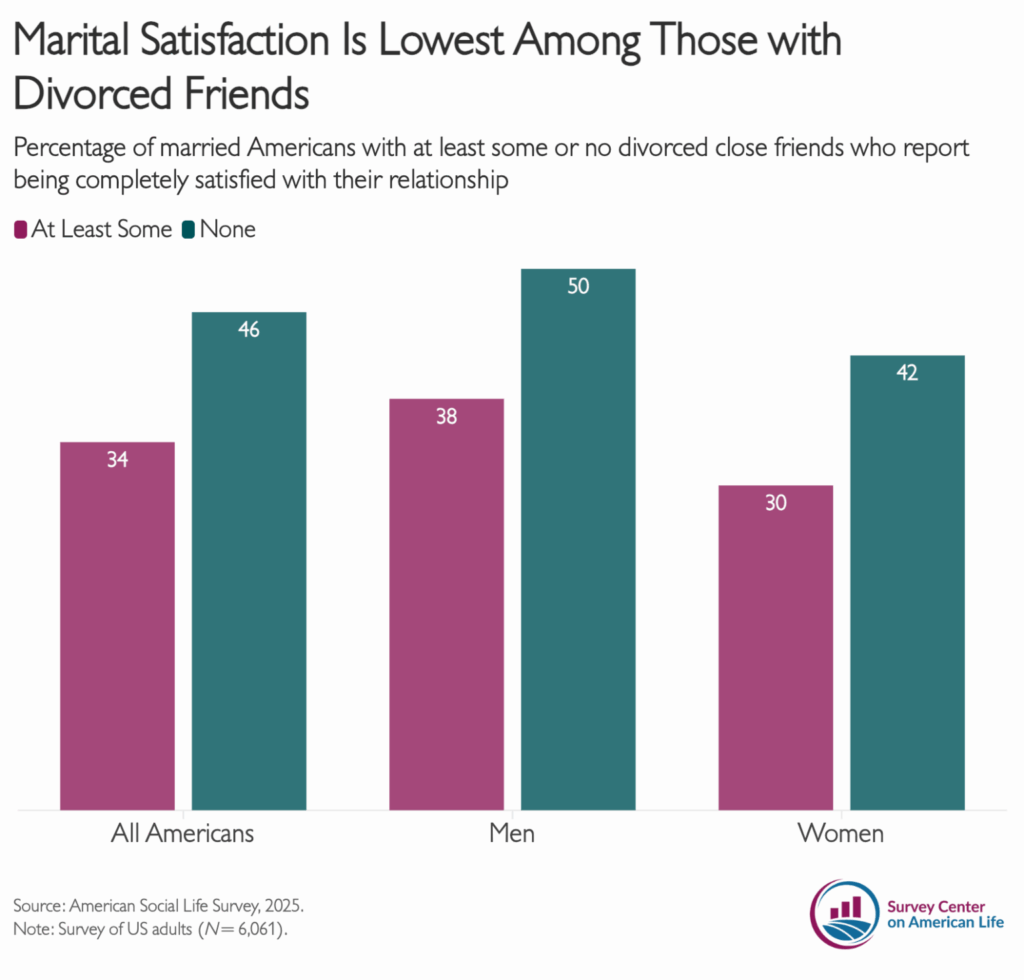
This research showed that married couples have lower marital satisfaction when they have friends who are divorced, explaining,

“Close to half (46 percent) of married Americans with no close friends who are divorced report being ‘completely satisfied’ in their relationship, compared to 34 percent who have at least some close friends who are divorced. The pattern is evident among men and women.”

The differentials look like this:

These researchers explain, “We can’t say for sure that these social connections undermine feelings of relationship satisfaction, but the association is robust.” However, individuals in their survey group indicated that when hard times came upon their own marriages, it was other married peers who offered helpful and encouraging perspectives on making marriage last.

Others admitted to getting unhelpful marriage advice from their divorced friends. This research report contends, “When marital troubles arise, our friends or family members could encourage us to seek counseling, advise patience, and recommend that we pay more attention to our partner’s needs rather than simply serving as one-sided validators of our relationship complaints.”

Some of the best advice in strengthening marriage is the simplest. Arthur Brooks, a Harvard professor, explains there are four basic steps for a man to save and strengthen his marriage.  

1. Develop the practice of having more fun together with your wife.  

2. More eye contact: Look your wife in the eyes when talking to her.

3. ABT: Always be touching … in simple ways.

4. Regularly read aloud to each other.

Professor Brooks says that for couples who have found themselves living as roommates in the ordinary slings and arrows of everyday life, these four simple things will renew your marriage. Another valuable point to add to this is: Always be willing to forgive.

Earlier this year, the Institute for Family Studies (IFS) published a report explaining four research-proven ways to develop greater happiness in a strong and stable marriage.

1. Be Fully Committed to Your Spouse and Your Marriage

The scholars authoring this report explain, “For husbands, completely agreeing that their marriage was one of the most important parts of their lives was linked to a 234% increase in the odds of being very happy in their marriage relative to other less committed husbands.” The same figure was a remarkable 399% for wives!

2. Be Protective of Your Spouse

This IFS report admits, “The biggest surprise of this new study was the second factor that we found to be strongly predictive of a flourishing marriage for both wives and husbands – having a highly ‘protective’ spouse.” It adds, “In fact, wives who felt that it was ‘definitely true’ that their husbands are protective were 137% more likely to be very happy in their marriage than their peers who rated their husbands as less protective.”

3. Participate in Shared Church Attendance

These scholars report, “Our analysis found that wives who attended church regularly with their husbands had odds of being very happy in marriage that were 112% higher than women who attended less often or not at all.” What is more, “For husbands, regular shared church attendance was associated with a 212% boost in their odds of being very happy in marriage compared with their less religious or non-religious peers.”

4. Establish a Pattern of Going on Regular Date Nights

Wives having regular date nights with their husbands were 56% more likely to report being “very happily married” compared to wives who went on date nights less often. Husbands who reported regular date nights with their wives had odds of being “very happily married” 114% higher than their peers who had fewer or no dates with their wives.

Having a happy marriage is one of the greatest riches in life, for men and women and their children. Developing a strong, thriving marriage is not rocket science nor a crap shoot. It stems from a few deliberate choices and consistent actions:

  • Are the friends we make and spend time with champions and encouragers of our marital success?
  • Have we built up helpful and simple habits that research shows strengthen marriage and lead to greater happiness and love?

Couples who have done these things, which are attainable by anyone regardless of education or income, are consistently shown to have enduring marriages and happier lives. This is very good news indeed.

Related Articles and Resources

New Research: Marriage Still Provides Major Happiness Premium

Marriage and Family Improves Happiness Far More Than a Pay Raise

Research Shows Marriage Boosts Well Being

Married Mothers and Fathers Are Happiest According to Gold-Standard General Social Survey

MythBuster: No, the Divorce Rate is Not as High in the Church as the World

Why Marriage Matters for Adults

Research Finds Republican Husbands More Faithful; Religious Even More

Marriage and Parenting Are Now Partisan Issues, With Liberals Falling Behind

Image from Shutterstock.

Written by Glenn T. Stanton · Categorized: Culture · Tagged: Random

Dec 01 2025

Liberty University’s College for a Weekend: Training Champions for Christ

I’m a millennial mom, and in November I took my high school junior daughter on her first college visit. We attended Liberty University’s “College For A Weekend” event and from the moment we stepped on to campus, we felt the weight of the university’s purpose and calling — to train champions for Christ. From athletic programs that honor Jesus to degrees that prepare students for missional vocations, Liberty University is the real deal. They are attracting college students who are committed to living their faith with boldness and conviction.

My husband and I attended a small Christian liberal arts college in Southern California in the early 2000s. Over the years we’ve watched an unfortunate trend unfold — far too many Christian colleges slowly cave to pressure from the Left. Institutions that once stood unapologetically for biblical truth are now hesitant to support values like the sanctity of human life and God’s design for male and female, marriage, and family. The louder the demands for ideological conformity, the quicker many Christian institutions seem to bow.

Today it’s hard to find Christian colleges or universities that are willing to stand for truth, no matter the cost.

As intentional Christian parents, we’ve spent years pouring God’s truth into our children. We pray over their future, their friendships, their education, and their walk with Christ. We want them to step into adulthood rooted in the things of God. That’s why choosing a college centered on Christian faith, purpose and calling is so important.

For our family, Liberty University’s unwavering commitment to follow Christ — and their refusal to bow the knee to woke ideology — were two of the primary reasons we wanted to learn more about the school.

I expected to be overwhelmed by the sheer number of students because Liberty is undeniably large, and yes, I was. But what surprised me even more was the overwhelming sense of belonging and spiritual unity woven in the community.

We sat in on classes, visited dorm rooms, tried the food, explored the campus, and even ventured up Liberty Mountain — a mountain owned by the university with gun ranges, an equestrian center, skiing, lodging, and even an outdoor adventure center. The opportunities for students to build community, grow personally and explore God’s creation were everywhere.

One of the more moving moments of the weekend happened in the cafeteria. In the middle of all the noise, movement, and busyness of dinner time, we saw a group of male students stop everything, lay hands on one another’s shoulders and pray over each other with focus and compassion. No hesitation. No embarrassment. Just genuine Christ-centered community.

During chapel, students lifted their hands in surrender to God during worship, leaning into God’s presence without the slightest concern about who was watching — including the 4,000 visitors on campus that weekend.

The Robertson family from Duck Dynasty spoke in chapel as a family who has been part of the Liberty journey for a long time. Several of the Robertson children attended Liberty and spoke about what it looks like to pursue a life committed to Christ after college.

God is clearly moving at Liberty University. It was a blessing to be a witness to His favor and the work of the Holy Spirit in the lives of thousands of young believers. Whether my daughter attends Liberty or not, it is inspiring to see God use Liberty University to call the next generation of believers into deeper relationship with Him and to be a witness for Christ to our culture.

Related Articles and Resources

Helping Your Young Adult Thrive in College

Choosing a College

Helping Your Teen Choose a CollegeHelp Your Student Choose the Right College: A University President Offers Guidance

Written by Nicole Hunt · Categorized: Culture · Tagged: Random

Nov 26 2025

An Apt Reminder of Christianity’s Unique Impact on Human Civilization

The Alliance for Responsible Citizenship, an international, interdisciplinary movement based in the UK, is working for a more flourishing and prosperous world for families, communities and nations. They have just released a new and very brief video explaining an important angle from human history.

It describes how the power of reason in classical antiquity and the Resurrection of Christ through Christianity joined to build the wonder of the modern world that we all experience and benefit from today.

The video begins with this statement: “It has been said that our civilization is a miracle, yet we seldom pause to understand why.” This is true.

It then correctly explains how our civilization grew out of the reasoning of the Athenian philosophers who explored the meaning (and answers) to three essential questions:

  • How should we organize society?
  • How do we live the good life?
  • What does it mean to be human?

These questions, and their answers, flowing from the ancient Age of Reason, gave us important concepts like democracy and the republic, as ancient Greece gave way to an expanding Roman Empire and all its marvels. The video explains, “Their influence endures in the very fabric of our nations’ roads, aqueducts and architecture.” Adding importantly, “But there is more to our foundations than the inheritance of Greece and Rome.”

The video then expresses that “at another moment in history when all seemed lost, a prophet in Bethlehem was born.” It is no accident that everyone knows who this is, without mentioning His name. Over the next several decades, “stamped out brutally by the juggernaut of state power that was the Roman Empire, His followers started to whisper a revolutionary word: Resurrection.”

It was the cross of Christ, and His world-changing resurrection from the grave, that along with reason (a Judeo-Christian ideal), transformed the world into a “civilization that holds that every individual human life is of infinite value, and that each person should live their life in freedom.” Of course, Jesus’ resurrection did far more than that. Having overcome death and sin, He reconciled heaven and earth. But ARC’s observation is not without merit.

This resurrection movement created a civilization “where service and humility are prized and where forgiveness and reconciliation are possible.” Christianity and classical antiquity also created a “scientific brilliance and artistic genius” that helped create the wonder of the modern world.

The video concludes,

The classical world – beauty and reason – united with the power of the resurrection. And ever since, these ideas have fused in unique ways to give us our inheritance.

ARC correctly states that today is the time to remember a truth “that is too easily forgotten.” This is a good reminder for believers of all nations.

You can see this surprising video here, and share it with your family:

Related Articles and Resources

Truth Rising: The Documentary

Christianity Invented Childhood. It’s Time We Defend it Again

In Our Troubled World, Take Heart and Remember That Christ is King

The New Pagan Revival

The Significance and Incredible Legacy of Nicaea

Notre Dame Cathedral Reopens, Reminding Us of Western Civilization’s Christian Heritage

Christianity and Cultural Change

The Church’s Lane is the Whole Cosmos

That the World May Know

Image from Shutterstock.

Written by Glenn T. Stanton · Categorized: Culture · Tagged: Random

Nov 25 2025

Falling in Love versus Learning to Love

Human relationships with the opposite sex are a fundamental part of being human. We have them at work, school and in our community. They are nice and make our lives interesting, for sure. But opposite sex relationships really reveal their most consequential and rewarding richness in romantic, marital, and sexual relationships.

Of course, this brings to mind the topic of love, for that is what draws together and enlivens such relationships. And after all, civilization does not work without love and procreative sexuality, and marriage is all about these two essential virtues.

That is why a new article over at the Institute for Family Studies entitled “The Other Side of Marriage” is so important. It addresses two seemingly competing truths that marital love is one of the most wonderful and difficult things in the world. This piece, although coming from a secular, psychological approach, contends with this important observation. The author explains, “The difficulties of marriage offer both the opportunity and the imperative to develop abilities – patience, discipline, self-awareness, curiosity, generosity – that are essential to strong and lasting love.”

This comes down to living in the wonder of falling in and remaining in love with one’s spouse, but also, like anything else that is important in life, working on and maintaining that love. This second part is the secret of marriage. This article explains, “We overvalue uncomplicated romantic bliss, individuality, control, choice, and comfort – all things that an intimate, committed relationship is likely to disrupt.”

Marriage is disruptive because it takes place over long periods of time and in the warp and woof of real life. In fact, do not the marriage vows – as they point to both easy and difficult times – anticipate such problems in the promises declared between husband and wife?

Learning to live in the messy reality of daily life of marriage is where our marriages become stronger. IFS explains, “Engaging with difficulties instead of pulling away or becoming aggressive is how you learn to turn marital conflict into real growth.” They add, “Hard conversations offer you the chance to learn to speak well and listen well when it’s distressingly difficult.” This is where genuine love is not only just “felt” but actually worked on and through.

IFS concludes, “Your interdependence and that extra sensitivity to each other that’s both wonderful and, at times, uncomfortable, can be the source of insight and problem solving.” This is the unavoidable path to an even stronger marriage because you are both becoming stronger, healthier people for having worked together on these challenges as a couple. Marriage includes both the feelings and the work of love.

I Corinthians 13:4-8 so beautifully explains what love is:

Love is patient, love is kind. It does not envy, it does not boast, it is not proud.It does not dishonor others, it is not self-seeking, it is not easily angered, it keeps no record of wrongs. Love does not delight in evil but rejoices with the truth. It always protects, always trusts, always hopes, always perseveres.

Love never fails.

As we clearly see, each of these are more intentional decisions and personal character qualities built up over time through hard work, discipline and learning a godly perspective, rather than feelings or emotions. Marriage includes both, but the latter is the spice that enlivens the meat and substance of the former. Great marriages rest on feelings toward and hard work with our spouse.

Related Articles and Resources

If you or someone you know is struggling with marriage issues, Focus on the Family offers a one-time complimentary consultation with our ministry’s professionally trained counseling staff. The consultation is free due to generous donor support.

To reach Focus on the Family’s counseling service by phone, call 1-855-771-HELP (4357) weekdays 6:00 a.m. to 8:00 p.m. (Mountain Time). Please be prepared to leave your contact information for a counselor to return a call to you as soon as possible. Alternatively, you can fill out our Counseling Consultation Request Form.

New Focus on the Family Report: Marriage Health in America

Marriage Assessment survey

Resist the Drift – a conference for strengthening marriages

Thriving Marriage Weekly Newsletter

“Crazy Little Thing Called Marriage”

Hope Restored – 3-5 day marriage counseling intensives for marriages in crisis

Don’t Believe the Modern Myth. Marriage Remains Good for Men

Harvard Evolutionary Biologist Brilliantly Explains Necessity of Monogamous Marriage

Important New Book Explains Why Marriage Still Matters

Written by Glenn T. Stanton · Categorized: Culture · Tagged: Random

  • Page 1
  • Page 2
  • Page 3
  • Interim pages omitted …
  • Page 17
  • Go to Next Page »

Privacy Policy and Terms of Use | Privacy Policy and Terms of Use | © 2025 Focus on the Family. All rights reserved.

  • Cookie Policy