• Skip to main content
Daily Citizen
  • Subscribe
  • Categories
    • Culture
    • Life
    • Religious Freedom
    • Sexuality
  • Parenting Resources
    • LGBT Pride
    • Homosexuality
    • Sexuality/Marriage
    • Transgender
  • About
    • Contributors
    • Contact
  • Donate

Study

Oct 09 2025

When Academics Sexualize Children

The world’s scholars are tasked with investigating important and even controversial topics in their pursuit of truth and virtue. A newly published article violates this call in a disturbing way. The manner in which it does is certainly worth our attention and condemnation.

The article, entitled “Childhood Sexualities: On Pleasure and Meaning from the Margins,” was published last month in the American Sociological Association’s journal Sex & Sexualities. It is authored by a scholar from the University of KwaZulu-Natal in South Africa whose stated specialty is childhood sexuality. She employs all the necessary buzz phrases so fashionable in leftist social justice theory, such as this opening line: “This article repositions childhood sexualities within a pleasure-centered, globally oriented, and power-aware frame informed by feminist, queer, and decolonial perspectives.” The article “interrogate[s] dominant narratives of sexual innocence that suppress young people’s desires and show how children negotiate pleasure and meaning amid intersecting hierarchies of age, race, gender, and class.”

This author is deeply concerned that “nowhere is this politics of misrecognition, erasure, and marginalization more acute than in childhood, where preadolescent children’s erotic capacities are routinely pathologized.” Yes, she is deliberately positioning that which is good and protective to appear evil.

The article is just over 3,000 words of this kind of thing. It is certainly not serious scholarship. It is a subversive ramble. But it got published all the same by an otherwise respectable sociological association.

The article’s thesis is predicated on this claim that is as bold as it is false: “What is clear is that the notion of childhood sexual innocence is not a natural construct.” The sexual innocence of every child that has ever been born is among the most natural of things. The very definition of childhood itself is that of innocence and wonder. G. K. Chesterton spoke truth in observing, “For children are innocent and love justice; while most of us are wicked and naturally prefer mercy.”

While one of the domineering virtues of childhood is innocence, a most damning vice of adulthood is the sexualization of children. This article gratuitously trades in the latter, objecting to “a colonial fiction that has long erased the very thought of putting sexuality and childhood together.” It advocates for the linking of the two in the name of everything they deem right and good. Why? Well, as this author explains, “Sexual pleasure and meaning are integral to understanding why children do what they do, and how they can be supported to lead healthier, happier lives.” Thus, “It is time for sexualities research to hone in on the meanings of sexual pleasure for children and young people.”

Every person who possesses any sense of reason and compassion for children and childhood must state that such a time will never come. They should recognize and denounce articles such as these as the latest effort to de-stigmatize sexualizing children and erase protective age-of-consent boundaries.

The author makes her intentions known in the conclusion of the article, stating, “Our focus is more than just an inversion of the usual risk-focused narrative; it is a call to transform how we think about childhood sexuality and whose experiences we value.”

We shudder to think what those valued experiences are. Yes, very bad people posing as serious academics are making real progress toward the further sexualization of our children. Academics and the journals who publish their pedophilic proposals take note:  “It would be better for him if a millstone were hung around his neck and he were cast into the sea than that he should cause one of these little ones to sin” (Luke 17:2, ESV).

Image from Shutterstock.
Written by Glenn T. Stanton · Categorized: Culture · Tagged: Random, Study

Sep 04 2025

Young Attend Church More Than Old — But Is It Enough?

Responding to news that he was either dying or dead, Mark Twain famously said, “The reports of my death are greatly exaggerated.”

According to a new report from Barna Research, the same might be said regarding the previous decline of young people’s faith and church attendance.

Released Tuesday as part of the group’s ongoing “State of the Church” initiative, “Gen Z” and “Millennials” attend church more regularly than their older counterparts.

Digging into the data, Gen Zers, those born between the mid to late 1990s and early 2010s, attend church 1.9 times per month. Millennials, those born between 1981 and 1996, average 1.8 times per month.

In contrast, Boomers (1946-1964) and Elders (those born before 1946) attend 1.4 times per month.

David Copeland, who serves as Barna’s vice president of research, acknowledged the surprise that accompanied the findings.

“It’s typically older adults who are the most loyal churchgoers,” he said. “This data represents good news for church leaders and adds to the picture that spiritual renewal is shaping Gen Z and Millennials today.”

But is it really good news that the typical Christian is attending church only two out of every five weekends?

Scripture makes clear the importance of regular corporate worship. The writer of Hebrews urged believers to “not [give] up meeting together, as some are in the habit of doing, but encouraging one another — and all the more as you see the Day approaching” (Hebrews 10:25).

The Fourth Commandment, “Remember the Sabbath day, to keep it holy” (Exodus 20:8) may not specifically dictate weekly church attendance, but it does demand our attention and our obedience. As Christians, if we’re not a member of a church and regularly attending weekly services, how are we setting apart the day? How are we not neglecting the call to meet together with fellow followers of Christ?

While it’s a good thing that young people’s faith doesn’t appear as anemic as suspected, if the standard we’re comparing it to is already dangerously low, a sober-minded awareness seems in order.

We’d also be wise to ask some difficult and even uncomfortable questions.

Why are Christians going to church so infrequently? Are we allowing ourselves to be pulled away by very worldly priorities like youth sports, vacation travel, creature comforts like sleeping in and having a leisurely Sunday morning instead?

This has no bearing on a committed believer’s responsibility to participate in corporate worship, but churches themselves should be examining elements of their service and outreach. Are they doing everything they can to retain interest, especially from those who may dip in and out, who are on the fringes of Christianity? Are they challenging people enough? Are pastors prepared and interesting, addressing issues relevant to real lives in real time?

It’s always curious why sports stadiums can sell out week after week, yet rare is the church that suffers from not having enough seats for those wanting to join the worship service.

“Church attendance is as vital to a disciple as a transfusion of rich, healthy blood to a sick man,” warned D.L. Moody.

Some Christians dismiss or diminish the importance of physical church attendance. Instead, they may talk of communing with God in nature, praying alone, or spending their quiet time with the Lord in personal reading of Scripture. Those disciplines are important and supplemental, but they cannot and must not replace corporate worship. The same goes for those able to attend in person but who instead opt out for church culture.

The famed evangelist Billy Sunday once said, “Going to church doesn’t make you a Christian any more than going to a garage makes you an automobile.” He was right. Inner transformation, repentance, and accepting Jesus Christ as Lord of your life is what makes you a Christian.  But going to church provides us with community, connection, opportunities for service, and ideally, offers solid spiritual teaching that will help us grow in our faith and strengthen us in numerous ways that will then equip us to share the Good News with others.

Given all those personal and Kingdom benefits available at church, wouldn’t you want to attend more than 21 weeks out of a 52-week year?

Image from Getty.

Written by Paul Batura · Categorized: Culture · Tagged: Evangelism, Paul Random, Study

Jul 30 2025

Is Marriage Making a Come Back? Scholars Share Some Good News

Nearly all indicators on marriage and married birthrates in America have been moving in the wrong direction over the last few decades. Marriage rates have been declining steadily, 54% overall since 1900. Matrimony has declined markedly among younger adults since 1980. Married births dropped precipitously over this same time compared to growth in births from single and cohabiting mothers. Additionally, cohabitation shot up over the last 40 years, with a shocking 80% of marriages today being preceded by cohabitation.

People are also waiting longer to marry, with age at first marriage increasing to 31 for men and 29 for women. These numbers were 23 for men and 20 for women in 1950.

This bad news seems to be turning round, according to important marriage scholars.

Brad Wilcox, a chaired professor of sociology and director of the National Marriage Project at University of Virginia writes in The Atlantic, saying that marriage “[shows] new signs of resilience.”

Professor Wilcox explains that “reports of marriage’s demise are exaggerated.” Other scholars have noted that it “is not naive optimism to believe that we are on the threshold of a marriage renaissance.”

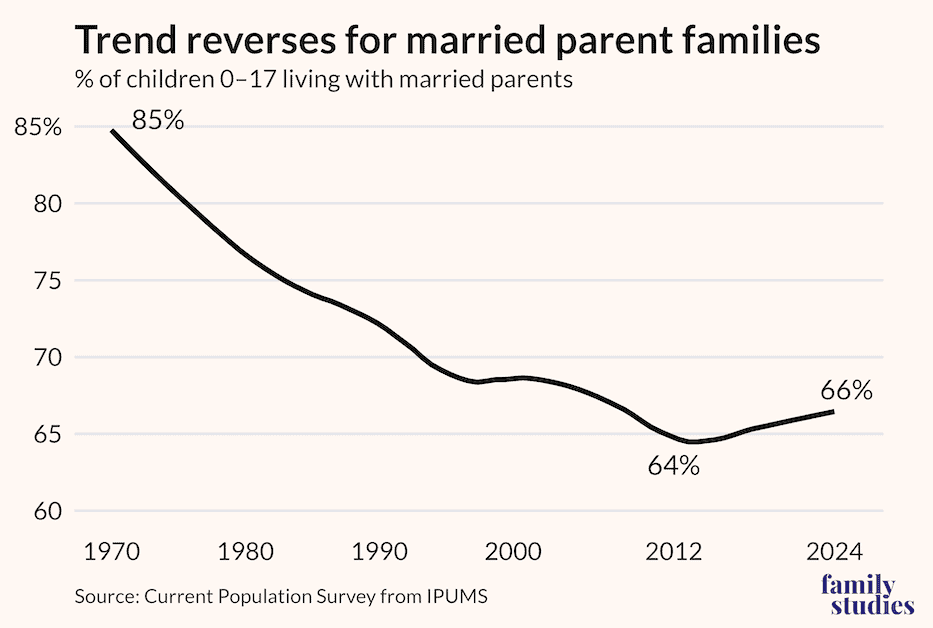
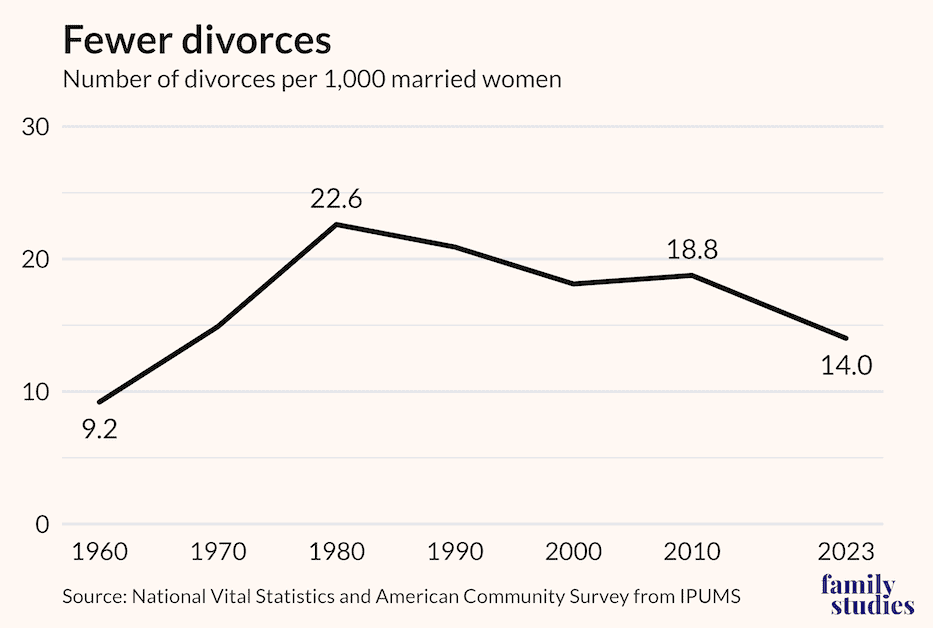
Wilcox explains, “Rather quietly, the post-60s family revolution appears to have ended.” This is most notably indicated by twin facts. Divorce has been declining for some years, and this has been well-established. More recently, the share of children living with two married parents is up.

In a companion story to Wilcox’s Atlantic essay, his Institute for Family Studies demonstrates these trends.

The divorce rate, since the early 1980s, has fallen by nearly 40%. Wilcox remarks much of this improvement “has happened in just the past 15 years.”

The improving trend in children being born to and living with a married mother and father is more recent to be sure. Wilcox explains, “After falling for more than 40 years beginning in the late 1960s, the share of children living in married families bottomed out at 64% in 2012 before rising to 66% in 2024.”

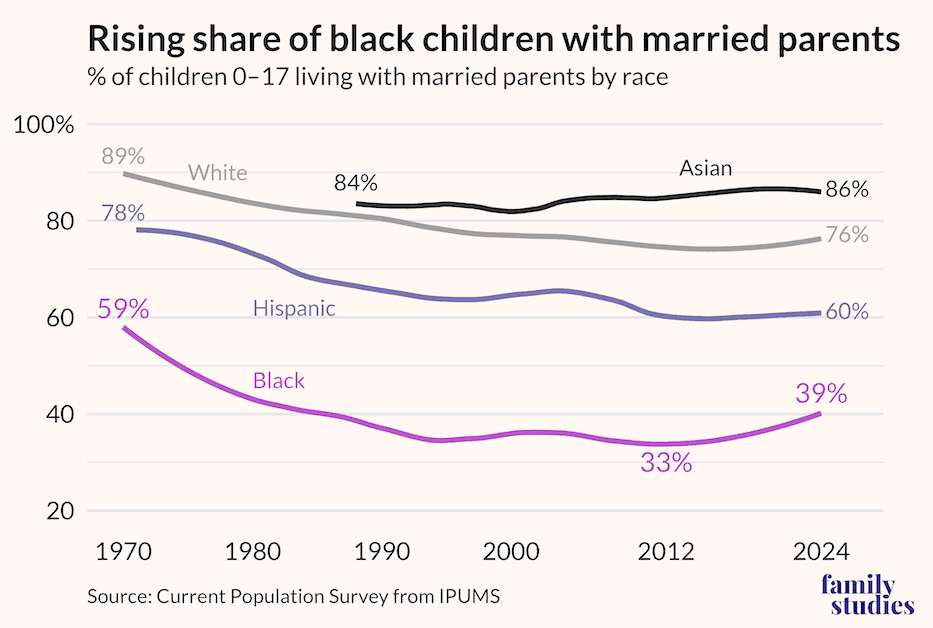
Married births have also risen among historically challenged racial groups. Wilcox explains “the proportion of black children being raised in a married-parent family rose from 33% in 2012 to 39% in 2024.”

Wilcox explains the crucial benefits, saying,

Marriage’s comeback is good news for society: Children raised in two-parent homes are much more likely to graduate from college than those raised in other families, and less likely to be incarcerated. Kids who don’t live with both of their married parents are far more likely to be depressed than those raised in intact families.

He adds,

After surveying the research on child well-being, the economist Melissa Kearney concluded that the “evidence is clear, even if the punchline is uncomfortable: children are more likely to thrive – behaviorally and academically, and ultimately in the labor market and adult life – if they grow up with the advantages of a two-parent home.”

Parents who are married increase these benefits for adults and children in innumerable ways. These facts explain why it is wise to celebrate notable, positive increases in marriage in our culture today. They result in higher levels of human and societal well-being.

Related Articles and Resources:

If you or someone you know is struggling with marriage issues, Focus on the Family offers a one-time complimentary consultation with our ministry’s professionally trained counseling staff. The consultation is free due to generous donor support.

To reach Focus on the Family’s counseling service by phone, call 1-855-771-HELP (4357) weekdays 6:00 a.m. to 8:00 p.m. (Mountain Time). Please be prepared to leave your contact information for a counselor to return a call to you as soon as possible. Alternatively, you can fill out our Counseling Consultation Request Form.

New Focus on the Family Report: Marriage Health in America

Research Shows New Data on Divorce Risk

Premier Research Documents Long-Term Divorce Harms for Adult Children

Reclaiming the Truth About Marriage

Four Things to Enhance Marital Happiness Among Wives

Research Update: The Compelling Health Benefits of Marriage

Important New Research on How Married Parents Improve Child Well-Being

How Marriage Fights Against Deaths of Despair

New Research: Marriage Still Provides Major Happiness Premium

Don’t Believe the Modern Myth. Marriage Remains Good for Men

Harvard Evolutionary Biologist Brilliantly Explains Necessity of Monogamous Marriage

Written by Glenn T. Stanton · Categorized: Marriage · Tagged: marriage, Study

Jul 24 2025

Research Shows New Data on Divorce Risk

The lifetime risk of divorce is not 50%, as so many assume.

This is the finding from a new sophisticated research analysis from the careful scholars at the Institute for Family Studies (IFS). They explain that the hope of a lifelong marriage is “no longer a coin toss.” The analysis was conducted by Yifeng Wan, a postdoctoral research associate at the University of Virginia. He explains, “My best estimate is that about 42% of first marriages today will eventually end in divorce if current patterns persist.”

While a 42% divorce risk is not great news, it is notably lower than the incorrect 50% divorce rate we often hear repeated. It is also important to appreciate that the 42% divorce risk applies to no individual or couple in particular because this is a prediction from overall populations.

As previous research done by Focus on the Family demonstrates, many couples marrying today actually have a dramatically lower risk of lifetime divorce because they have made life choices and have advantages that dramatically elevate their risk of building a successful marriage. This includes things like not cohabiting or engaging in sexual intimacy prior to marriage, sharing a common serious religious faith, growing up in an intact family, and marrying before having children.

This helpful new report from IFS is very beneficial because it explains the demographic complexities of predicting divorce risk in a very concise and straightforward way. Intelligent and quick, it’s valuable reading for all curious students of the family. You can access it here.

Related Articles and Resources

Premier Research Documents Long-Term Divorce Harms for Adult Children

Reclaiming the Truth About Marriage

Four Things to Enhance Marital Happiness Among Wives

Research Update: The Compelling Health Benefits of Marriage

Important New Research on How Married Parents Improve Child Well-Being

How Marriage Fights Against Deaths of Despair

New Research: Marriage Still Provides Major Happiness Premium

Family Scholars Explain the Current Marriage Paradox in America

New Research Shows Married Families Matter More Than Ever

Cohabitation Still Harmful – Even as Stigma Disappears

Don’t Believe the Modern Myth. Marriage Remains Good for Women

Don’t Believe the Modern Myth. Marriage Remains Good for Men.

Yes, Married Mothers Really Are Happier Than Unmarried and Childless Women

Married Fatherhood Makes Men Better

Marriage and the Public Good: A New Manifesto of Policy Proposals

Image from Shutterstock.

Written by Glenn T. Stanton · Categorized: Marriage · Tagged: IFS, Random, Study

Jul 09 2025

Maternal Health is Declining Because We are Ignoring Mothering

Leading medical research indicates maternal mental and physical health is declining of late in the United States. A recent Journal of the American Medical Association (JAMA) report explains a cross-sectional study of nearly 200,000 American mothers with children ages 0 to 17 showed “large declines in self-reported mental health and small declines in self-reported physical health from 2016 to 2023.” The medical researchers who conducted the study explain,

“Mental health declines occurred across all socioeconomic subgroups; however, mental and physical health status was significantly lower for single female parents, those with lower educational attainment, and those with publicly insured children.”

Jamie Daw, lead author of the study and a Columbia University professor, explains,

“We found consistently worse health outcomes for mothers compared to fathers, suggesting that mothers may need additional consideration and attention in policies aimed at supporting parental health and especially mental health.”

Declining maternal physical and mental health is a critical cultural indicator because mothers are the fount of humanity. We all came from one, after all, so paying attention to the health and well-being of mothers is vital. But what, we should ask, is affecting maternal health in such a negative way?

Psychoanalyst Erica Komisar, author of Being There: Why Prioritizing Motherhood in the First Three Years Matters, took up this question in an article over at the Institute for Family Studies (IFS) blog. While many elites blame current economic challenges for mothers declining well-being, Komisar takes a different perspective, explaining that blaming the mental health crisis experienced by mothers “on economics alone is a shallow analysis.”

She contends, “While these financial pressures can be debilitating, they are not – in my professional opinion – the primary cause.”

Instead, Komisar blames unrealistic expectations of mothers and motherhood in today’s culture. She explains,

“The more plausible cause of this mental health crisis is the relentless societal expectation – amplified by families, governments, and even mothers themselves – that women should be able to do everything, all at once. Raising children has always been demanding, but today, mothers are struggling in alarming numbers.”

Komisar isolates one particular expectation from an influential source.

“With the rise of the second-wave feminist movement in the 1960s,” she writes, “a new expectation emerged: that women should not only care for their children but also pursue ambitious, high-achieving careers.”

Yes, many mothers find the need to work outside the home to make their household budget work, Komisar acknowledges, “But the expectation that they should simultaneously excel at an intense, fulfilling career while raising young children has pushed many beyond their limits.”

This crashes headlong into motherhood itself, as “mothering is more than a full-time job – it’s a lifelong commitment with no days, weeks, or months off” Komisar admits. Yet she adds, “It’s not surprising, then, that many women find it easier to return to work, leaving their children in day care or with nannies, because working outside the home feels, in some ways, less overwhelming than the relentless demands of 24/7 caregiving.”

But many people don’t fully grasp that “they remain mothers no matter where they are” and that weight of responsibility is not erased because she has a high-powered, widely respected career.

Komisar asserts, “In reality, it sets in that they’ve taken on two full-time roles, often in conflict with each other, while operating with finite time and energy.”

She continues,

Mothers also struggle when they realize that becoming a mother has changed them in ways they didn’t expect – that they want to stay home with their newborns but feel torn between that desire and the promises they’ve made to their partners, their jobs, and themselves. In my field of psychoanalysis, we define depression as a preoccupation with past and present losses, and anxiety as a preoccupation with potential future losses. 

As a result, “Many mothers experience profound regret after giving birth because they did not anticipate this transformation.” Komisar observes, “Instead of bonding with their babies in peace and joy, they’re consumed by internal conflict and arguments with their spouses about whether to return to work.”

She warns that the troubling narrative that career success and monetary achievement are more important than the time-intensive nurturing work of mothering must change.

Komisar concludes with this hopeful insight,

“Unless we recognize the deeper internal and external conflicts women face, we will not reverse this troubling trend. But it’s not too late to change the narrative. We must embrace the wisdom of nature: that nurturing comes first.”

Yes, the way to help mothers become healthier is to better understand and support that which mothers actually do, as mothers. They are present every day to love, protect, care for and nurture their children. It is the natural, motherly instinct to do so. Diminishing the significance of that human necessity by elevating professional attainment as “real work” is unfair to women.

Komisar properly concludes, “By honoring our instincts, we can find our true path and build a more mentally healthy society for mothers, fathers and children alike.”

Let us all do what we can in our families, workplaces, communities and personal lives to encourage, celebrate and make ample room for mothering work. Without it, none of us would be where we are.

Related Articles and Resources

More, New Research in Praise of Mothers

A Uniquely Christian Understanding of the World-Shifting Power of Motherhood

No, Chappell Roan, Motherhood is Not Hell

Thoughts About Mothers

The Important Parenting Differences Between Moms and Dads

Image from Shutterstock.

Written by Glenn T. Stanton · Categorized: Culture · Tagged: Random, Study

  • Page 1
  • Page 2
  • Go to Next Page »

Privacy Policy and Terms of Use | Privacy Policy and Terms of Use | © 2025 Focus on the Family. All rights reserved.

  • Cookie Policy