
• Skip to main content
Daily Citizen
  • Subscribe
  • Categories
    • Culture
    • Life
    • Religious Freedom
    • Sexuality
  • Parenting Resources
    • LGBT Pride
    • Homosexuality
    • Sexuality/Marriage
    • Transgender
  • About
    • Contributors
    • Contact
  • Donate

Study

Jun 18 2025

New Scholarly Fatherhood Report Offers Important New Insights

An important new research report from politically diverse scholars working from seven leading universities and think tanks explores the importance of fathers for healthy child development. The report’s scope focuses on the state of Virginia, but its implications are applicable across the nation and the world. It documents important ways fathers matter for child and societal well-being.

The report asserts, “A large body of research indicates that children who have the benefit of an engaged father are more likely to flourish.” And they flourish in every important measure of academic, physical, emotional and social well-being. University of Delaware scholar Rob Palkovitz explains early in the report,

Greater positive father involvement with young children tends to be associated with overall life satisfaction, happiness, and psychological well-being when offspring reach early adulthood and fewer behavioral problems for children and adolescents.

The report’s authors explain “Social scientists in recent decades have learned that the value of an engaged father extends well beyond his paycheck.” They add, “Their value derives in part from the fact that fathers often parent in distinctive ways.” This is because fathers, as males, parent differently. It is well-documented that fathers play differently, discipline their children differently, they protect them differently than mothers and they communicate differently. Each of these differences make essential and unique contributions to healthy child development.

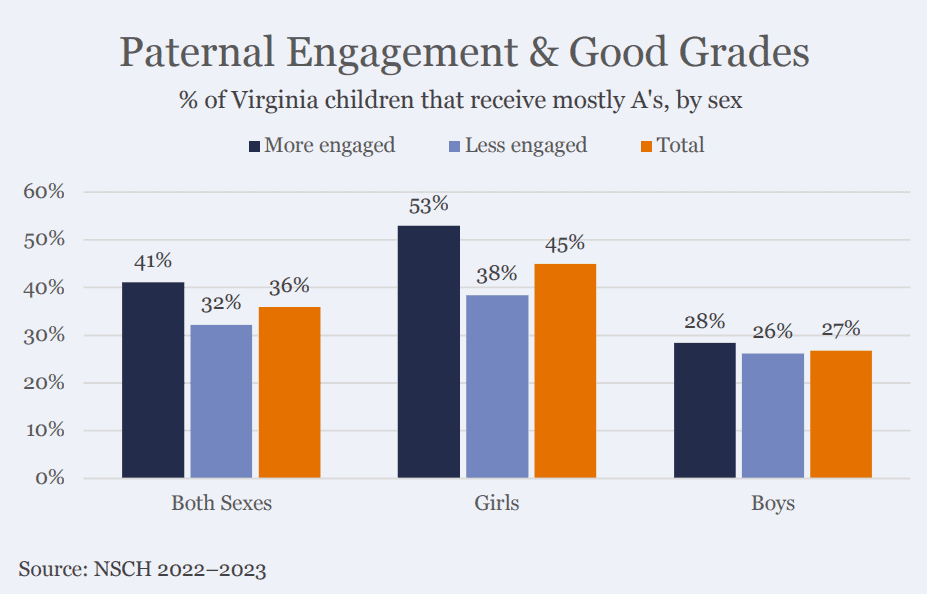
Father engagement has a measurable effect on children earning top grades in school. The following chart shows how fathers’ involvement boosts superior grade attainment for boys and girls.
Greater fatherhood engagement also has a dramatic impact in reducing depression in children.
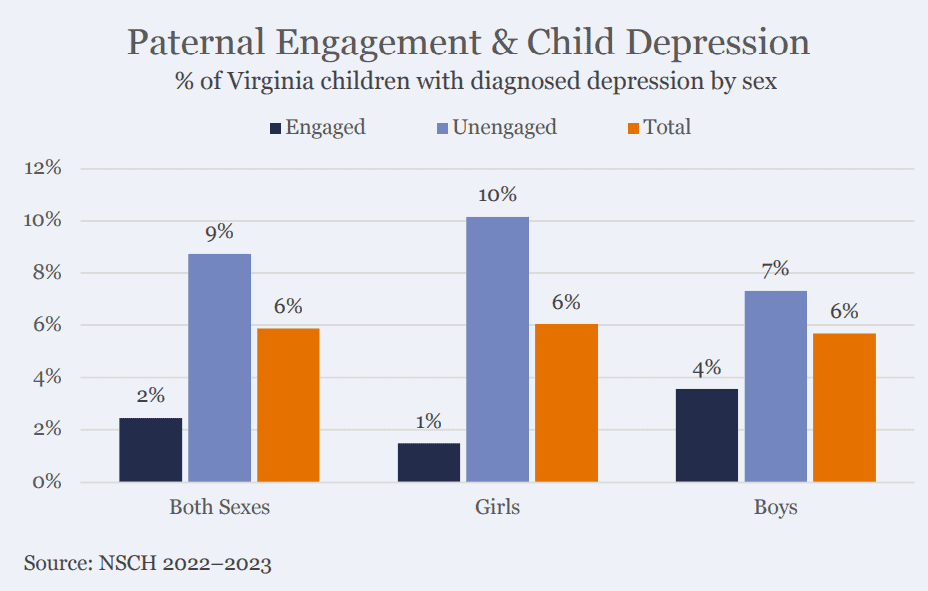
These scholars report,

When the association between paternal engagement and childhood depression is controlled for family intactness and demographic factors like race and parental education, the odds of a child being depressed are nearly four (3.7) times greater for children with uninvolved fathers as for those with highly engaged fathers.

What is more, fathers who live with their children and are married to their mother spend about 10 times more time with their children compared to kids with non-residential fathers.

Children living with their married mother and father are roughly five times less likely to be living in poverty compared to peers in fatherless families.

Minority Kids Benefit Even More

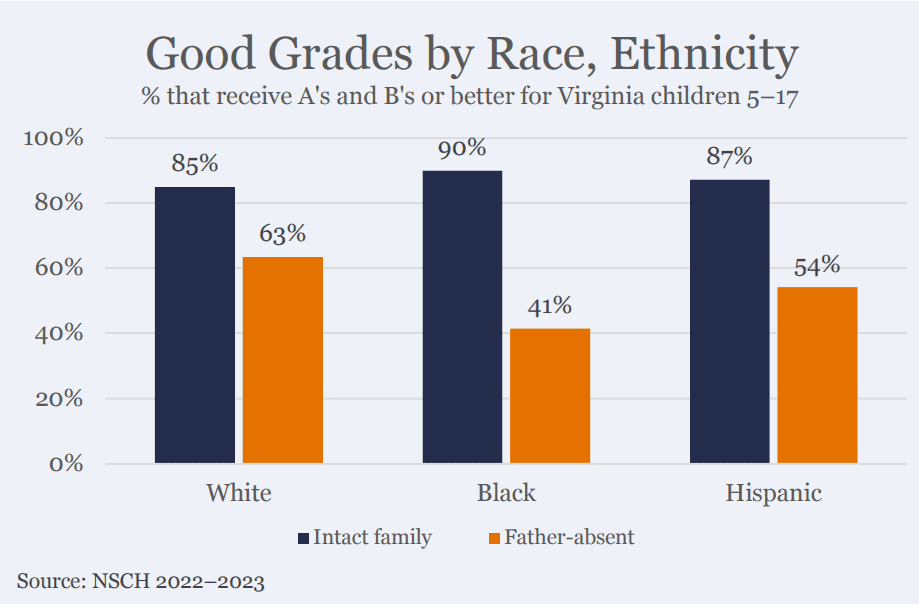
Data indicate both Black and Hispanic kids benefit more strongly from intact families and father involvement than White children do, as show in this graph.
Children living in homes where their mother is married to the father, creating a situation where dad is dramatically more likely to be involved in the lives of their children, translates into dramatic reductions in children ever experiencing or witnessing neighborhood violence. Of course, this is a marked positive indicator for child well-being.
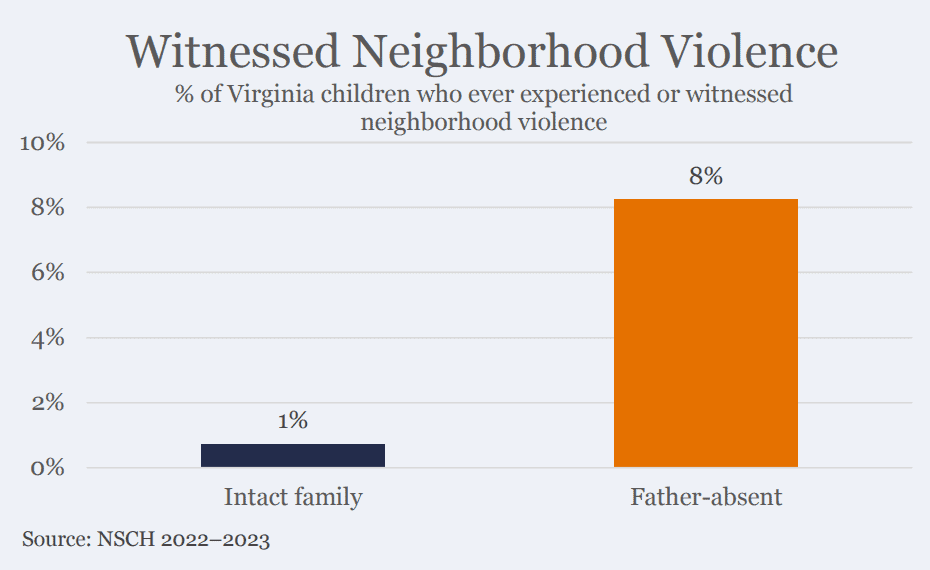
Scholars explain the power of this statistic:

After controlling for parent education, family income, race of child, immigrant status, and sex and age of child, the odds of exposure to violence were 10 times higher for children in father-absent homes, than for children with both parents present in the home.

Policy Recommendations

The report offers six policy recommendations they believe will help serve the promotion of fatherhood involvement and child well-being in the decades to come.

The first is making schools more boy friendly. Boys are falling behind girls in both grade school and college achievement. Correcting this means making all levels of education more appealing to boys’ imaginations, interests and learning styles. It also means seeking out more male teachers, especially in the earlier years. This is particularly important given the share of male K-12 teachers declined nationally from 33% in the early 1980s to 23% today. We must reverse this decline. We should also be more open to single-sex schools where boys can learn together as boys.

Schools should also teach the Success Sequence, a research-supported and relatively simple formula for nearly guaranteeing that no one ever lives poverty. Simply put, the Success Sequence requires three basic steps:

  1. Finish high school.
  2. Maintain a full-time job once you finish school.
  3. Get married before you have children and stay married.

A full 97% of youth who follow these steps will never be poor as adults. It works just as powerfully for minority youth and those from broken and impoverished homes.

Their second recommendation is creating a more positive culture of fatherhood and father involvement. This can be done through policy changes, public service announcements and greater overall education on the essential importance of dads being married to their child’s mother and involved in their kids’ lives.

The third recommendation is limiting access to pornography. The scholars’ reasoning is simple:

The near-universal availability of pornography has deformed countless boys’ conception of healthy relationships. Through pornography, young men are trained to enjoy violence, domination, and the objectification of the opposite sex as part and parcel of relationships and a future marriage and family life.

They are precisely right. We cannot form good fathers and a healthy marriage culture in porn-saturated society.

Their fourth proposal is what they call “reviving civic effort to promote prosocial masculinity.” This means countering the vile and corrosive idea that masculinity is inherently toxic and replacing that with vibrant examples of what healthy, prosocial masculinity looks like, helping more boys and young men become “responsible, respectful, and hard-working family men in the future.”

Their fifth proposal is to help all dads, regardless of racial, economic or educational background, flourish in the lives of their children. The related sixth proposal involves helping previously incarcerated fathers re-enter the lives of their children and maximize their positive influence on their sons and daughters.

Richard V. Reeves, a Brookings Institution scholar, president of the American Institute for Boys and Men and co-author of the report, says of fathers,

Dads matter. Fatherhood is a load-bearing wall—for healthy families, flourishing kids and for strong communities. For too long, the debate over fathers has focused too narrowly on financial issues, as if dads are little more than walking ATMs. But fathers are providers of love, time, energy and laughter as much as of money.

Focus on the Family applauds every effort to educate citizens on the importance of fatherhood. This helpful report furthers that work in important ways.

Related Articles and Resources

The Important Parenting Differences Between Moms and Dads

Married Fatherhood Makes Men Better

Important New Research on How Married Parents Improve Child Well-Being

New Research Shows Married Families Matter More Than Ever

Why Marriage Really Matters – 3 Focus on the Family Reports

Reclaiming the Truth About Marriage

Research Update: The Compelling Health Benefits of Marriage

New Research: Marriage Still Provides Major Happiness Premium

Cohabitation Still Harmful – Even as Stigma Disappears

Don’t Believe the Modern Myth. Marriage Remains Good for Women

Don’t Believe the Modern Myth. Marriage Remains Good for Men.

Married Mothers and Fathers Are Happiest According to Gold-Standard General Social Survey

Image from Shutterstock.

Written by Glenn T. Stanton · Categorized: Culture · Tagged: Random, Study

May 05 2025

Who Falls in Love Faster, Men or Women?

Families usually start with a man and woman falling in love. So how and when love develops between romantic partners is an important topic for those interested in studying how marriages and families form.

A recent study published in the journal Biology of Sex Differences conducted by an Australian research team examines the very interesting question of who typically falls in love first.

This study claims to be the first to explore this question in a substantive, cross-cultural sample with validated measures. It involved a sample of 808 young adults (age 18-25) who are currently experiencing romantic love, residing in 33 different countries.

This research finds that while women think about their love-interest more often than men do – in 54% of their waking hours, compared to 44% of men’s waking hours – men are slightly more likely to fall in love with their girlfriends and do so markedly sooner. These scholars explain,

The [time] difference was about one month, with females falling in love on average about two months after starting a romantic relationship and males falling in love on average about one month after starting a romantic relationship. It was also demonstrated that a larger proportion of males than females had fallen in love before a romantic relationship had commenced.

The authors add, “Falling in love one month earlier is practically meaningful.”

This is because “Falling in love one month earlier provides males with a greater opportunity to use romantic love to promote courtship, to demonstrate romantic love as an honest signal of commitment, and to say ‘I love you’ first.”

Yes, the study states, “There is good evidence that males express their love sooner than females do” in dating relationships and these findings are internationally robust.

Overall, the study discovered:

  • Males fall in love slightly more often than females do, which is consistent with previous research.
  • Males fall in love about one month earlier than females do.
  • Females experience romantic love slightly more intensely than males do.
  • Females in love think about their loved one more than males do.
  • Females in love are slightly more committed than males are.

Why Do Males Fall in and Express Love Faster?

Is it because males are more feeling and sentimental than women? Few would argue this, but it is an interesting question. To understand the reasons, we must first define what falling in love means.

Most agree it is more of an emotional experience than a rational one. The study’s authors, coming at this academically, explain “falling in love” is “early-stage romantic” or “passionate love.” They offer a very clinical definition: Romantic love is “a motivational state typically associated with a desire for long-term mating with a particular individual.” It is a uniquely intense human attraction.

The authors of this study, who titled their published article “Sex Differences in Romantic Love: An Evolutionary Perspective,” clearly come at this from a naturalistic, evolutionary perspective.

They are interested in how human males and females cooperate to pass their DNA onto the next generation of the human species. In essence, they ask: Why is it in the male’s best mating interest to declare his love for the potential mother of his children first?

They conclude, “According to this line of thinking, romantic love may initially serve the function of a commitment device whereby a male shows they are committed to a female, providing the female with a signal that allows her to become emotionally, physically, and reproductively invested in the male.”

Since the work of passing on one’s DNA to the next generation is practically more difficult and time-intensive for the woman, “A female would be less likely to fall in love before a male has shown adequate behavioral signs of commitment, which are the signal that typically enable the female to fully fall in love.”

But do the man and woman potentially forming familial relationships really make such calculated considerations when negotiating the emotions of falling in love? Humans are certainly more than breeding beings and love is a higher order and uniquely human experience than participating in the evolutionary game of sending one’s DNA into the future.

It seems clear we need something more than an evolutionary model to answer the question of why males fall in love more often and sooner than their female love interests. An important question that this study does not address is whether women prefer their male mates to take the lead in communicating their love. Do women actually enjoy and find comfort in young men taking that lead?

Data seems to indicate that they do.

“Subsequent studies have provided an important scientific advance in documenting that women prefer mates who are kind and trustworthy specifically with respect to themselves and their families.” The male being first to express his love can certainly be an indicator of these essential qualities in a potential and reliable marriage partner. But the woman’s determination of the man’s sincerity of his declaration of love and his ability to deliver on that claim is even more critical.

A family certainly requires much more than just love. But a family without love is not desirable either. In Mere Christianity, C.S. Lewis explains,

Being in love is a good thing, but it is not the best thing. There are many things below it, but there are also things above it. You cannot make it the basis of a whole life. It is a noble feeling, but it is still a feeling. Now no feeling can be relied on to last in its full intensity, or even to last at all. Knowledge can last, principles can last, habits can last but feelings come and go. And in fact, whatever people say, the state called ‘being in love’ usually does not last.

A man’s words of “being in love” must be backed up by many actions that are the day-in and day-out demonstration of that love. The daily decision of a man to love his wife and children is the foundation of a family, and his wife’s reciprocation of that demonstration are its continuation and life.

Image from Shutterstock.

Written by Glenn T. Stanton · Categorized: Marriage · Tagged: Random, Study

Feb 28 2025

Four Things to Enhance Marital Happiness Among Wives

A recent study by the Institute for Family Studies and the Wheatley Institute reveals key factors that significantly enhance marital happiness among wives. The research indicates that four primary attributes in husbands – commitment, protectiveness, shared church attendance and regular date nights – lead to a much higher likelihood of wives reporting being “very happy” in their marriages.

Commitment

First, and perhaps not surprisingly, the study reveals that wives with committed husbands are 399% more likely to report being very happy in their marriages. This data point illustrates the importance of husbands demonstrating dedication to the marital relationship.

According to the report, four significant components of creating commitment in marriage are: a desire for a future together, the sense of being a team, prioritizing the relationship and sacrificing for one another. Commitment fosters trust and security in the marital relationship and is key to long-term satisfaction in marriage.

Protectiveness

Next, data indicates that wives are 137% more likely to report being very happy in their marriage if their husbands exhibit protective behaviors.

Researchers say this finding was an unexpected indicator of happiness. Protective was listed among other personal traits, including ambition, confidence, physical strength, being a good provider, being respectful, attractive, loving and sexually responsive.

Researchers believe that the term “protective” refers not only to a wife’s sense of physical safety but also to the sense of protection surrounding the relationship demonstrated through loyalty, faithfulness and fidelity. In a broad sense, protection reassures wives that their husbands are protective of the marital relationship, which leads to stability and happiness for wives.

Shared Church Attendance

Third, the study indicates that wives who attend church regularly with their husbands have a 112% higher chance of being very happy in their marriages.

Shared religious beliefs and practices provide couples with a common framework of values, which increases marital stability and a sense of meaning and purpose in their lives. Religious engagement also promotes virtues like forgiveness, compassion and love, which are very beneficial to the long-term health of marriages.

The study declares, “More often than not, the couple that prays together flourishes together.”

Researchers point out that marriage and family are a significant part of religious devotion in almost all world religions. Religion encourages prioritizing family and commitment in marriage, which are vital to healthy families and marriages.

In addition, the study suggests that shared religious activities help wives and husbands manage stress, deal with relationship challenges and positively focus on shared future hopes.

Regular Date Nights

Finally, the data indicates that wives who reported having regular date nights with their husbands were 56% more likely to be happily married. Interestingly, wives who reported regular date nights were 84% more likely to report feeling stability in their marriages.

Researchers suggest that the link between date night frequency and the feeling of stability in marriage reveals that date nights are one way women determine the quality of their marriage.

In addition, the report demonstrates that regular date nights lead to better communication, more commitment and greater sexual satisfaction.  

Checklist for Marital Happiness

So, if you are a husband looking to enhance your wife’s marital happiness and create a more fulfilling and stable relationship, consider incorporating these attributes into your marital life daily.

  • Demonstrate Unwavering Commitment: Prioritize the marriage and actively work through challenges together.
  • Be Protective: Offer support and reassurance, stand by your wife in times of need and faithfully protect your marital relationship.
  • Attend Church Together Regularly: Go to church with your wife and family, build a set of shared values and pray together.
  • Make Date Nights a Priority: Plan regular date nights and keep romance alive.

By embracing these behaviors, husbands can take the lead in building healthy and strong marriages.

Image from Shutterstock.

Written by Nicole Hunt · Categorized: Marriage · Tagged: marriage, Study

Feb 26 2025

New Pew Report Shows ‘Decline of Christianity’ Leveling Off – But Church Remains Strong

A new Pew Research Center study indicates that the apparent “decline of Christianity” in the United States “shows signs of leveling off – at least temporarily.” Their massive report shows “evidence both of a long-term decline in American religion and of relative stability in the last few years, since 2020 or so.”

Their data simply examines how many Americans personally identify as “Christian” or with some other faith category.

From 2007 to 2019, the number of people who say they identify as “Christian” decreased from 78% to 63%. It has fluctuated between 64% and 62% since then. Pew explains that “for the last five years, between 2019 and 2024, the Christian share of the adult population has been relatively stable, hovering between 60% and 64%.”

They add,

Both Protestant and Catholic numbers are down significantly since 2007, though the Protestant share of the population has remained fairly level since 2019 and the Catholic share has been stable since 2014, with only small fluctuations in our annual surveys.

Americans who identify with a religion other than Christianity remains very low, but is inching up slightly, possibly due to immigration and a diversifying population rather than actual changes in beliefs of American citizens.

Nones – those identifying with no particular faith – plateaued in recent years according to Pew’s data.

Now, mere identity with a particular faith is not a very robust measure of the actual health of that faith.  People choose to identify or dis-identify with a name for various reasons beyond strongly held faith convictions and practices. Still, this new Pew data does indicate “rates of prayer, attendance at religious services also [are] relatively stable.” Younger generations have shown less faith adherence.

According to Pew, “the youngest adults in the survey (ages 18 to 24) are less likely than today’s oldest adults (ages 74 and older) to:

  • Identify as Christian (46% versus 80%)
  • Pray daily (27% versus 58%)
  • Say they attend religious services at least monthly (25% versus 49%).”

“Since 2020, however, our surveys indicate that the religiousness of most birth cohorts has remained relatively stable.”

One thing we must all remember is that the same Holy Spirit – the Spirit of Truth – whom Jesus promised would guide every generation into Truth is just as much at work today as He was at Pentecost, or any age since. He has not grown old, tired, weak or out of touch. As I explain in the final chapter of my book, The Myth of the Dying Church, “the Holy Spirit is not asleep at the wheel.” He continues to barrel through human history like a freight train, drawing people to the truth and regeneration of Jesus Christ.

We read as much in the conclusion of Scripture itself,

After this I looked, and behold, a great multitude that no one could number, from every nation, from all tribes and peoples and languages, standing before the throne and before the Lamb, clothed in white robes, with palm branches in their hands, and crying out with a loud voice, “Salvation belongs to our God who sits on the throne, and to the Lamb!” (Revelation 7:9-10, ESV).

The Christian Church throughout history and the world is right on track. Just as the cells of every living person multiply every minute of every day, so do the cells that make up the body of Christ. It can’t be otherwise because the life of the Holy Spirit is life-giving.

Do not let incomplete, momentary news reports from polling organizations threaten this hope.

Related Articles and Resources

The Church’s Lane is the Whole Cosmos

The Cultural Paradox of Following Jesus Christ

Why Believe in Christianity? Because it is True.

How Big is Your View of the Gospel?

Dear Christian, Have Hope in Jesus Christ Amid Our Cultural Chaos

Appreciating the Full Scope of the Lordship of Christ – and the Gospel Itself

Christianity is Both a Religion and a Relationship

Against the Prosperity Gospel

Is Another Trump Era a Threat to the Gospel?

Written by Glenn T. Stanton · Categorized: Culture · Tagged: Random, Study

  • « Go to Previous Page
  • Page 1
  • Page 2

Privacy Policy and Terms of Use | Privacy Policy and Terms of Use | © 2025 Focus on the Family. All rights reserved.

  • Cookie Policy