• Skip to main content
Daily Citizen
  • Subscribe
  • Categories
    • Culture
    • Life
    • Religious Freedom
    • Sexuality
  • Parenting Resources
    • LGBT Pride
    • Homosexuality
    • Sexuality/Marriage
    • Transgender
  • About
    • Contributors
    • Contact
  • Donate

thanksgiving

Nov 26 2025

5 Victories the ‘Daily Citizen’ is Thankful for This Year

The Daily Citizen has covered several important legal and legislative victories for families in 2025.

This Thanksgiving, we’re particularly thankful for these five wins.

Congress Defunds Big Abortion

Congress defunded the abortion industry in July with the One Big Beautiful Bill Act.

The provision prohibits Planned Parenthood and its compatriots from receiving Medicaid funds for one year, depriving the abortion industry of an estimated $800 million of taxpayer money.

Nearly 70 Planned Parenthood centers closed from lack of funds this year — good news for babies and taxpayers alike.

Supreme Court Upholds State Law Banning Sex-Rejecting Procedures

In United States v. Skrmetti, the US Supreme Court upheld a Tennessee law banning sex-rejecting procedures for minors.

The groundbreaking decision created a constitutional blueprint for states seeking to protect children from dangerous wrong-sex hormones, puberty blockers and sex-rejecting surgeries.

Executive Orders Shore Up Title IX

President Donald Trump signed two executive orders reestablishing the integrity of Title IX, which prohibits sex discrimination in federally funded education programs.

The first order, “Defending Women From Gender Ideology Extremism and Restoring Biological Truth to the Federal Government,” defines sex as either male or female. It directs the federal government to enforce statutes like Title IX using the correct, scientific definition of sex, rather than ideological interpretations including so-called “gender identity.”

The second order, “Keeping Men Out of Women’s Sports,” instructs the federal government to rescind funding to educational programs allowing boys to participate in womens sports.

Together, the executive orders incentivize school districts to protect women and respect biological reality.

HHS Report Discrediting Sex-Rejecting Procedures

The Department of Health and Human Services released a comprehensive report on the effects of sex-rejecting procedures on children in May.

The evidentiary review confirmed what many American medical institutions denied for years: Wrong-sex hormones, puberty blockers and sex-rejecting surgeries permanently damage children’s bodies with no evidence of benefit.

“So-called ‘gender-affirming care’ has inflicted lasting physical and psychological damage on vulnerable young people,” Health and Human Services Secretary Robert F. Kennedy Jr. wrote in a press release on the finalized report.

“That is not medicine — it’s malpractice.”

The report gives child advocates and scientists a powerful weapon against gender ideology in medicine.

Supreme Court Upholds Age Verification

In Free Speech Coalition v. Paxton, the Supreme Court upheld a Texas law requiring pornography companies verify the ages of their online consumers.

The ruling established a constitutional precedent for states to give pornography companies some legal responsibility for ensuring minors do not access adult content.

Such laws significantly decrease pornography consumption. When Louisiana implemented its age-verification law in 2022, traffic to Pornhub.com from the state reportedly dropped by 80%.

These policy wins protect children and families from gender ideology, transgender medical interventions, pornography and abortion. The Daily Citizen thanks God for his provision and for the opportunity to cover these critical topics.

Happy thanksgiving from our families to yours!

Additional Articles and Resources

Appeals Court Allows Congress to Defund Planned Parenthood

US Supreme Court Upholds Tennessee Law Protecting Kids From Transgender Mutilation

Defending Women From Gender Ideology Extremism and Restoring Biological Truth to the Federal Government

Keeping Men Out of Women’s Sports

HHS Releases Report on Harms of ‘Transgender’ Medical Interventions for Minors

HHS Finalizes Report Finding Sex-Rejecting Procedures Harm Minors

Porn Companies Condition viewers to Desire Illegal and Abusive Content
Written by Emily Washburn · Categorized: Culture, Winter Reads · Tagged: thanksgiving

Nov 26 2025

Farm Bureau: Traditional Thanksgiving Dinner Costs Less This Year

While we count our blessings and thank God for His goodness this Thanksgiving, we can also be grateful that a traditional Thanksgiving dinner costs less this year.

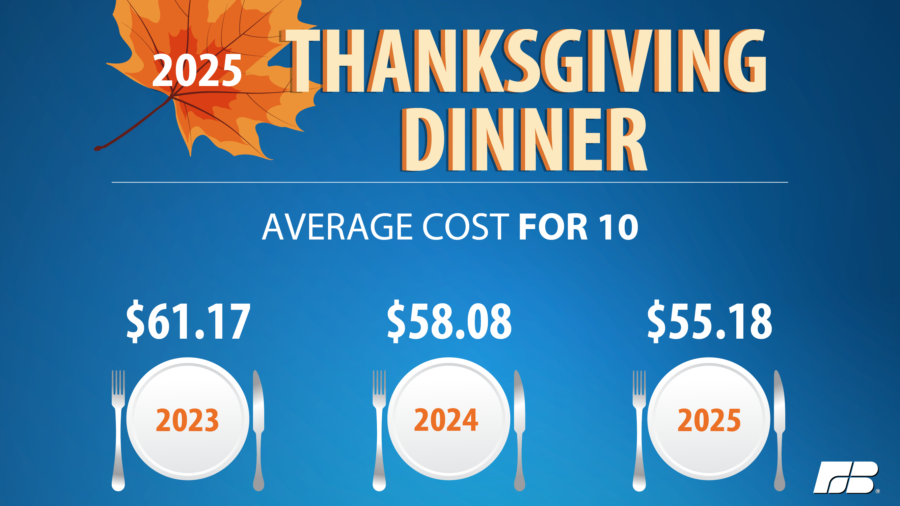
Of course, “traditional” means different things to different families – and varies in different regions of the country (more on that in a bit), but the American Farm Bureau Federation reported a 5% decrease in price for a “classic” Thanksgiving meal from 2024 to 2025.

That’s good news for families.

“Cooking a Thanksgiving dinner for your friends and family will cost less than last year, marking the third straight year of price declines,” the Farm Bureau stated.

“The American Farm Bureau Federation’s 40th annual Thanksgiving dinner survey provides a snapshot of the average cost of Thanksgiving staples that make up a classic holiday feast for 10, which is $55.18 or about $5.52 per person.”

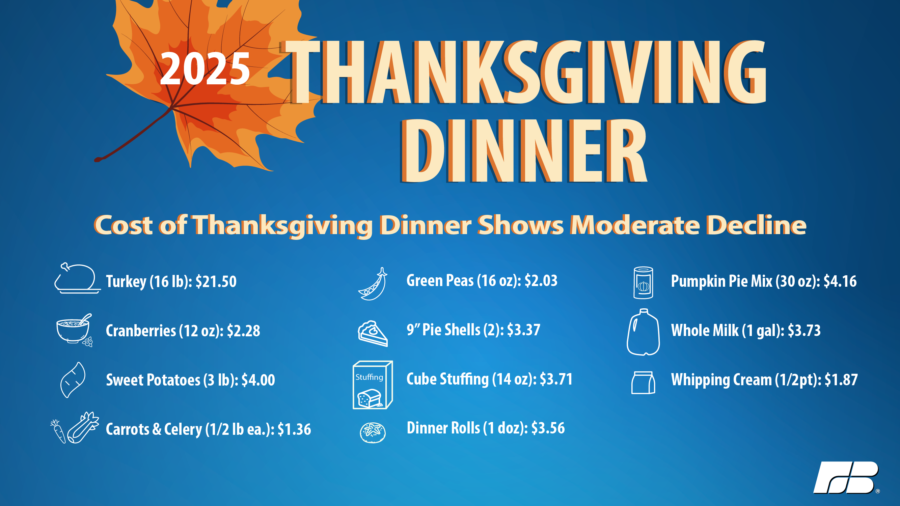
So what’s in a “classic holiday feast for 10?” The Farm Bureau lists a 16-pound turkey, cubed stuffing mix (always Mrs. Cubbison’s when I was growing up), frozen peas, dinner rolls, cranberries, a vegetable tray and sweet potatoes.

For dessert, the group lists whipped cream and ingredients for two pumpkin pies – but you can save $1.54 by buying one of those giant Costco pies for $5.99.

The two items with the biggest price increases were a 1-pound tray of carrots and celery and 3 pounds of sweet potatoes. Sweet potatoes were up because of hurricane damage in North Carolina in 2024.

The turkey and dinner rolls had the biggest decreases from last year.

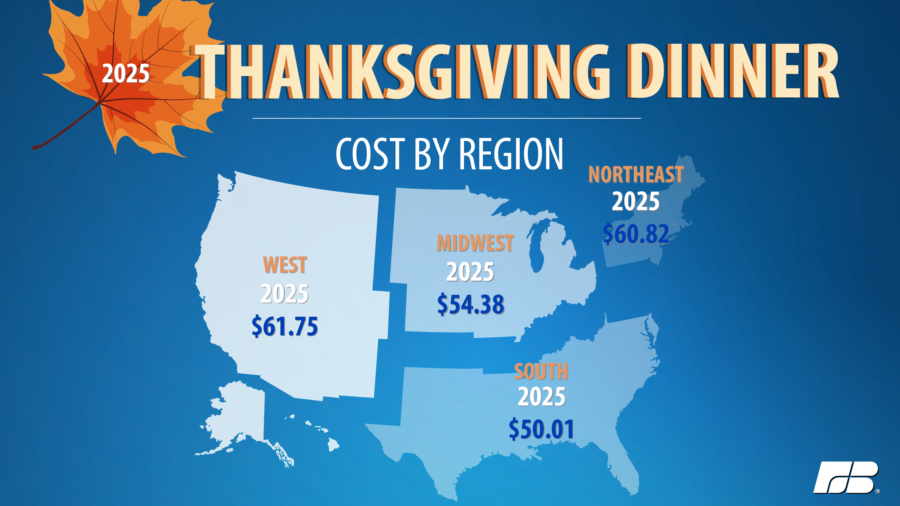
The Farm Bureau uses volunteer shoppers who check prices in the first week of November, and it notes that there are big regional differences in the cost of the meal.

“The cost for the classic meal was the most affordable in the South at $50.01, followed by the Midwest at $54.38, the Northeast at $60.82, and the West at $61.75.”

Now, you may have looked at the Farm Bureau’s grocery list and immediately thought: What about the Durkee Onion Green Bean Casserole?

This Thanksgiving Day staple, as we all know, was invented by Dorcas Reilly in 1955 in the Campbell Soup Company test kitchen and inducted into the National Inventors Hall of Fame in 2002.

We hope Dorcas received a huge bonus for her creation.

Aside from the Durkee Onion Green Bean Casserole, what about the mashed potatoes? Or, what if we’ve switched to ham?

Not to worry. A few years back, the Farm Bureau expanded the menu to include Russet potatoes, frozen green beans and boneless ham. The group said, “Adding these foods to the classic Thanksgiving menu increases the overall cost by $21.91, to $77.09.”

As we mentioned earlier, every family adds their own twist to the “traditional” Thanksgiving meal, and different regions of the country, with different ethnic and cultural influences, add to the menu.

For example, when my family moved to Baltimore almost thirty years ago, our priest announced that the church’s food pantry needed more items for Thanksgiving, adding, “But we have enough cans of sauerkraut.”

I laughed – but nobody else did. Maryland is a Southern state, but it also has a large German population. So sauerkraut is a Thanksgiving staple for many families – along with classic Southern dishes like hominy and succotash. Crab cakes and oysters often make it onto the menu there, too.

Many years ago I celebrated Thanksgiving with a Greek friend in Chicago, and we had spanakopita, pastitsio and baklava along with our turkey, mashed potatoes and gravy.

A work colleague, of Italian extraction, sternly explained to me, “Thanksgiving isn’t Thanksgiving without pasta.” Her family has lasagna, a big bowl of pasta, and Italian wedding soup as side dishes every year.

So what are your family’s special favorites at your Thanksgiving feast?

Do you have Midwestern wild rice casserole or corn pudding? New England’s oyster cornbread stuffing? Southern deep-fried turkey or collard greens and black-eyed peas? Southwest tamales? Utah’s green Jell-O salad?

What’s the food where you say, “It’s not Thanksgiving without … ?”

Related Articles and Resources

Candace Cameron Bure Issues Gratitude Challenge, Says She is Thankful for Her Salvation

Celebrating the Miracle of Thanksgiving

Christian Chef and Food Network Star Offers Life Lessons and Thanksgiving Cooking Tips

The Christian History of Thanksgiving in America

Giving Thanks on Thanksgiving: Why You Should Give a Hoot About Gratitude

Oklahoma Governor Declares November ‘Family Month,’ Encouraging Family Mealtimes

President Lincoln’s Thanksgiving Proclamation Reminds Us to Give Thanks

Rush Limbaugh and the True Story of Thanksgiving

A Thanksgiving Eve I Will Never Forget

Three Gifts Christians Can Be Thankful for This Thanksgiving

Written by Jeff Johnston · Categorized: Family, Winter Reads · Tagged: thanksgiving

Nov 27 2024

Giving Thanks on Thanksgiving: Why You Should Give a Hoot About Gratitude

Today’s Thanksgiving celebrations typically involve a whole lot of angst before families give thanks.

We spend days, sometimes weeks, worrying about cooking, hosting combative family members, the price of groceries, holiday travel and winter weather to achieve one perfect moment — everyone around the table, saying what they’re thankful for.

A holiday synonymous with gratitude shouldn’t be filled with anxiousness. God says gratitude is supposed to be our antidote for worry. Philippians 4: 6-7 tells us:

Do not be anxious about anything, but in everything by prayer and supplication with thanksgiving let your requests be made known to God. And the peace of God, which surpasses all understanding, will guard your hearts and your minds in Christ Jesus (ESV).

As a person who struggles with anxiety, I know what you’re thinking: “It’s not that easy,” or “I can’t help it,” or “If I don’t worry, nothing will get cooked!”

But gratitude isn’t the instantaneous absence of worry, or the placid peace you feel sitting around the Thanksgiving table. It’s the decision to relinquish your worries and fill your mind with the blessings you’ve been given.

Max Lucado, the author of Anxious for Nothing, says it this way.

The anxious heart says, “Lord, if only I had this, or that, or the other, I’d be okay.” The grateful heart says, “Oh, look! You’ve already given me this, that, and the other. Thank you, God.”

This isn’t a passive process.

It means praying for God to move your focus away from the things that worry you, even when you want to keep ruminating on them. It means choosing to dwell on the God’s promises, even if we can’t see how He’s keeping them.

The Apostle Paul demonstrated unshakeable gratitude while chained up in a prison. He wasn’t planning his escape, or thinking about the ways God could get him out of there. He wasn’t wondering how spending time in jail could possible be for his benefit (Romans 8:28). Instead, he wrote,

I have learned in whatever situation I am in to be content. I know how to be brought low, and I know how to abound. In any and every circumstance, I have learned the secret of facing plenty and hunger, abundance and need. I can do all things through him who strengthens me. (Philippians 4:11-13)

Ready to trade your worry for a grateful heart? Me too. Here’s some things you can try.

  • Take a couple minutes each morning to pray for gratitude, even if you aren’t feeling particularly worried. Giving thanks is a practice that builds on itself, not a quick fix.
  • Write down three things you’re grateful for every day — and not just during the holidays. Write them on sticky notes and post them on your mirror, or keep them in a notebook where you can see your blessings build up before your eyes.
  • Keep a list of your prayers, and keep track of how God answers them.
  • Keep a list of God’s promises on your phone and read them aloud when your mind starts spinning.

Here’s to making this Thanksgiving more about giving thanks than feeling angst.

Written by Emily Washburn · Categorized: Winter Reads · Tagged: thanksgiving

Nov 27 2024

Selfless Giving Makes You Scientifically Happier

Have you ever gotten warm, fuzzy feelings after helping a neighbor in need?

It’s not all in your head. Acts of generosity increase our brain’s production of dopamine — one of the hormones that make us feel happy.

Dopamine is a neurotransmitter the brain produces to signal when an experience, like eating a certain food or listening to a certain kind of music, is worth repeating. Dopamine inspires pleasurable feelings that encourage us to keep seeking the same stimulus.

Studies show selfless giving stimulates two of the brain’s reward centers: the ventral tegmental area (VTA), which creates dopamine, and the ventral striatum, which interprets dopamine signals. These results suggest the brain processes kindness as a pleasurable behavior, or, as Time magazine puts it:

Altruism is hardwired in the brain — and it’s pleasurable.

This isn’t true in all circumstances. For instance, people generally don’t experience a dopamine high when they are coerced or manipulated into giving. But more than a decade of research confirms the positive relationship between pleasure chemicals and kindness across different ages and relationships.

Naomi Eisenberg, a social psychologist and neurobiologist who studied the effect of generosity during the pandemic, told PBS, “We found that even in the height of COVID, two or three acts of kindness a week seem to significantly reduce levels of depression and anxiety.”

Psychologists say this neurological phenomenon has to do with humans’ “basic psychological need for ‘relatedness,’ or feeling close to others.” This conclusion isn’t wrong, but it isn’t complete, either.

Humans are deeply relational creatures because we are created in the image of a relational, triune God. Genesis 1:26 (ESV) reads, in part:

Then God said, “Let us make man in our image, after our likeness…”

Genesis 2:18 subsequently reads:

Then the Lord God said, “It is not good that the man should be alone; I will make him a helper fit for him.”

God meant for humans to live together. He made our brains to enjoy acts of generosity in service of this community. How’s that for intelligent design?

This Thanksgiving, as we remember the generosity of the Wampanoag Indians toward the starving Mayflower pilgrims more than four centuries ago, give thanks also for the incredible capacity God gives us for kindness.

And if you’re feeling low this holiday season, remember that giving of yourself will make you scientifically feel better.

Written by Emily Washburn · Categorized: Winter Reads · Tagged: thanksgiving

Privacy Policy and Terms of Use | Privacy Policy and Terms of Use | © 2025 Focus on the Family. All rights reserved.

  • Cookie Policy