Supreme Court Hears Case About Counting Ballots That Arrive After Election Day
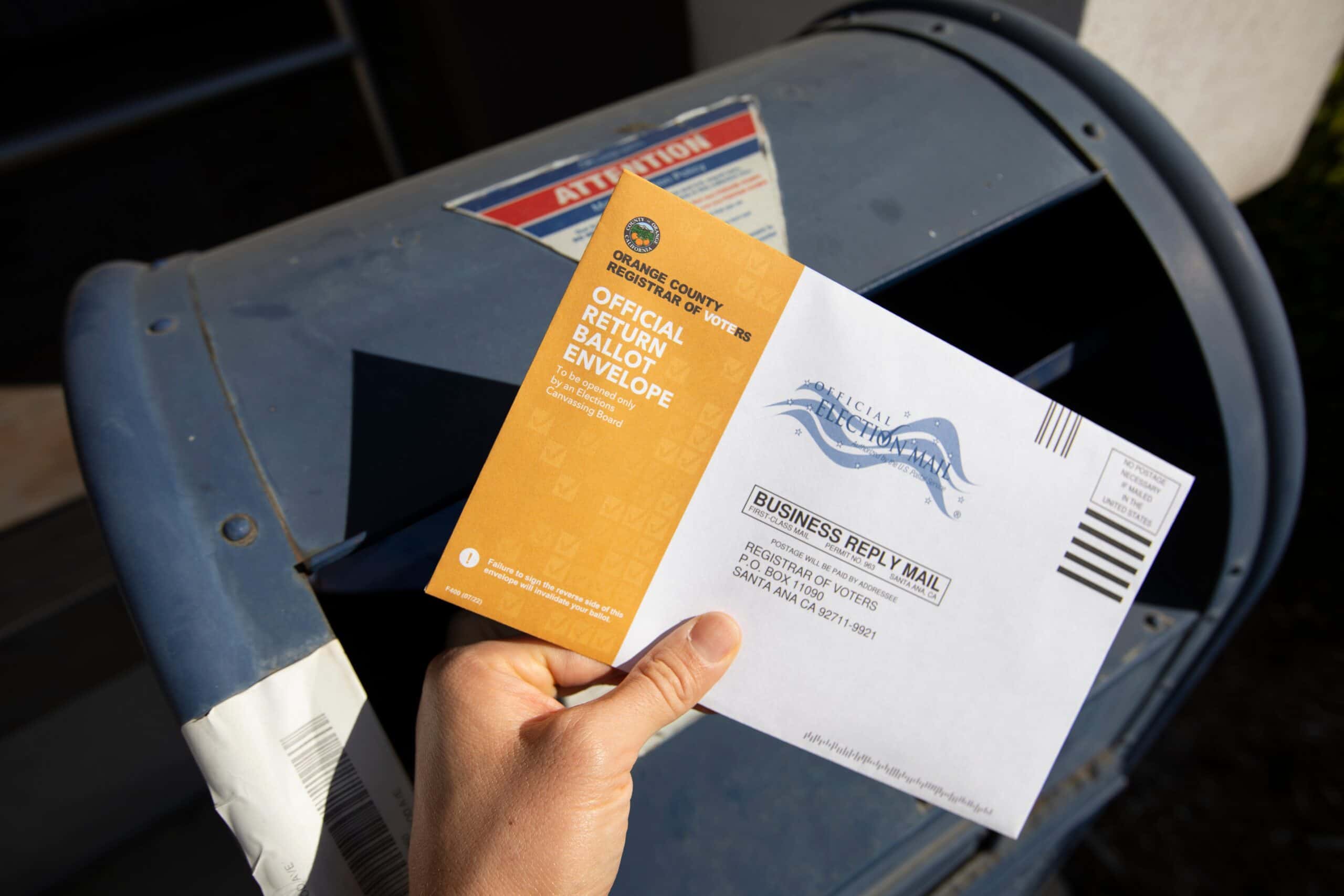
The U.S. Supreme Court heard a case on Monday challenging a Mississippi law that extends the counting of mail-in ballots postmarked by Election Day but received up to five days later.
The ruling in Watson v. RNC could affect 14 states, three territories and Washington D.C., all of which accept and count late ballots, reports the National Conference of State Legislatures.
Mississippi argued in its brief to the Supreme Court that voters were required by federal law to “make a final choice of officers” by Election Day, contending this does not mean that ballots have to be received by then.
The Republican National Committee (RNC), disagreed, saying states were experimenting “with novel ballot handling rules.” Its brief quoted a previous Supreme Court decision:
These post-election receipt deadlines invite “the chaos and suspicions of impropriety that can ensue if thousands of absentee ballots flow in after election day and potentially flip the results of an election.” …
It’s hard to blame Americans for those suspicions when some States produce quick results, while others take days to even know how many ballots need to be counted.
While we won’t know the outcome for several months, conservative justices signaled their concern when late ballots are counted.
Justice Brett Kavanaugh quoted a law review article from New York University Professor Richard Pildes. Kavanaugh said:
Professor Pildes and others have said that late-arriving ballots open up a risk of what might destabilize the election results. “If the apparent winner the morning after the election ends up losing due to late-arriving ballots, charges of a rigged election could explode. The longer after Election Day any significant changes in vote totals take place, the greater the risk that the losing side will cry that the election has been stolen.”
He then asked Mississippi Solicitor General Scott Stewart:
Is that a real concern? Two, does that factor into how we think about how to resolve the scant text and the maybe conflicting or evolving history here?
Stewart responded that he respected that perception but added, “There has not been much of a showing about actual fraud from post-Election Day ballot receipt itself.”
Other conservative justices expressed concern with Mississippi’s law. Justice Amy Coney Barrett asked Stewart why the state allows the U.S. Postal Service, whose workers are not state officials,to deliver late ballots that will be counted but preclude a friend or neighbor from delivering ballots “as long as it gets to the ballot box five days after Election Day.”
Justice Samuel Alito pointed to Washington state, which allows ballots to be received and counted 21 days after Election Day, asking Stewart if there was an outer limit to when ballots can be received.
Alito also pointed to elections taking place on a single day, saying:
We have lots of phrases that involve two words, the last of which, the second of which is day, Labor Day, Memorial Day, George Washington’s birthday, Independence Day, birthday, and Election Day, and they’re all particular days.
The justice did note that there were some exceptions to the single day during times of war, but then asked, “What would an ordinary person have thought Election Day meant in 1872?” – the year Congress directed House elections occur on the Tuesday after the first Monday of November.
The more liberal justices seemed likely to side with Mississippi, saying courts should defer to state and federal laws. Justice Sonia Sotomayor pointed to the long history of permitting absentee ballots received after Election Day to be counted during times of crisis, like the Civil War and World War II. She said to Stewart:
So the people who should decide this issue are not the courts but Congress, correct? … The states and Congress.
Mississippi first enacted the law to accept late-arriving mail-in ballots during the COVID-19 lockdowns in 2020. RNC, the Mississippi Republican Party and two individuals challenged the law in January 2024.
The next month, the Libertarian Party of Mississippi also filed a lawsuit against the state’s election policy. The cases were consolidated by the U.S. District Court for the Southern District of Mississippi, which later ruled against the plaintiffs.
The RNC and the Libertarian Party appealed, and the 5th U.S. Circuit Court of Appeals ruled in their favor, so Mississippi Secretary of State Michael Watson appealed to the Supreme Court.
At issue are two provisions in the U.S. Constitution. The electors clause states, “The Congress may determine the Time of chusing the Electors” for president. The elections clause gave states the authority to decide “The Times, Places, and Manner of holding Elections for Senators and Representatives,” but it adds, “The Congress may at any time by Law make or alter such Regulations.”
Initially, states had 34 days in which to hold elections, but the outcome from early voting states could affect turnout and influence votes in states that held late elections.
In 1845, Congress established the Tuesday after the first Monday in November as the date for presidential elections, voting in 1872 that House elections would be held the same day. In 1914, after the 17th Amendment was passed allowing direct voting for senators, Congress again voted to hold those elections on the same day as the presidential and House elections.
Voters want access to voting, but they also want election security, with elections free from fraud or the appearance of fraud.
A recent poll from the Honest Elections Project showed that 83% of voters support Election Day ballot deadlines, with 78% of voters agreeing that this makes elections more secure.
We’ll know in several months whether the Court agrees with them and decides whether federal laws mandate that ballots are cast and received by Election Day.
The case is Watson v. RNC.
Related articles and resources:
Are Elections Secure? 10 Examples of Election Issues Around the Country
Can the US Postal System Be Trusted with Our Ballots?
Election Security Is on the Ballot in November and December
Georgia’s Election Integrity Act – Voter Suppression or Election Integrity?
The Heritage Foundation: Election Integrity and the American Republic
Is it ‘Voter Suppression’ to Require Proof of Citizenship to Vote?