• Skip to main content
Daily Citizen
  • Subscribe
  • Categories
    • Culture
    • Life
    • Religious Freedom
    • Sexuality
  • Parenting Resources
    • LGBT Pride
    • Homosexuality
    • Sexuality/Marriage
    • Transgender
  • About
    • Contributors
    • Contact
  • Donate

population decline

Jul 14 2026

Could Taylor’s Marriage Spark a Global Swiftie Baby Boom?

So Taylor and Travis are married, finally. What took them so long?

The mega-famous power couple wed in a sweltering blaze on July 3 in Madison Square Garden, just to make sure there was enough room at their star-studded celebration. She walked down the aisle to an instrumental version of her own song “Love Story.” Adam Sandler officiated the ceremony. Kansas City Chiefs coach Andy Reid said Sandler’s best advice to the couple was “keep kissing.”

So now they settle into family life. Will a baby be coming soon?

At the news of their engagement last August, American Enterprise Institute fellow Timothy Carney posted on X, “Pregnancy is contagious. Familism and Natalism are conveyed culturally.”

He added, “If Kelce and Swift have kids and quickly, this could trigger a Baby Boom.”

We should all hope it will because the world’s most pressing long-term need is many more babies being born today so that we have a tomorrow. Two-thirds to nearly three-fourths of humanity live in a nation well below replacement level which translates into what one leading global analyst called “mass extinction numbers.”

So, the question is certainly worth considering: Could impending news of a little Swiftie in the oven trigger a baby boom, or at least a bump? Possibly. 

First, it is important to recognize that Carney is correct. Pregnancy is indeed contagious. Academic studies here, here, here and here demonstrate that pregnancies happening within a woman’s personal network can stimulate her entry into motherhood. The decision to have a baby is less individualistic than most assume. The behaviors of others affect our own.

In an interview with the Daily Citizen, Carney contends, “Pregnancy is contagious on a local level, among extended family circles and on a cultural level.” How does this happen? Carney explains, “People are motivated by what fills their imagination, what they see, what they are exposed to.” He notes, “If you were the CIA and you wanted to drive up birthrates, you would simply expose people to the rewarding experiences of lots of families with lots of kids.”

So yes, familism and natalism are conveyed culturally. Carney told Daily Citizen, “What I articulated in my X post was a hope, not a prediction, not an expectation.”

But he admitted, “I think celebrities having kids, especially married celebrities having kids, raising them in a happy family, enjoying life together — that is analogous to actually seeing kids running around on your street.” He confessed, “It is not as good as that, but certainly analogous.”

As Veronica Clarke noted over at First Things last August, Taylor’s “engagement signals to Swifties and lovelorn women worldwide that finding love in the twenty-first century is not a fairy tale.” If she and Travis welcome a wedding baby, that news could have the same effect.

Lyman Stone, director of the Institute for Family Studies’ Pronatalism Initiative, also sat for an interview with Daily Citizen. He told us, “I definitely share the perspective that major celebrity figures, social influencers, role models, whatever, they absolutely have an effect on people’s family decisions.” Stone adds an important angle though,

When elites, people in positions of great social influence on others, not only have kids, but have kids in a way that seems happy and attainable, that can be predictive.

He adds the larger population must see those things as attainable for themselves. Buying a new plane or an expensive second home in Italy does not have the same effect. But something that is clearly in reach for most young adults, like marriage and parenthood, can be driven by the influence of others.

Stone notes, “So to the extent that Swifties look at Taylor and say, ‘Well, if the woman who did four break-up albums can find love with the football star, maybe I can find love too.’” He observes, “Maybe that could happen with motherhood too, if she gets pregnant soon enough.”

What if Taylor outsources her mommy wish and gestational labor to a surrogate? The motivation to keep her famous starlet body and her more than ample financial resources make this a very real possibility. But this makes her pathway to motherhood unattainable (and hopefully undesirable) for most Swifties, thus having no baby bump effect.

But it also matters how Tay Tay talks about motherhood, if that time comes. Stone explained, “If we get Taylor Swift’s Lullaby Album for her beloved baby, we’re there, on the path to a prenatal culture.” He counters though, “But if we get her ‘Honest Reflections on the Difficulties of Motherhood’ i.e., negative comments about motherhood, that’s unlikely to go in a great direction.” Stone concludes, “If Taylor talks about her family life in a way that is encouraging of others, then I think we could get a Swiftie baby bump.”

As Carney noted in the Washington Examiner, the day after his X post went viral: “If someone who is constantly watched by millions of people starts living a married life and a mother life, then the idea of being married and a mother becomes more imaginable – even if her life is inaccessible in so many other ways.”

Such is the power of modern, mediated entertainment culture. Sometimes its upside possibilities are worth hoping for.

Let’s hope for a baby boom.
Written by Glenn T. Stanton · Categorized: Culture · Tagged: parenting, population decline

Jul 09 2026

New Dire Fertility Prospects for the United States and Real Hope for a Fix

It has been well documented that fertility is falling in the U.S. and in nearly every part of the world. The Daily Citizen has tracked this well, here, here, here and here.

Sustained declining fertility violates God’s first command to humanity to not only be fruitful and have children, but to actually multiply – to have more children than the couple themselves. A demographic truism is that a population that is not moderately multiplying is slowly dying. That is the present fact of global fertility.

Leading UPenn demographer Jesús Fernández-Villaverde has explained, “Humanity has entered a new era of rapid population decline.” He adds, “If we are unable to address our fertility crisis, the US will face an existential economic crisis driven by a steep decline in fertility rates – one that could have an impact measured in the quadrillions of dollars.”

Fewer people means more economic troubles because people are producers. They work. They create ideas, goods and resources that make life better for other people. Humans innovate. In fact, Paul Romer won the 2018 Nobel Prize in economics for mathematically demonstrating how people are much stronger, more powerful producers of goods and solutions to real problems than they are dangerous consumers. As Romer showed, our minds are more beneficial to the future of humanity than our stomachs are a threat. This fact turned what most people wrongly believed about population growth on its head. God is right. Population growth is not a problem. It is essential to human thriving and an improved and growing civilization.

A new report from the scholars at the Institute for Family Studies (IFS) further documents just how serious the problem of fertility decline is for America. They note that as we celebrate our nation’s 250th birthday, we must recognize what got us to “our current scale and strength as a nation – families raising their own children.”

IFS laments, “Without a new birth of family life in America, the greatest days of freedom will indeed be behind us.” They properly add, “The future of liberty for all of us depends on the future of family.”

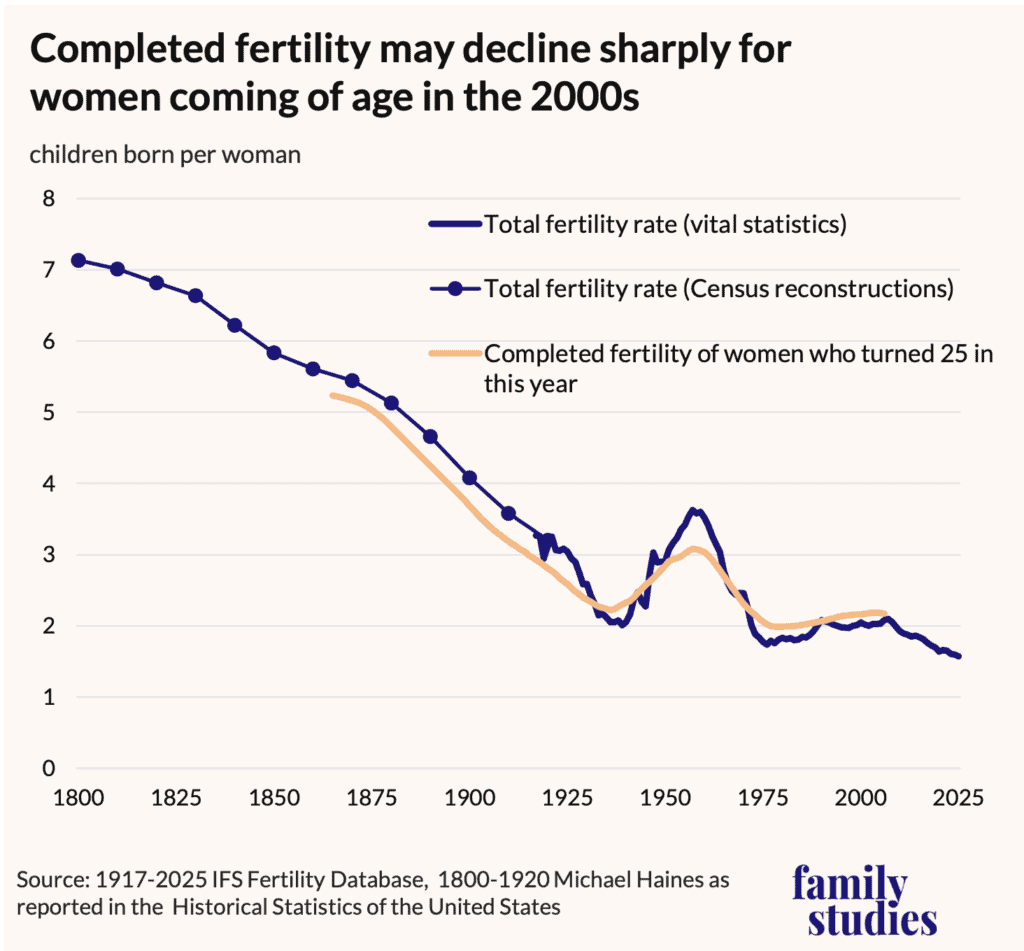
Their report, entitled The Demographic Dead End: 2026 State of Fertility, shows the U.S. is now in its third historic period of extended below replacement fertility. And this third period is longer and more sustained than previous declines. They chart national U.S. fertility since 1800 to the present and it looks like this:

This is certainly not a growth trend line. IFS reports that if this downward trend continues, the U.S. population will peak in 2054, decades ahead of projections, and then start declining in the 2080s.

Once a population starts to decline, it is nearly impossible to bring it back up to replacement level. In fact, a leading group of Gates Foundation funded demographers reported in a major study from 2020 that “once global population decline begins, it will probably continue inexorably.” The Cambridge dictionary defines “inexorably” as “in a way that continues without any possibility of being stopped.”

This fact is sobering, as it means this sustained trend will likely be the eventual end of humankind.

Desired Fertility vs. Actual Fertility

Yet, IFS expresses hope.

Data consistently shows that actual fertility – babies actually being born – is lower than desired fertility, the number of children young couples or singles say they want to have one day. For Americans, actual fertility is 1.6. Desired fertility is, according to Gallup, 2.7.

And beliefs about God and life impact this. States with higher levels of church attendance, happy marriages and family strength tend to have higher birth rates than states with lower rates of faith,marriage and intact family formation. An additional IFS report, The Ideological Fertility Divide, explains how “liberals are more likely to hold views linked to fewer kids.”

But the fact is, no generation has ever had all the children they say they desire. Every age lags between the family size they say they want and what they actually have. For various confounding reasons, this is a human truism.

But it is good that the stated desire is there. It is something to work with.

This is even more meaningful when we consider that IFS, in their new Demographic Dead End report, explains that fertility is not so much a function of economics, but of social dynamics.Drawing from this IFS report, Rob Henderson, a senior fellow at the Manhattan Institute, concludes the trick to getting more babies is having more friends, and ideally, more friends who have babies themselves. Henderson states, “Americans are not having fewer children because they want fewer children.” He adds, “They are having fewer children, in part, because friendship has thinned and social support for family life has weakened.”

The decline of social familism drives down fertility. Thus, according to Henderson, “The gap between desired and actual family size is the widest it has been since the early 1970s.”

So it is not really economics and housing costs that limit fertility. IFS found that for Americans under 30 with a small circle of friends who are generally less supportive in helping with common life struggles, their fertility rate is about 1.7. For those reporting a larger, more supportive friend base, their fertility rate was 2.8, just above what Gallup reports as desired fertility. As Henderson explains, “having friends with kids predicts wanting more kids yourself.” Philosophical anthropologist René Girard would say this is because of mimetic desire, the fact that humans tend to desire what they observe other people enjoying. We need to see more young couples enjoying having kids.

We humans must revive the culture of fertility, having and enjoying plenty of children. Others will catch on to the craze. Human civilization depends on this shared habit. It is, after all, the first thing God told us to do. And demographers are now telling us how much it matters. Our very future depends on it.

Related articles and resources: 

The Pressing Need to Fix Global Fertility Decline and How to Do It

Is Inflation Driving Fertility’s Decline?

American Deaths to Exceed Births Faster Than Expected, CBO Reports

U.S. Fertility Rate Falls to Lowest on Record – Again

Global Population Has Passed ‘Peak Child’ – an Ominous Milestone

Why Americans Over and Under 50 Say They Don’t Have Kids

Death of the West? U.S. Fertility Rate Falls to Record Low.

China’s Population Drops by 2 Million in 2023 Due to Record Low Birth Rate

Discarding Genesis 1, U.S. Population Set to Decline This Century Amid World Population Collapse

The Importance of God’s Design for Marriage and Family

New Report Gives Update on Family Formation and Child Well-Being

Written by Glenn T. Stanton · Categorized: Culture · Tagged: Fertility, population decline

Jan 14 2026

American Deaths to Exceed Births Faster Than Expected, CBO Reports

U.S. fertility has been falling to deeply concerning historic lows and according to a new Congressional Budget Office (CBO) report, that decline is expected to worsen in the coming decades.

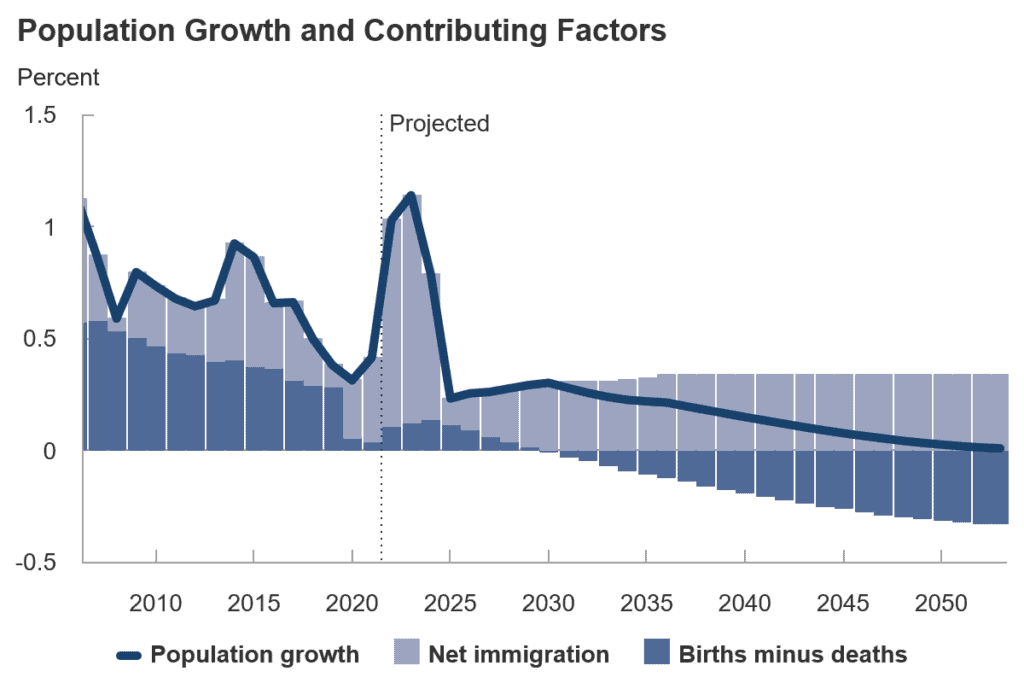
In fact, the CBO now predicts deaths will exceed births in America 10 years sooner than their 2024 projection. In January 2024, the CBO reported that American deaths would overtake the total number of births in 2040. This new report now predicts that will now happen for the first time in 2030. This is also three years sooner than their January 2025 report, which placed that ominous date in 2033.

If this reporting trend continues, the 2027 CBO report will likely place that date even sooner, in 2028 or 2029. This means we are hurtling even closer to a natural death over fertile life trend in America.

The CBO demonstrate how quickly population growth in the United States has been declining over the last few decades. The blue markers show how annual births over deaths will grow even more dramatic through 2050.

This means an increasingly aging population. “The segment of the population age 65 or older,” the report states, “is projected to grow more quickly, on average, than younger groups, causing the average age of the population to rise.” Immigration will then become the only way America can grow. However, the U.S. experienced net negative migration in 2025 for the first time in 50 years.

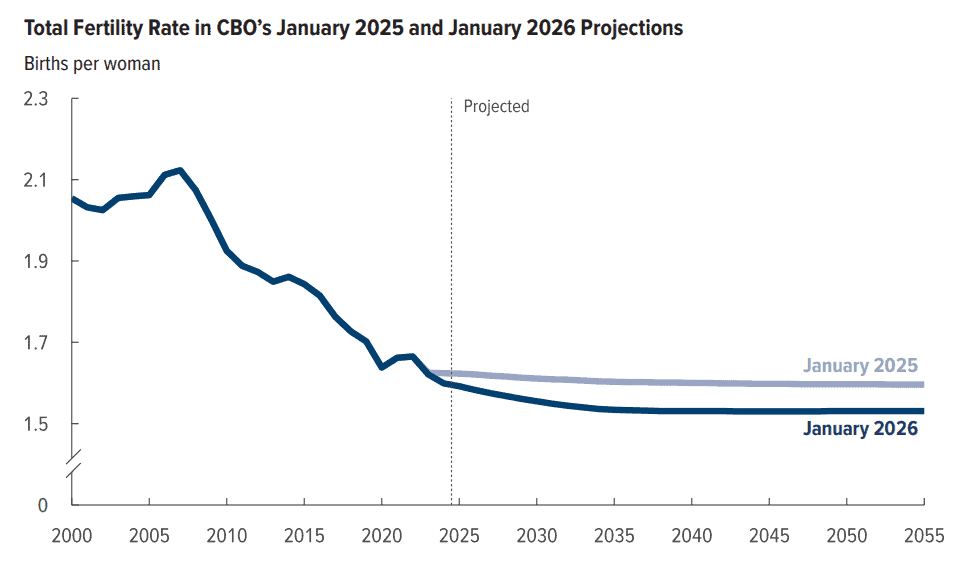
The U.S. fertility rate declined to 1.6 in 2024, below the necessary 2.1 replacement level, and the CBO predicts it will decline to 1.58 this year, then to 1.53 in 2036. That is likely an overly positive prediction. They report births by women age 30 and younger will decline even more, from 0.74 births per woman this year to 0.60 in 2056.

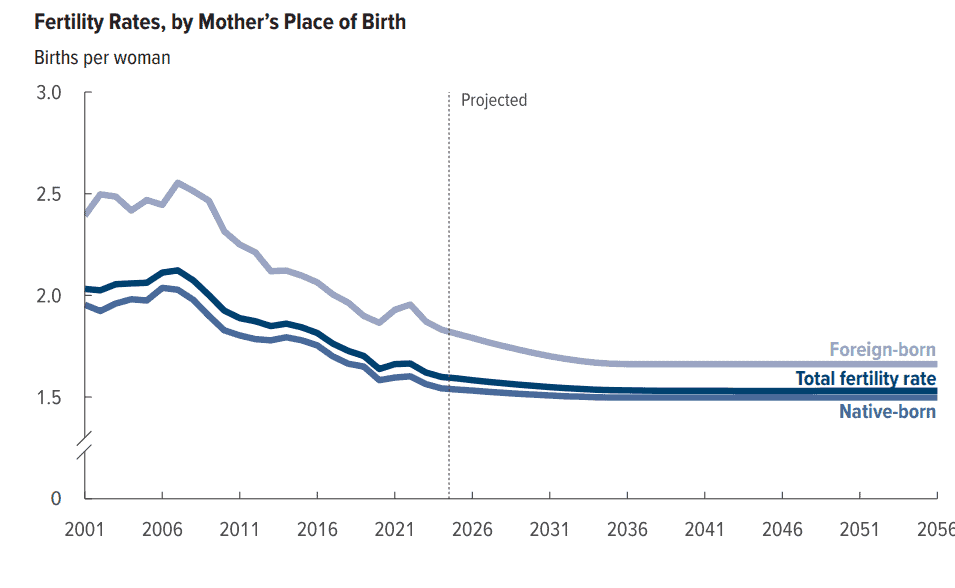
The CBO also projects that the fertility for foreign-born women in the U.S. is expected to outpace the birthrates of native-born women. It is currently at 1.53 births for native-born women, but 1.79 births per foreign-born women. Those numbers are expected to decline to 1.50 and 1.66, respectively in 2036 and stay at roughly that rate through 2056.

The CBO trendlines look like this:

The CBO is “now projecting a smaller population over the next three decades than it projected last January.” They now predict that the U.S. population will be 7 million less in 2035 and 8 million less in 2055 than they predicted just last year. That is a 1.9 and 2.1 percent decline in population projections for 2035 and 2055 over last year’s projections.

So not only is fertility declining to historic lows, but it is declining faster than experts anticipated over the most recent years. This matters for various reasons. The interests of the CBO are highly pragmatic as the first line of their new report explains, “The outlook for the U.S. economy and the federal budget depends on projected changes in the size and composition of the population.”

Increasingly shrinking populations, where fertility becomes outpaced by deaths, mean a declining national economy and federal budget. This translates into loss of national power and influence. Babies matter because they drive the future.

This data tells us that God’s first command, to go forth and multiply, is still very much in effect. When we cease to obey, even cold, calculated government accountants will take notice and tell us something is deeply wrong. That is precisely what we find in this new government budget office report.

Related articles and resources: 

U.S. Fertility Rate Falls to Lowest on Record – Again

Global Population Has Passed ‘Peak Child’ – an Ominous Milestone

Why Americans Over and Under 50 Say They Don’t Have Kids

Death of the West? U.S. Fertility Rate Falls to Record Low.

China’s Population Drops by 2 Million in 2023 Due to Record Low Birth Rate

Discarding Genesis 1, U.S. Population Set to Decline This Century Amid World Population Collapse

The Importance of God’s Design for Marriage and Family

New Report Gives Update on Family Formation and Child Well-Being

Written by Glenn T. Stanton · Categorized: Culture · Tagged: birth rate, family, population decline

Privacy Policy and Terms of Use | Privacy Policy and Terms of Use | © 2026 Focus on the Family. All rights reserved.

  • Cookie Policy