• Skip to main content
Daily Citizen
  • Subscribe
  • Categories
    • Culture
    • Life
    • Religious Freedom
    • Sexuality
  • Parenting Resources
    • LGBT Pride
    • Homosexuality
    • Sexuality/Marriage
    • Transgender
  • About
    • Contributors
    • Contact
  • Donate

pro-life

Nov 12 2025

Arkansas Named Most Pro-life State in America for Sixth Year

Americans United for Life named Arkansas the most pro-life state in the nation for the sixth year in a row. This recognition, which AUL announced in its newly released 2026 life list, affirms Arkansas’ long-term leadership in defending life from conception to natural death.

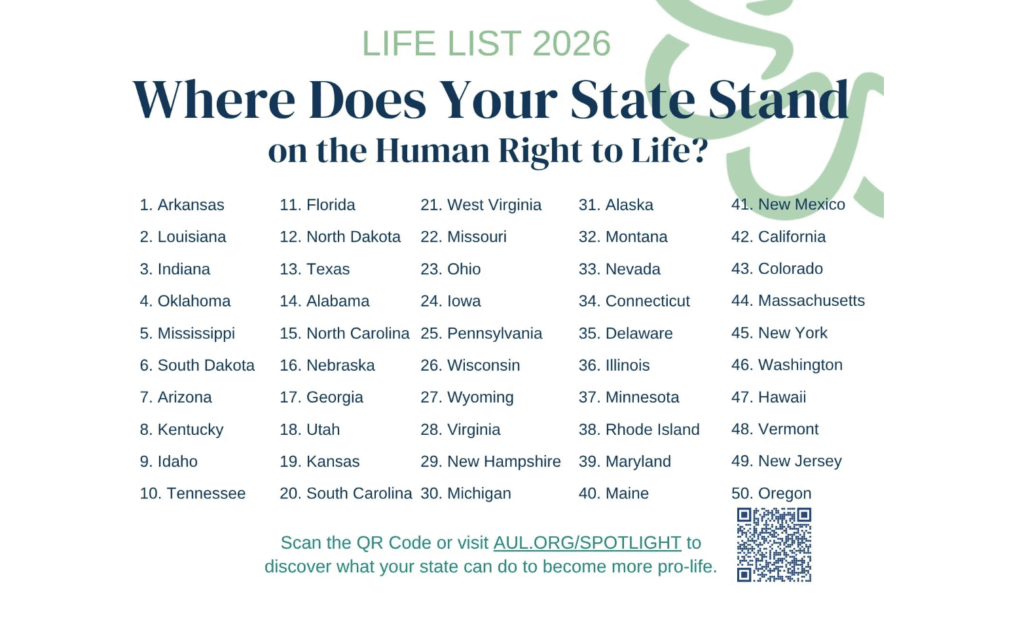
AUL’s annual ranking of all 50 states evaluates state-specific abortion regulations, protections for the preborn, end-of-life care, conscience protections for health care workers and efforts to promote a culture of life. The list also offers a comprehensive look at each state’s life-affirming policies, including bioethics, assisted suicide, conscience protections for medical workers and abortion policy.

Once again, Arkansas was recognized as a national model for pro-life policy and comprehensive legislative action. It protects all preborn babies, promotes adoption, defends conscience protections, advocates for vulnerable groups like the elderly and disabled, and provides funding for pregnancy resource centers.

The top five most pro-life states in the nation were Arkansas, Louisiana, Indiana, Oklahoma and Mississippi. Each demonstrated a strong commitment to strengthening life protections for the preborn and expanding support for expecting mothers and families. Rounding out the top ten are South Dakota, Arizona, Kentucky, Idaho and Tennessee.

Unfortunately, pro-life momentum from past years has waned as many states have contended with pro-abortion ballot measures attempting to enshrine abortion-on-demand in state constitutions.

In the last year, seven states passed amendments to put so-called abortion rights in state constitutions, including Arizona, Colorado, Maryland, Missouri, Montana, Nevada and New York. However, for the first time, three states (Florida, Nebraska and South Dakota) successfully defeated efforts to enshrine abortion in their constitution.

The five lowest-ranking states on this year’s list were Washington, Hawaii, Vermont, New Jersey and Oregon, with Oregon coming in last. These states received the lowest marks for their expansive abortion-on-demand laws, permissive assisted suicide statutes and laws shielding abortion providers from liability for violating other states’ pro-life laws.

Source: Americans United for Life

AUL’s life list is important because it serves as a scorecard for the pro-life community to identify which states are advancing the cause of life and to determine where more work needs to be done to promote life-affirming laws and policies.

Arkansas’s consistent leadership in advancing comprehensive pro-life policies demonstrates how one state’s vision and commitment can serve as a roadmap for other states seeking to strengthen a culture of life through law.

To learn more about how each state can strengthen its life-affirming state-based laws, consider consulting AUL’s State Spotlight.

In addition, state legislators may wish to connect with AUL regarding model legislation they can introduce in their state to protect and promote life.

Click here to see where your state ranks on the life list.

Image from Shutterstock.

Written by Nicole Hunt · Categorized: Life · Tagged: pro-life

Aug 15 2025

Pro-Abortion States Beef Up Protections for Abortion Pill Prescribers

JUMP TO…
  • Prescription Label Laws
  • Shield Laws
  • Pro-Life Challenges to Shield Laws
  • Why It Matters

Pro-abortion states are passing laws stripping prescriber names off chemical abortion pill labels.

The laws further insulate doctors who prescribe chemical abortion pills to people in pro-life states from investigation and prosecution.

Prescription Label Laws

New York, Maine, Vermont, Washington and Colorado have passed laws allowing prescribers to remove their names from prescriptions for mifepristone and misoprostol, the drugs used in a chemical abortion.

The laws make it nearly impossible for pro-life states to identify out-of-state, online abortionists—let alone investigate or sue them.

It’s unclear whether this kind of legislation is even legal; federal law requires prescriber names appear on all drug labels. But, so far, the laws remain unchallenged — and deeply problematic for pro-life states.

Importantly, prescription label laws making abortionists anonymous cover both local doctors prescribing abortions and doctors from other states that fill orders through local pharmacies. That means a mail-order abortionist in California could strip his name from a chemical abortion prescription if he filled the script at a pharmacy in New York.

California hopes to capitalize on this loophole by passing AB 260 — a bill that would remove both prescriber and patient names from chemical abortion pill labels. Most pharmacies that dispense mifepristone are in California, according to the left-leaning news outlet 19th Street

AB 260 is awaiting committee action in the California Senate. It passed the Assembly in May.

Shield Laws

Prescription label laws anonymizing abortionists beef up pro-abortion “shield laws” against pro-life judicial challenges.

States with abortion “shield laws” promise not to investigate out-of-state abortion providers or cooperate with investigations and prosecutions from pro-life states.

Eight states — California, Colorado, Maine, Massachusetts, New York, Rhode Island, Vermont and Washington — have shield laws explicitly protecting doctors who prescribe chemical abortions to patients in other states.

Fifteen others offer at least some protection from pro-life states’ investigations.

Of the 95,710 abortions prescribed or performed nationwide in December, an estimated one-in-seven were prescribed to women in pro-life states by abortionists in shield law states, according to a Kaiser Family Foundation analysis of data collected by the Society of Family Planning.

Pro-Life Challenges to Shield Laws

Pro-life states are workshopping ways to circumvent shield laws in court.

Louisiana and Texas pursued state judgements against Maggie Carpenter, a New York mail order abortionist, earlier this year— but they proved impossible to enforce without New York’s cooperation.

Now, pro-life states are empowering individual citizens to sue out-of-state abortionists for wrongdoing.

In July, Texas father Jerry Rodriguez sued California abortionist Remy Coeytaux in federal court for the wrongful death of Rodriguez’ pre-born children. A federal judgement in favor of Rodriguez would effectively strip Coetytaux of California’s shield law protections.

A Louisiana law allowing citizens to sue out-of-state abortionists, and extending the statute of limitations on abortion lawsuits to five years, took effect earlier this month.

Prescription laws anonymizing abortionists make it harder to file lawsuits like these by hiding the offenders’ identity.

Why It Matters

Chemical abortions are extremely dangerous. Nearly 11% of the more than 865,000 women who filed insurance claims for chemical abortions between 2017 and 2023 experienced severe adverse medical events within 45 days of taking mifepristone, according to data analysis by the Ethics and Public Policy Center, including:

  • Sepsis
  • Infection
  • Blood loss requiring a transfusion
  • Hemorrhage
  • Related hospitalization
  • Related ER visit
  • Related life-threatening cardiac, pulmonary and allergic reactions
  • Repeated surgical abortion
  • Other severe or life-threatening abortion-specific complications

Out-of-state, online abortion providers compound these dangers by prescribing abortion pills to:

  • Women more than 10-weeks pregnant, which is the FDA’s gestational limit for chemical abortions.
  • Teenage girls, often without parents’ consent, and even though mifepristone has never undergone pediatric testing.
  • Women who have not had an ultrasound, which doctors use to detect dangerous ectopic pregnancies mifepristone can disguise.
  • Women who will take the pills without a doctors’ supervision, which greatly increases the rate of complications.
  • People on behalf of women, which can indicate a woman is being coerced or tricked into getting an abortion.

Pro-abortion states should not be allowed to absolve abortionists of responsibility for the harms their actions cause vulnerable women.

To speak with a family help specialist or request resources, please call us at 1-800-A-FAMILY (232-6459).

If you are experiencing an unexpected pregnancy and want to learn more about your options, visit My Choice Network.

Some women, after taking the first abortion pill (mifepristone) come to regret their decision. Thankfully, there is a way to reverse the pill’s effects if prompt action is taken. To learn more about the abortion pill reversal protocol, visit abortionpillreversal.com or call 1-877-558-0333 to be connected with a medical professional who can guide callers through the process of reversing the pill’s effects.

To learn more about pro-life legislation in your state, contact your state Family Policy Council.

To learn more about the consequences of a chemical abortion, visit the links below.

Additional Articles and Resources

Texas Father Sues Out-of-State Abortionist for Killing His Preborn Children

Shield Laws Enable Chemical Abortion in Pro-Life States

Shield Law Abortion Providers Advertised Alongside Black Market Abortion Pills

Texas Sues New York Doctor for Prescribing Abortion Meds

New Abortion Pill Study Confirms Danger to Mothers

Woman Nearly Dies from Abortion Pill, Story Reflects Disturbing EPPC Data

Focus on the Family Broadcast: Abortion Pill Reversal

#AbortionChangesYou: A Case Study to Understand the Communicative Tensions in Women’s Medication Abortion Narratives (Health Communication)

The Abortion Pill Harms Women: Insurance Data Reveals One in Ten Patients Experiences a Serious Adverse Event (Ethics and Public Policy Center)

Written by Emily Washburn · Categorized: Government Updates, Life · Tagged: abortion, mifepristone, pro-life

Jul 14 2025

Emily’s Story: Pro-Life Supporters are More than ‘Pro-Birth’

“Pro-life.”

When you read this, what do you see? It might be the image of an ultrasound or pro-life events like the March for Life in Washington, D.C. Others may see a newborn wrapped in a cozy blanket.

But what happens to this baby after his or her birth?

Although the church does incredible work to care for children who have been granted their right to life, it feels as though the stereotypical pro-life movement is not often associated with advocacy measures for what comes after birth: the rest of a child’s life.

As a pro-life supporter, it frustrates me that these two discussions – the protection of preborn human life, and proper care for children after birth – do not always go hand-in-hand. While pro-life activists rightfully encourage healthy pregnancies and safe births, we must remember that the term “pro-life” also includes services such as safe foster homes and adoptions. In fact, a well-functioning foster care system could significantly reduce women’s felt “need” for abortions.

Tragically, many children who receive their right to life are born into horrible circumstances – abusive or neglectful homes, abandonment, families battling addiction, parents who lack resources to care for their child, the death or incarceration of a parent – the list goes on.

Terrible situations such as these have forced the removal of countless children from their families and warranted their placement in the foster care system. Unfortunately, the term “pro-life” does not typically prompt images of such scenarios.

In 2023, the Adoption and Foster Care Analysis and Reporting System (AFCARS) estimated a total of 343,077 children in the United States foster care system. In 2023 alone, 175,283 children entered foster care, with 82% of these placement cases involving abuse and neglect.

While foster care has been a blessing to many children and families, the system is not perfect. As of 2023, 20% of children in the foster care system had spent at least 3 years waiting for either adoption or reunification with their families. Additionally, some choose to foster simply for the extra cash it provides, rather than because they genuinely care about the children in the system.

It is both devastating and difficult to imagine the individual children these statistics represent – boys and girls who were rightfully granted the chance to live, but removed from their biological families and thrown into circumstances beyond their control.

A very close friend of mine, Emily, represents just one of the thousands of children impacted by the foster care system. I recently had the honor of listening to Emily describe her moving experiences with foster care and adoption.

Her story demonstrates exactly why pro-life advocacy does not stop at birth.

Emily was born in 2003, the fifth out of nine children. Her parents did not have the resources to properly care for their family, and their house was crowded and dirty. Emily recalls her youngest sister “crawling around eating cat food and toilet paper” off the ground.

In 2010, Emily’s home was investigated after police found her disabled brother wandering their neighborhood unattended on two separate occasions. As a result, Emily and several of her siblings entered the foster care system due to neglect.

Emily was only six years old when she was removed from her family.

While her two-year-old sister was placed in a stable, loving foster home, Emily and her three-year-old sister lived a very different story – one that no child should ever have to tell.

The two girls remained in their first foster home for one year. During these twelve months, Emily remembers being locked in her bedroom or out of the house for hours at a time, forcing her to use the bathroom outside.

She also recalls her foster mother taking away a book the girls had received from their biological mom. It was never returned. 

During this time, Emily and her sister were often taken back home to visit their parents.

“I didn’t understand why I could see them, but not live with them,” she said.

One day, after waiting until her foster mother had left for the grocery store, Emily called 911 for help. She remembers feeling “scared, confused and wanting to leave.”

When the police arrived at her foster home, they told seven-year-old Emily there was nothing they could do to help her.

A year after their initial placement, Emily and her sister were “dropped off at a friend’s house” so their foster mother could go on vacation. These people were not foster care certified, and when Emily’s social worker found out, the two girls were immediately removed from their first foster care placement.

The sisters were then relocated to a temporary placement, where they stayed for four months before transitioning to a more permanent foster home.

Around this time, Emily was given the option of returning to her biological parents’ home or pursuing adoption. Ultimately, Emily chose adoption.

When describing her third foster care placement, Emily noted she had “nothing bad to say about that place.” It was in this home that Emily and her sister were first introduced to Christianity and ultimately to their adoptive parents.

Little did Emily know that her Sunday school teacher at church would soon provide a permanent, loving home for three girls in need of a family.

After spending 27 months in foster care, Emily and her two sisters moved into their new and final home on October 18, 2012.

Initially, nine-year-old Emily didn’t believe this arrangement was truly permanent, but the girls soon integrated with their new family. They began calling their parents “mom and dad” early on, and were lovingly embraced by their three older siblings.

Today, Emily works as an Early Childhood Educator, teaching a preschool class at a daycare. She explained how her background has allowed her to resonate and sympathize with children in her class who have difficult home lives or struggle with certain issues.

“I had it pretty good overall,” Emily said. “Some kids have it way worse.”

Emily’s story demonstrates that the battle for children’s rights doesn’t stop at birth. As Christians, we are obligated to advocate for children who are alive as a result of the births we have fought for – especially children who have spent years in the foster care system, waiting for either adoption or reunification with their biological families.

Contrary to the stereotype, pro-life supporters are more than just “pro-birth.” We care for a child’s entire life – from conception until the very end.

When I read the words “pro-life,” I still picture the ultrasounds, marches and newborns. But now, I also see faces of children who were given the chance to live, yet are trapped in situations beyond their control.

I see faces like Emily’s – the freckled redhead who has not only become one of my closest friends, but has also deeply influenced my own life with her powerful story.

Ultimately, I see countless lives we can change by providing safe foster homes and adoptions for children in need of Christ’s love.

So, I ask you to read these two words again: “Pro-life.”

What do you see now?

Related Articles and Resources:

Wait No More

Adoption From Foster Care

Faces of Foster Care

Resources: Fostering or Adopting Children From Difficult Backgrounds

Focus on the Family: Pro-Life

Written by Meredith Godwin · Categorized: Life · Tagged: advocacy, foster care, pro-life

Jun 26 2025

Pro-Life Win: US Supreme Court Clears Path to Defund Planned Parenthood

In a significant victory for the pro-life movement, the United States Supreme Court ruled 6-3 in favor of South Carolina’s plan to defund Planned Parenthood, creating a pathway for other states and Congress to finally stop using taxpayer dollars to subsidize Planned Parenthood.

This decision affirms state governments, and even the federal government, have the authority to define a qualified medical provider and confirms Medicaid recipients can’t sue to block those decision.

Background

The case, Medina v. Planned Parenthood, concerns South Carolina’s decision to withhold Medicaid tax dollars from abortion providers.

As reported by the Daily Citizen, the case originated with an executive order South Carolina’s governor issued in 2018, which prohibited abortion clinics from participating in the state’s Medicaid program.

Planned Parenthood sued the state on behalf of Medicaid recipients, claiming they have a judicially enforceable “right” to choose which qualified medical providers Medicaid should cover, including Planned Parenthood.

The Court heard oral arguments in April.

Opinion

The majority opinion was authored by Justice Neil Gorsuch and joined by Chief Justice Roberts and Justices Thomas, Alito, Kavanaugh and Barrett.

The central issue in this case was whether the Medicaid Act’s language gives recipients a legal right to sue in court. The majority said no because the language is too vague. If Congress wanted to permit individuals to sue, the Court opined, it would have used crystal-clear “rights” language. In this case, it did not.

The majority also reasoned that, because Medicaid is a spending program, federal agencies are responsible for holding states accountable, not individuals filing lawsuits.

The dissenting opinion was written by Justice Ketanji Brown Jackson and joined by Justices Sotomayor and Kagan.

Dissenting justices argued that, in their opinions, the statutory language gives individuals the right to sue. They contend that if Medicaid recipients can’t sue in court to defend their rights, they are powerless to challenge the state’s actions.

The case reveals an important philosophical divide within the Court regarding the separation of powers, federalism and the role of the judiciary.

The majority represents a more restrained and limited role of judicial power, requiring unambiguous language from Congress to interpret a private cause of action in federal statutes. The dissent presents a more expansive interpretation of the law and judicial power to infer rights in federal law that may not be explicitly stated.

Impact

Medina is a landmark case because it empowers states and Congress to defund Planned Parenthood and other abortion providers.

Focus on the Family applauds the Court’s decision. This ruling will save women and babies from the tragedy of abortion.

Other states can now look to South Carolina’s law as an example of how they, too, can defund Planned Parenthood at the state level.  

In addition, Congress now has strong legal authority to defund Planned Parenthood and other abortion providers at the federal level.

Now is the time to call on Congress to defund Planned Parenthood. American taxpayer dollars shouldn’t subsidize abortion providers. Contact your senator and representative today.

Written by Nicole Hunt · Categorized: Life · Tagged: planned parenthood, pro-life, supreme court

Jun 24 2025

Abortion Pill Chemicals May Be Contaminating America’s Tap Water

In addition to aborting babies and harming women, mifepristone (the abortion pill) is possibly contaminating America’s tap water.

In a recent letter to the Environmental Protection Agency (EPA), Senator James Lankford and Congressman Josh Brecheen urged EPA Administrator Lee Zeldin to investigate “the potential contaminant effects of this drug”:

We request that the EPA study the impact of the “byproducts” of mifepristone, such as the active metabolites that are entering our nation’s water system and threatening access to safe drinking water.

In 1996, the Center for Drug Evaluation and Research (CDER) conducted an environmental evaluation for mifepristone, stating, “Mifepristone may enter the environment from excretion by patients, from disposal of pharmaceutical waste, or from emissions from manufacturing sites.”

Ultimately, the CDER concluded that mifepristone posed no major threats, and could be “used and disposed of without any expected adverse environmental effects.”

However, this brief investigation occurred long before the popularization of at-home chemical abortions.

Today, medication abortions (mifepristone is the most popular abortion pill on the market) account for over 60% of known US abortions – an estimated 648,500 at-home abortions in 2023 alone.

The drug functions as a progesterone blocker, inducing abortion by disrupting a pregnant woman’s hormones.

Since the CDER’s 1996 assessment, at least one study has shown these harmful byproducts in mifepristone remain active even after passing through the human body.

In their letter, Lankford and Brecheen express concern that,

If residual amounts of the drug and its metabolites persist in wastewater, prolonged exposure could potentially interfere with a person’s fertility, regardless of sex.
We believe it is reckless to allow a known progesterone blocker to be flushed into America’s drinking water without knowing definitively if it impacts fertility rates.

In a pro-life campaign earlier this year, Students for Life of America claimed:

As women increasingly use the pills at home to end pregnancies and flush the expelled tissue, trace amounts of the medication make their way into rivers and streams, where they can harm endangered species and livestock.

After conducting their own testing, the group also claimed that mifepristone is “contaminating tap water and could be threatening human fertility.”

Zac Kester, an advising attorney with Students for Life, stated:

We know it’s synthetic. We know it’s potent. We know it’s designed to end pregnancy, to stop biological processes. So we’re hoping that this prompts local governments and other bodies to pursue more testing and research.

It seems Students for Life’s efforts have done just that. In their letter to the EPA, Lankford and Brecheen, along with three other senators and 20 additional representatives, demanded a serious study of mifepristone byproducts by August 2025:

Scientific research on the health effects of water sources where there are trace amounts of a chemical that is designed to end the life of a child in the womb should not be controversial.
The American people deserve to know what contaminants might be present in their drinking water and their potential impacts on public health.

Related Articles and Resources:

Pro-Life: Focus on the Family

New Insights on the Dangers of the Abortion Pill

The Abortion Pill: How Does It Work?

Woman Nearly Dies from Abortion Pill, Story Reflects Disturbing EPPC Data

New Abortion Pill Study Confirms Danger to Mothers

Here’s the Secret Pro-Abortion Activists Won’t Tell You About the Abortion Pill: It’s Dangerous

Shield Laws Enable Chemical Abortions in Pro-Life States

Written by Meredith Godwin · Categorized: Culture, Life · Tagged: mifepristone, pro-life, water

  • Page 1
  • Page 2
  • Page 3
  • Page 4
  • Go to Next Page »

Privacy Policy and Terms of Use | Privacy Policy and Terms of Use | © 2025 Focus on the Family. All rights reserved.

  • Cookie Policy