
• Skip to main content
Daily Citizen
  • Subscribe
  • Categories
    • Culture
    • Life
    • Religious Freedom
    • Sexuality
  • Parenting Resources
    • LGBT Pride
    • Homosexuality
    • Sexuality/Marriage
    • Transgender
  • About
    • Contributors
    • Contact
  • Donate

Random

Feb 10 2025

A New Agenda for Tech and Family

In Lewis Carroll’s Alice in Wonderland, Alice asks the Cheshire Cat, “Would you tell me please, which way I ought to go from here?”  

The wily cat replies, “That depends a good deal on where you want to get to.”  

Alice than says, “Well, as long as I get somewhere.”  

“Oh, you’re sure to do that,” the cat replies, “as long as you walk far enough.” 

The inseparable and essential relationship between the destination and the journey should be obvious, but it often isn’t. This is especially true of technology, which is progressing at a dizzying pace and taking us all along for the ride, often without a clear idea of where we’re going or why. 

From artificial intelligence to assisted reproduction to social media to automation to assisted suicide, new developments in technology are transforming how we live, love, communicate, procreate, and die. Few who are leading this technology seem willing or able to explain our destination. Is the purpose efficiency? Maximizing utility and pleasure? Making tech billionaires richer? With technology so pervasive and powerful, it’s essential to ask, like the cat, where society should go before deciding where it will go.  

A new project to explore how technological progress should serve human flourishing has united a stellar group of conservative leaders. A Future for the Family is asking where technology should take us. In a statement of principles that was just published in First Things, these leaders state: 

A new era of technological change is upon us. It threatens to supplant the human person and make the family functionally and biologically unnecessary. But this anti-human outcome is not inevitable. Conservatives must welcome dynamic innovation, but they should oppose the deployment of technologies that undermine human goods.  

The statement gives numerous examples. For instance, medical interventions in the form of IVF and surrogacy bypass the body in reproduction, turn vulnerable women into wombs-for-rent and commodify the smallest lives, often fatally. Technological efforts to control life and death have led to a slippery slope of euthanasia and assisted suicide on one hand, and a transhumanist quest for immortality on the other. Ever-expanding access to pornography and “digital prostitution” has turned sex into a product that propels addiction, predates on children, and corrupts essential relationships. And unchecked algorithms of social media have rewired children’s brains and hijacked their most vulnerable stages of development in the name of profit.  

In short, our technologies promise human connection and productivity while in actuality isolating users and placing us all under constant surveillance. This so-called “progress” has left life more disembodied, removing image bearers from the natural world, and making physical community and human contact an afterthought.  

The consequences have been especially terrible for the family, which is the institution most essential for human flourishing. Our technologies promise to redefine, renegotiate, and even redesign this fundamental aspect of how God made the world, but cannot deliver. “The triangle of truisms, of father, mother and child,” G.K. Chesterton wrote, “cannot be destroyed; it can only destroy those civilizations which disregard it.” 

Nothing could be more foolish than to place the future of families in the hands of tech companies whose sole motives are profit and efficiency. Good policy guidance, beginning at the federal level, is needed. This “Future for the Family” statement proposes ten sound principles to direct our technological journey. 

The list of signatories and organizations behind “A Future for the Family” is impressive to say the least. Together, these experts in policy, social science, family, and theology offer what has long been missing in the rush toward technological “progress.” This is a project Christians can celebrate, join, and support.  

Image from Shutterstock.
Written by John Stonestreet · Categorized: Culture · Tagged: family, Random

Feb 05 2025

New Report Gives Update on Family Formation and Child Well-Being

In a new report, State of the Nation, 14 university-based and think tank scholars provide a look into how the United States is in relation to other leading countries around the world.

This study comes from a mix of conservative, moderate, and liberal contributors. The report examines 37 measures across 15 different categories. Topics like children & families, citizenship & democracy, mental health, life satisfaction, physical health, education and attitudes of trust in various social institutions.

The Daily Citizen will examine their measures on children and families.

In terms of family formation, they only look at children living in single-parent families. This is an important measure of child and societal well-being, but it is only one among others like marriage rates, divorce, out-of-wedlock births and cohabitation.

This report correctly admits that “growing up in a single-parent household is associated with a wide range of negative consequences during adolescence, including lower academic achievement, higher dropout rates, increased aggression in school, fewer social connections, risky behaviors (e.g., drug use), and a higher chance of teen pregnancy.”

They add, “When they become adults, these children tend to have lower incomes, higher rates of anxiety and depression, difficulty engaging in their own stable relationships (e.g., they have higher divorce rates), and increased rates of incarceration.”

This is a categorical denunciation of the “Love Makes a Family” propaganda of family-redefinition advocates. Married families where children are raised and loved by their own mother and father produce the strongest results in healthy child development.

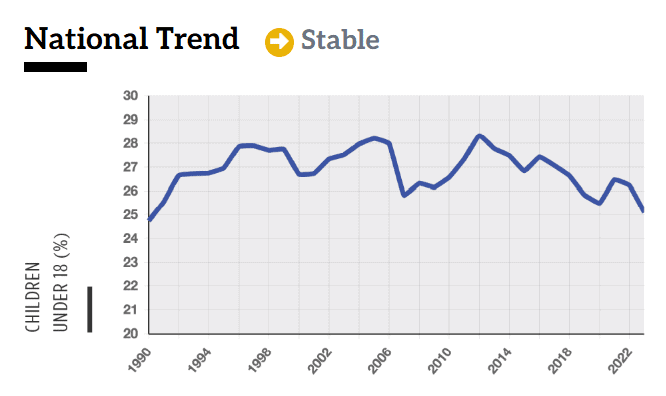
This report finds that the rate of children living with a single parent has essentially remained stable overall from 1990 to the present, with numerous up and down rises and dips as shown here.

These scholars “saw rising rates of single-parent childhood in the 1990s” which “stayed at this level until the mid-2010s.” They continue, “This has been followed by a decline of three percentage points that offset the initial rise. For that reason, we now stand at almost exactly the same level as 1990.”

This report claims that the three countries in their global survey that have higher rates of single-parent families than the U.S. are Lithuania, Belgium, and France. This conflicts with a 2019 Pew Research Center report which states that out of 130 countries and territories, “The U.S. has the world’s highest rate of children living in single-parent households.”

This seeming conflict could be because of the three – percentage point decline this current report mentions, which might not have been reflected in Pew’s data. But Pew did examine the years 2010 through 2018.

This report also found that child mortality has been improving in the United States. Globally, child mortality has been almost halved since 1990. These scholars assert the “recent decline in US child mortality is almost entirely due to a decline in motor vehicle accident deaths.” They note, “The decline in mortality is also happening despite the rise in low birth weight, which increases child mortality.”

Low birth weight babies have been increasing slightly since the 1990s in the United States. Yet, it is still at a low level. These scholars offer an explanation for the increase:

Some of the rise in low birth weight is driven by the rising age at which women are having children. Also, the rising use of assisted reproduction (e.g., in vitro fertilization, IVF) leads to a greater prevalence of multi-child births where each baby generally has a lower birth weight.

They also state that mother’s obesity, malnutrition, sexually transmitted diseases, stress and substance abuse can contribute to low birth weights.

These scholars also report that youth depression is worsening. They state, “The US ranks second-to-last in the world of 112 higher-income countries – just behind Greece, Spain, and Portugal – and we have been falling further and further behind.”

Other sources have been reporting the same alarming youth depression trend. In April 2022, The Atlantic featured a major piece documenting increasing feelings of persistent sadness and depression among America’s youth. They show the trends this way.

Note that so-called “LGBT” youth have the highest levels of sadness and hopelessness. This trendline is sharply increasing at the very time our nation, and the rest of the developed world, is telling such children they have everything to celebrate in being sexually and gender divergent.

This State of the Nation report correctly recognizes that “the time that parents and other family members spend with their children shape children’s values, knowledge, skills, habits, beliefs, and emotional well-being.”

They conclude, “In the long run, no country can be more successful than its children.”

Related Articles and Resources

Mapping Declining US Marriage Rates

Mapping US Fertility and Married Parenting Rates

Mapping US Divorce Rates

Mapping US Unmarried Cohabitation Rates

Important New Book Explains Why Marriage Still Matters

Family Scholars Explain the Current Marriage Paradox in America

New Research Shows Married Families Matter More Than Ever

Why Marriage Really Matters – 3 Focus on the Family Reports

Research Update: The Compelling Health Benefits of MarriageCohabitation Still Harmful – Even as Stigma Disappears

Written by Glenn T. Stanton · Categorized: Family · Tagged: family, Random

Feb 04 2025

Is Another Trump Era a Threat to the Gospel?

First Things posted a very important piece last week raising the question of whether four more years of Donald Trump in the White House is harmful to the Gospel. It is an important question and the article is a must-read.

The author, James. R. Wood, is a professor of religion and theology at Redeemer University in Ontario.

So, has the work of the Gospel suffered under Trump?

Professor Wood says no. 

He opens his piece claiming “American culture is undergoing a ‘vibe shift’” where we are seeing a new “resurgence of hope among conservatives that politics and culture will increasingly return to reality.” Indeed we are, as documented here.

The professor acknowledges the issues many Christians have had with the president over the years, but notes:  

And yet, over a week into his second term, it is clear that gospel opportunities were not sacrificed on Trump’s altar; evangelical voting patterns did not devastate evangelism. In both politics and culture, there has rarely been a time when more people have been interested in Christianity. 

Wood is right.

The Gospel, and third Person of the Trinity who guides us into all truth, are far more powerful than any election cycle. They will not and cannot be thwarted by the movements of man. They move of their own accord, like a freight train, barreling through human history.

He who fell upon the world at Pentecost is still at work. He has not grown feeble, out of touch, or behind the times. He is the Holy Spirit. He does not need our marketing brilliance. Jesus, the King of Kings and Lord or Lords, does not need better PR.

Wood continues, 

We are entering an evangelistic hot zone, especially among young men who are searching for faith and meaning on YouTube and popular podcasts. This may be the spring before an evangelistic harvest of what I call “reality-respecters.” 

He goes onto highlight a remarkable turn of events that illustrates this fact. 

On January 7, mega-ton gorilla of podcasters Joe Rogan sat down for three and a quarter hours to ask 33 year-old Canadian Christian apologist and Ph.D. student Wesley Huff penetrating questions about the reliability of Scripture, the historicity of Jesus’s resurrection from the dead and the logical coherence of the Christian faith. 

Huff was persuasively masterful in explaining the historic truths of Christianity to Joe Rogan and his roughly 50 million followers. The episode went wildly viral with 5.8 million views on YouTube to date, followed by some 40 thousand comments. 

You can catch the entire episode on Spotify or on YouTube here:

You don’t get that much interest in a topic people are supposedly losing interest in because many Christians strongly supported another four years of President Trump in the White House. You just don’t.

Professor Wood explains,

Amid the digressionary journey that is a Joe Rogan episode, Huff ably defended the faith and the reliability of the biblical text using classical, left-brain arguments that many had assumed were obsolete in our postmodern age. Huff employs logic with the assumption that reality can be known—that we can have confidence about events in the past. 

He adds, “And Rogan ate it up. Many have already speculated that this will be the most heard presentation of the gospel in world history.”

Wood ties it all together for our present day and political atmosphere.

Huff’s Rogan episode was released on January 7, one day after Donald Trump’s election was certified and just two weeks before the inauguration. The timing is noteworthy. Fears that Trump’s evangelical support would undermine evangelistic efforts, discredit our witness, and offend seekers are not coming to pass. 

Professor Wood concludes “it is clear that things are not necessarily panning out according to the never-Trump jeremiads. Evangelistic opportunities were not sacrificed on the altar of political agendas.” 

The Gospel of Jesus Christ is thriving in unexpected, miraculous and life-giving ways. After all, that is its very nature. Nothing we can do will ever change that.

Related articles and resources:

The Church’s Lane is the Whole Cosmos

The Cultural Paradox of Following Jesus Christ

Why Believe in Christianity? Because it is True.

How Big is Your View of the Gospel?

Dear Christian, Have Hope in Jesus Christ Amid Our Cultural Chaos

Appreciating the Full Scope of the Lordship of Christ – and the Gospel Itself

Christianity is Both a Religion and a Relationship

Against the Prosperity Gospel

Image from Getty.

Written by Glenn T. Stanton · Categorized: Culture · Tagged: Random

Jan 31 2025

The Rise of Intentional Single Mothers

A recent, gut-wrenching story from the New York Times should be required reading for anyone thinking about employing In vitro fertilization. After a mix-up, two California couples ended up carrying, birthing and raising each other’s baby girls for several months. Ultimately, the two sets of parents made the “unbearable decision” to switch children, choosing custody of their genetic daughter over the one they had welcomed and nursed and loved.  

Though describing a rare occurrence, the story illustrates why this under-regulated industry needs more oversight, as the author notes. What is missed in the piece, however, is that the main problems with this kind of assisted reproduction aren’t the freak accidents with things that might but probably won’t go wrong. The main issue is the any number of things that go wrong anytime babies are created in ways that ignore God’s design for the family.   

For example, just as tragic as parents learning they must give up a baby they thought was theirs is when one genetic parent conceives a child without wanting the other parent to be involved in that child’s life. Unlike a rare embryo mix-up, this kind of parental alienation is common in the fertility industry. The Guardian recently reported that the number of single women seeking fertility treatments in the U.K. has more than tripled in the last decade, outpacing the growth of IVF in general and even the growth of same-sex couples seeking to make a baby.  

In her Guardian article, Amelia Hill quoted several women who chose to become solo mothers. They feel “empowered” because they “did it on their own.” Typically, the father relegates himself to the status of “sperm donor.” One single 45-year-old, conscious of her ticking biological clock, put it this way:  

I’m never gonna meet anybody. … I think doing it without a partner is probably a bit easier. … I worried whether [my daughter would] mind not having a dad. … But now I think it’s good not to have rushed into a relationship that might not have worked simply for that reason. 

According to the mother, the experience has been liberating. “People would ask: ‘Did he leave you—did you leave him?’ and it felt good to be able to say: ‘Nope, I did it on my own!’” 

But she didn’t do it on her own. No woman or man has a child on his or her own. In her case and in the case of each of the thousands of single women in the West turning to science to give them children, there is always a father involved.  

In any other situation that a father is alive but absent, he would be considered a “deadbeat.” The child and the mother are rightly considered abandoned and wronged. Somehow, in this case, choosing the abandonment is empowerment and progress for women. 

All the euphemisms in the world will not change what has happened to the child. Intentionally conceiving with the intent to raise a child without the father creates the same painful situation as if the father left. The consequences are not altered because technology was utilized. 

The rise of intentionally single mothers and same-sex couples hiring surrogates and “donors” has exposed how selective our society is with compassion. Major magazines run long-form articles about rare and terrible cases in which children are born to the wrong parents, but if a baby is taken from either their mother or father as the plan we are supposed to celebrate “freedom” and autonomy. And the children are not allowed to complain.

Each assumption behind these far-more common tragedies is adult-centric. Babies are a right that adults can demand. Adult happiness is the priority of the child’s wellbeing. Marriage and moms and dads are optional aspects of childrearing. The family can be remolded and deconstructed at will. 

Tragically, many Christians approach surrogacy and embryo-destructive IVF with the same “the kids will be alright” assumption, as long as adults get what they want. This is completely backwards. The first consideration when it comes to marriage and procreation is what God intended. This allows us to know what is best for children, what and whom they have a right to, and how children were meant to come into the world.

Failing to answer these questions has subjected children to serious harm, even when all the technology goes “right.”

Written by John Stonestreet · Categorized: Family · Tagged: Life, Random

Jan 31 2025

Andrew Tate’s Counterfeit Masculinity

Recently, internet celebrity Andrew Tate was back in the headlines after being released from house arrest in Romania. The champion kickboxer-turned-influencer-and-life-coach is facing charges of sex trafficking minors, rape, and money laundering. Anyone familiar with Tate’s videos won’t find these allegations hard to believe. He has openly billed himself for years as a “pimp,” gotten rich running a webcam pornography ring, and taught men how to manipulate and abuse women via his “Hustler’s University.” 

Tate has over ten million followers on X, and before YouTube took down his channels, his subscription based, get-rich-quick program, “The Real World,” had accumulated 450 million views. In other words, despite his rap sheet, a lot of people are listening to him—and most of those are young men.  

According to the U.K.-based market research consultancy, Savanta, in 2023, one in three 16- to 25-year-old men said they had a positive view of Andrew Tate. Anecdotally, it seems more than a few of them are Christian young men. Nancy Pearcey, author of The Toxic War on Masculinity, wrote recently on X: 

A former graduate student of mine now teaches at a high school, and she sent me an email saying, "All my male students are fans of Andrew Tate. They are even including quotes from Andrew Tate in the yearbook."

I asked, "Where do you teach?"

"At a classical Christian school."… https://t.co/HBzStOMflm

— Nancy Pearcey (@NancyRPearcey) January 12, 2025

So why the draw to Tate, especially for young men who claim to follow Jesus?  

One answer, suggested by a writer in The Federalist, is that Tate exploits a void created by the “war on masculinity.” Mainstream culture, under the influence of progressive and feminist ideas, has for years dismissed everything distinctive about men as “toxic.” Male strength, competitiveness, and physicality have been denounced in pop culture and medicated in schools. The idea of fathers leading a home has been mocked ceaselessly on television, and boys have been subtly taught there’s nothing they can do or aspire to that girls can’t do better.   

Faced with this crisis of identity, many boys and men turn to online gurus who assure them, contrary to the message they get everywhere else, that their masculinity is good. The image they project of physical fitness, financial success, self-mastery, and confidence with women can be intoxicating to guys who’ve been called toxic all their lives.  

And too often, this retreat to morally iffy influencers has been driven by churches failing to offer a healthy and robust alternative vision of manhood. Faced with the question, “What does it mean to be masculine?” many pastors and Bible study leaders fumble, not wanting to engage in stereotypes, and failing as a result to point to anything uniquely good about being a man. 

As Seth Troutt wrote recently in World Opinions, Tate appeals to what’s fallen in young men, telling them, in essence, “Everything you want is good.” His message boils down to, “Get out of your mom’s basement, quit smoking weed, work really hard, get physically fit, and you’ll get rich and have lots of sex, just like me.” As Troutt concludes, “The first part of that message Christians can resonate with—the last half is evil.” 

This is where Christian leadership—at home and church—should be able to rebuke figures like Tate and portray exactly what is good about being a man. C.S. Lewis observed in Mere Christianity that “The devil always sends errors into the world in pairs—pairs of opposites.” In this case, the progressive error of condemning all that is uniquely masculine as “toxic” is fueling an opposite error that celebrates the fleshly desires of men and encourages them to chase after them. Both ways lead to spiritual darkness, as Tate’s depraved lifestyle demonstrates.  

Thankfully, there is an answer to the question, “What does it mean to be masculine?” and it’s one Christians are best positioned to give. There really are traits, both scripturally and historically, which men are especially called to cultivate—traits like mental and physical toughness, competitiveness, camaraderie, and loving, sacrificial leadership. A Christian book like Anthony Esolen’s No Apologies: Why Civilization Depends on the Strength of Men does a good job of explaining these. Nancy Pearcey, in her book, The Toxic War on Masculinity also cites evidence from anthropology that shows “masculine traits” like providing, protecting, and involved fatherhood discernible across cultures. 

Ultimately, young men, when left to be taught by assertive online influencers eager to avoid the feminist ditch, can be driven straight into the pimp ditch. They must instead be taught through real relationships with fathers, pastors, friends, and mentors who are willing to live out all that is distinctive about God’s design for men. That is the true meaning of a role model, and the call to all of us who know young men asking this age-old question.

Written by John Stonestreet · Categorized: Culture · Tagged: Random

  • « Go to Previous Page
  • Page 1
  • Interim pages omitted …
  • Page 13
  • Page 14
  • Page 15
  • Page 16
  • Page 17
  • Go to Next Page »

Privacy Policy and Terms of Use | Privacy Policy and Terms of Use | © 2025 Focus on the Family. All rights reserved.

  • Cookie Policy