• Skip to main content
Daily Citizen
  • Subscribe
  • Categories
    • Culture
    • Life
    • Religious Freedom
    • Sexuality
  • Parenting Resources
    • LGBT Pride
    • Homosexuality
    • Sexuality/Marriage
    • Transgender
  • About
    • Contributors
    • Contact
  • Donate

culture

Feb 24 2026

‘LGBTQ+’ Identity Likely Hits Peak Saturation in U.S.

Data continues to demonstrate we have likely hit the apex of trans and queer identity in the United States. That is worth celebrating.

The idea that anyone can be an “LGBTQ+” person — with all of its self-contradictory and exclusionary letters — is incoherent. Leading activists have been admitting this for years.

But young people have been adopting this “identity” in increasing numbers, often without any demonstrable evidence for their claim. They just claim it. This ever-expansive alphabet soup became an increasingly trendy political identifier, rather than anything denoting any actual change in behavior.

Liberal comedian Bill Maher famously poked fun at this reality years ago.

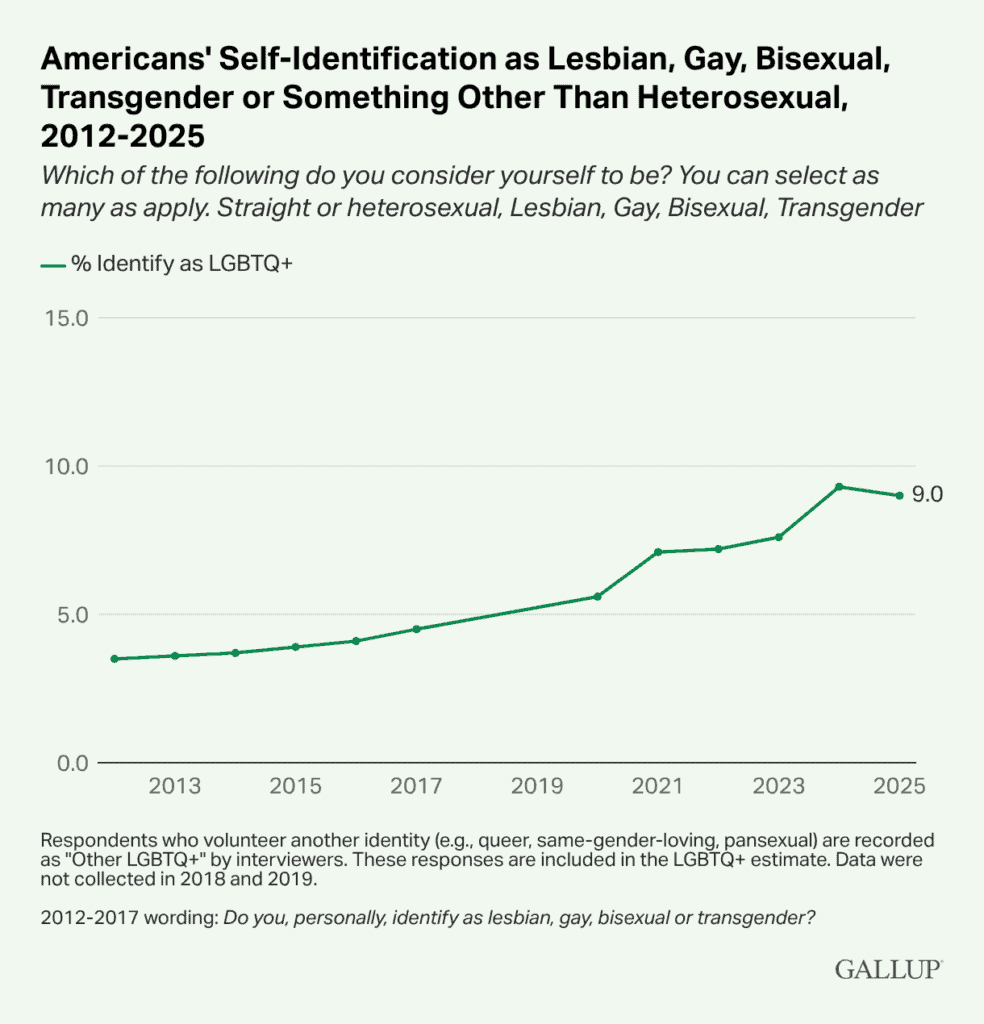
Gallup reported LGBT identification ticked up to 7.1% in 2022 from just 3.5% ten years earlier. Of course,  just ten years or more before that, hardly anyone identified this way because the ridiculous, ever-growing string of letters was just being invented. But it wasn’t done rising. Gallup reported it reached 9.3% in 2025.

Gallup is now reporting LGBT identification has declined slightly for first time since its relatively recent creation, from 9.3% last year to 9.0% today.

Other data supports this welcome development.

Late last year, the Daily Citizen reported here and here that “trans” identity and gender ideology was thankfully slipping among young Americans. This data came from University of Buckingham’s Eric Kaufmann, who documented “the decline of trans and queer identity among Young Americans” and San Diego State University scholar Jean Twenge’s finding that “identifying as nonbinary is in free fall among teens as young as 13.”

She added,

With three nationally representative samples showing a decline in transgender or nonbinary identity since 2023, its clear things have shifted just in the last few years. And now we know the change isn’t just among young adults – it extends to even the youngest teens.

The false shine of gender ideology appears to be fading.

We can pray this means we will never see as many of our young people supporting deceptive and meaningless “LGBTQ+” politics as we saw last year. Afterall, you can only artificially prop up a lie for so long. Eventually, it reveals itself for what it is. 

This is precisely what is happening with gender ideology.

Additional Resources:

A Singularly Christian View of the Transgender Problem

Why Christians Can’t Avoid the “Trans” and Gender Redefinition Issue

Yes, Transgenderism is a False Belief System

What Does it Mean to Be Trans, Anyway?

How the “Trans” and Gender Redefinition Issue Attacks the Family

Do Not Fall for the ‘Affirm Them or They Will Die’ Lie

Written by Glenn T. Stanton · Categorized: Sexuality · Tagged: culture, LGBT

Feb 23 2026

My Impassioned Testimony Before the Colorado State Senate

Last Wednesday, I went to the Colorado State House to testify against a particularly pernicious bill. There have been a great many of these lately, and more are coming.

It was a very interesting experience.

This particular bill that Focus on the Family had its sights on last week was SB 26-018, which would have forced all parents to affirm their child’s subjective and inventive “gender identity” or risk losing custody of that child. Of course, the ideology driving this bill dictates that affirmation of “trans” identity is the only option for any parent. Try to lovingly help your child with their delusion and the state could take them from you. It is one of the most harmful anti-family bills we have seen.

Here is what I told Colorado legislators considering this new law:

Members of the Senate Judiciary Committee,

I am Glenn Stanton, and I work as a researcher at Focus on the Family where I have studied adolescent gender identity for over two decades.

SB-18 is an ill-advised bill. Governor Polis had to pull this proposal at the final hour last year because of negative media and community blow-back. If this bill is so essential for child well-being now, why not last year? 

This bill will cut a vulnerable child off from the parent or parents they need the most: Those that do not unquestionably accept a child’s new identity. 

The reasons are clear.

1) The best research regularly documents that overwhelmingly, most youth who believe they are “trans” come to live with their biological sex before reaching puberty. Something that is most likely to change is not a “protected class”!  

2) The American Psychiatric Associations readily admits “transgender” is neither a medical nor psychiatric diagnosis. It is not something science can recognize because it is a subjective self-perception and ideological construct. This is why desistance rates are, thankfully, so high.

3) Two major medical organizations that were once supportive now refuse hormonal or surgical interventions for gender confused children and adolescents. The American Society of Plastic Surgeons and the American Medical Association announced on Feb 3 there is “insufficient evidence” to guarantee such interventions are not seriously harmful. 

But a parent who says any of this in Colorado could lose their child because of this ill-informed legislation.

The research is clearly on the side of the parent who is lovingly skeptical of a child’s new gender claim. The fact is, there is no such thing as a “transgender” child and gender identity is not a scientifically documented reality. 

It is a psychic conception.

Colorado has no right to sever the natural parental bond over a minor’s often temporary belief.

But before any testimony was heard, that section — which the bill itself claimed was “necessary for the immediate preservation of the public peace, health or safety” — was stricken from the bill at the direction of Colorado’s openly gay governor. Even he knew it was too radical. 

The governor’s spokeswoman told The Denver Post he “opposed the contradictory and troublesome family law provisions in the legislation, which were substantially the same as those he opposed last year.” Some trans activist groups in the state also warned the bill was politically problematic.

Yet radical legislators in the Colorado State House ran that bill last year, they tried to bring it back this year, and they will most certainly try again next year. That is why Focus on the Family, along with so many other good citizens across Colorado, testified strongly against this bill. In fact, those testifying against the bill outnumbered those in favor by about 90%. Yet, the bill was passed onto the full Colorado Senate by the judiciary committee.

Focus on the Family will continue to track and oppose such bills across the country.

Related Articles and Resources: 

Colorado Bill Would Force Parents to Accept Child’s New ‘Gender Identity’

Colorado Legislature Passes Radical ‘Transgender’ Bill with Amendments

Colorado Law Mandates Health Insurance Coverage for ‘Transgender’ Mutilations

Focus on the Family Testifies Against Nightmare Bill, Colorado’s Radical ‘Trans’ Legislation Advances

Meet Three Heroes Working to Protect Colorado Children

Parents’ Rights Groups Sue Colorado Over Radical Trans Law

Protect Kids Colorado

Radical Colorado ‘Transgender’ Bill Threatens Parents’ Rights and Free Speech

Written by Glenn T. Stanton · Categorized: Government Updates · Tagged: culture

Feb 23 2026

State Roundup: Legislation Affecting Families in Indiana, Kentucky, New Hampshire and Washington

At least 46 state legislatures are in session right now, considering bills that affect life, marriage, families and religious freedom. While Congress’ actions often receive the most media attention, there are important measures being debated in each state. 

Legislative efforts often spread from one state to others, so it’s important for those concerned about culture and policy issues to pay attention to what’s happening around the country — as well as what legislators propose in their own state. 

Here’s a quick rundown of bills in four different states — Indiana, Kentucky, New Hampshire and Washington — dealing with key issues affecting families. 

Defining “Male” and “Female” in Indiana

Indiana Family Institute (IFI) is supporting Senate Bill 182, a measure which defines “male” and “female” for all state laws. The Institute, a Focus on the Family-allied Family Policy Council, explains why the bill is needed: 

For decades, no statutory definition of “male” or “female” was necessary, but modern gender-identity activism has made clarity essential. Defining sex according to objective biological markers protects the original meaning of laws like Title IX and prevents the legal chaos that would result from replacing sex with self-declared identity. Senate Bill 182 would codify a clear, biologically based definition of “sex” in state law and require that birth certificates reflect an individual’s sex at birth, without later alteration.

In addition, the bill prohibits public schools “from requiring a student to share sleeping quarters with a member of the opposite sex, unless the individual who is a member of the opposite sex is a family member.” It also “requires public schools … to designate a multiple occupancy restroom or changing area as follows: (1) For the exclusive use of the male sex. (2) For the exclusive use of the female sex.”

Check out Indiana Family Institute for more information about their 2026 Legislative Agenda to support issues related to marriage, family, life and religious freedom. 

Religious Freedom in Kentucky

Kentucky’s Senate overwhelmingly passed legislation to protect the conscience rights of doctors, nurses and other health care professionals, with a vote of 28-5. SB 72, the Healthcare Heroes Recruitment and Retention Act, is supported by The Family Foundation, a Focus on the Family-allied Family Policy Council. The organization explains why this bill is important: 

This important bill protects doctors, nurses, and other medical professionals from being forced to perform harmful or unethical procedures that violate their oath and conscience.

David Walls, executive director of the pro-life, pro-family organization, encouraged the Kentucky House to pass the bill, saying, “No Kentuckian, especially our frontline healthcare workers, should be forced to choose between their faith and their profession.” 

There’s more information about The Family Foundation here. 

New Hampshire’s Pro-Life Measure 

“Right-to-try” laws allow patients with chronic and debilitating illnesses to access treatments that are not yet fully approved by the Food and Drug Administration. New Hampshire has a right to try law, but HB 1292 would improve the law and protect life by criminalizing the use aborted babies’ organs as a source for stem cell lines.

New Hampshire’s Cornerstone, a Focus on the Family-allied Family Policy Council, explains the importance of this legislation: 

After last year’s advancements for the right to try experimental life-saving treatments, biotech companies are now taking interest in New Hampshire. Layon’s bill will help continue to attract innovation to the Granite State while ensuring we stop and criminalize use of abortion byproducts.

The organization explains that the legislation is modeled after a successful Florida law, adding: 

By prohibiting experimental treatment biotech companies from using stem cells of aborted children, companies can research life-saving treatments without supporting a life-taking industry. Stem cell treatments that do not use abortion will still be strongly protected. 

Learn more about New Hampshire’s Cornerstone and how to support family-friendly legislation here. 

Higher Taxes in Washington State

The Washington State Legislature is considering a bill titled “Establishing a tax on millionaires.” SB 6346 is opposed by the Family Policy Institute of Washington (FPIW), a pro-life, pro-family Focus on the Family ally. 

The organization explains in a Facebook post that the bill places  a “9.9% income tax on income over one million dollars, along with a cap on charitable deductions.” Pastor Brian Noble, CEO and President of FPIW, argues that the “‘Millionaires Tax’ violates biblical principles of justice, property rights, charity, and civil authority, and also conflicts with the state constitution and voter intent.”

FPIW states that SB 6346 will negatively affect all families, giving this warning: 

High earner income and wealth taxes are associated with capital flight and relocation of entrepreneurs, investors, and business owners to lower tax states, which can shrink the long-term tax base and private sector job growth rather than strengthen it. In the name of “tax the rich,” the real impact of this bill will be to hurt middle- and lower-income families, who need good jobs in order to prosper.

Citizens of the Evergreen State can find out more about the bill here and more about Family Policy Institute of Washington here. 

Related articles and resources: 

How to Get In Touch With Your State Policy Group

Activist Erin Friday on Protecting Kids and Fighting ‘Gender’ Ideology

‘The Babylon Bee’ Fights Hawaii Law Censoring Political Speech

Invoking God’s ‘Mercy,’ NY Gov. Kathy Hochul To Sign Assisted-Suicide Bill

Kansas Legislature Overrides Governor’s Veto, Protects Women’s Bathrooms

Meet Three Heroes Working to Protect Colorado Children

Sixteen Attorneys General Demand Answers on YouTube Censorship

UPDATED: Pornography Age Verification Laws — What They Are and Which States Have Them

Washington State Citizens Fight for Parents’ Rights, Girls Sports

Written by Jeff Johnston · Categorized: Government Updates · Tagged: culture, Legislation

Feb 19 2026

Kansas Legislature Overrides Governor’s Veto, Protects Women’s Bathrooms

The Kansas Legislature overrode a veto to pass a bill protecting women’s safety and privacy in single sex areas of public buildings, including bathrooms, locker rooms and showers.

SB 244 mandates that public buildings, including public schools and universities, have private spaces “for use only by individuals of one sex.” It also requires birth certificates and drivers’ licenses to designate “gender” based on birth sex — not false “gender identities.”

The new law defines “male” and “female” biologically, according to an individual’s reproductive system; sets penalties for those who repeatedly violate the law; and allows individuals whose privacy is violated by a member of the opposite sex to sue that person. 

Kansas Governor Laura Kelly vetoed SB 244, but the Senate voted 31-9 and the House voted 87-37 to override her decision. 

Kelly explained her veto in a press statement, saying the bill was poorly written and arguing: 

I believe the Legislature should stay out of the business of telling Kansans how to go to the bathroom and instead stay focused on how to make life more affordable for Kansans.

Alliance Defending Freedom Legal Counsel Sara Beth Nolan applauded the veto override, explaining why the bill was necessary: 

Women and girls shouldn’t be forced to sacrifice their privacy and safety in the name of promoting gender ideology. Allowing men to invade women’s most intimate spaces – including changing rooms and restrooms – compromises their dignity. SB 244 ensures that the private spaces of women and girls in government buildings are not open to men. It rightly prioritizes privacy and safety over ideology. 

Rep. Abigail Boatman, D-Wichita, who was born male but believes he is a woman, denounced the law’s passage, accusing lawmakers of trying to police and control women. 

Boatman, who was appointed to a seat by a vote of his party’s precinct leaders, told The Topeka Capital-Journal: 

It’s hard to feel like it’s not, at least in part, about me, since I am a transgender person who spends my whole day in a government building. 

But, as much as this may be about me and about transgender women in general, this is about policing women. 

Boatman continued: 

This is about policing what is acceptable expressions of womanhood and femininity, and we don’t do that to men. There’s been no outrage, at least not yet, about trans men and trans boys. 

It’s always trans girls and trans women, and that’s because this is a mechanism to control women. One among many. 

No. “Trans women” are not women. And boys and men are equally concerned when girls and women invade their privacy. 

Radical journalists went along with the charade that a man can become a women with destructive, body-damaging drugs, hormones and surgeries. 

Instead of calling this a reality-based, pro-woman bill that protects privacy and safety, many inaccurately labelled the bill an “anti-trans bathroom bill,” saying it requires “requires people to use bathrooms in public places that align with their sex assigned at birth.” 

But sex is not “assigned at birth” — it’s objectively recognized and acknowledged. And people should use sex-segregated facilities in line with their sex — not some spurious self-identity. 

Christians and conservatives have compassion for individuals struggling with self-hatred,  mental health, and sexual sin and brokenness — some of the contributing factors that might lead someone to live as the opposite sex. We want them to accept and embrace their bodily reality.

But we also hold to the truth about human sexual dimorphism. There are only two sexes, individuals are either male or female, and no one can change from one sex to the other. 

At least 20 states have laws protecting privacy and safety in bathrooms in public buildings or in K-12 schools and universities. 

Kudos to the Kansas Legislature for joining them in recognizing truth and protecting privacy and safety in sex-segregated spaces. 

Related articles and resources: 

California Students Battle to Protect Girls’ Private Spaces in Schools

Chloe Cole: Gender Reassignment Surgery Regret

Counseling for Sexual Identity Concerns: A Measured, Careful, and Compassionate approach

Focus on the Family with Jim Daly: Becoming the Woman God Made Me to Be

Focus on the Family with Jim Daly: The Journey Back to My True Identity

Helping Children with Gender Identity Confusion

Laura Perry Smalts’ Authentic Shift From Transgenderism To Embracing God’s Design

Middle School Girls Who Protested ‘Trans’ Athlete Are Banned From Future Competition

Riley Gaines and 15 Other Female Athletes Sue NCAA Over ‘Transgender Policy’

President Trump: ‘There are Only Two Genders: Male and Female’

Transformation: A Former Transgender Responds to LGBTQ 

Transgender Resources

Trump Signs Executive Order Protecting Women’s Sports and Spaces

Written by Jeff Johnston · Categorized: Government Updates · Tagged: culture, transgender

Feb 18 2026

Colorado Bill Would Legalize Prostitution

Colorado legislators have introduced a bill that would remove all legal prohibitions forprostitution throughout the state. 

While Nevada permits prostitution in licensed brothels in specific counties, and Maine has decriminalized selling sex — but not purchasing it, if this bill is passed and signed into law, Colorado would be the first state to fully legalize and regulate “commercial sexual activity.” 

Legalizing prostitution would be disastrous for the Centennial State. 

SB26-097, “Decriminalize Adult Commercial Sexual Activity Among Consenting Adults,” “repeals the state criminal offenses of prostitution, soliciting for prostitution, keeping a place of prostitution, patronizing a prostitute, and prostitute making display.” 

Public solicitation for prostitution could become commonplace in cities and towns, exposing even young children to this perversion of God’s good design for relationships and sexuality. 

The state law would preempt any city, town or county ordinances and regulations that criminalize commercial sexual activity. It also “repeals the offense of pandering when it involves knowingly arranging or offering to arrange a situation that permits a person to practice prostitution.”

SB26-097 is sponsored by four seriously misguided Democrats: Senate Majority Whip Nick Hinrichsen, Senate Assistant Majority Leader Lisa Cutter, Representative Lorena Garcia and Representative Rebekah Stewart.  

The bill declares: 

Criminalizing prostitution endangers adults who engage in consensual sexual activity. Fear of criminal punishment among consenting adults engaged in commercial sexual activity encourages physical, emotional, and structural violence against sex workers, subjects them to economic crimes, and increases resistance to harm-reduction practices.

SB26-097 also states: 

Like workers in other fields, sex workers deserve the opportunity to screen their clients to ensure a safe transaction. Criminalizing client conduct creates a disincentive for prospective clients to share personal information, which inhibits sex workers’ ability to maintain their safety.

But the truth is, prostitution is not like “work in other fields.” It is inherently damaging — spiritually, physically and emotionally — for both the prostitute and the “client.” 

As the National Center on Sexual Exploitation (NCOSE) documents, prostitution — even legalized — preys on vulnerable people: 

Many people in systems of prostitution suffer from vulnerabilities and marginalization. Common adverse experiences that are pathways to prostitution include childhood sexual abuse, homelessness, and poverty. 

Other factors associated with prostitution involvement include a history of foster care, not having a high school degree, being a racial minority, an immigrant, an indigenous minority, or LGBT person, as well as “entry” into prostitution as a child (i.e., sex trafficking).

NCOSE further notes that legalizing prostitution does not make prostitution safe: 

Prostitution creates trauma that cannot be regulated or decriminalized away. Prostitution is inherently harmful. Prostitution results in a wide range of devastating physical harms and/or psychological trauma to those sold in it – even when it’s legal or fully decriminalized.

Legalizing prostitution actually leads to even more coerced sex trafficking, as Janice G. Raymond points out in the Journal of Trauma Practice. When examining legal prostitution in the Netherlands, researchers found more illegal sex trafficking was taking place: 

One argument for legalizing prostitution in the Netherlands was that legalization would help to end the exploitation of desperate immigrant women who had been trafficked there for prostitution. However, one report found that 80% of women in the brothels of the Netherlands were trafficked from other countries. In 1994, the International Organization of Migration stated that in the Netherlands alone, “nearly 70 % of trafficked women were from CEEC [Central and Eastern European Countries].”

Researchers found the same increase in sexual trafficking in other countries where prostitution is legalized, such as Germany and parts of Australia. 

NCOSE concurs, explaining: 

Brothels, illicit massage parlors, escort agencies, and online platforms are overlapping systems of prostitution and sex trafficking occurs in all of them. Normalization of prostitution expands demand for paid sex. This emboldens sex traffickers who see this as a conducive “business” environment. Cross-national studies have found higher levels of human trafficking in countries with legalized or decriminalized prostitution.

Raymond notes that decriminalizing prostitution also increases child prostitution, citing studies from Australia and the Netherlands. She writes:  

The Amsterdam-based ChildRight organization estimates that the number of children in prostitution has increased by more than 300% between 1996 –2001, going from 4,000 children in 1996 to 15,000 in 2001. ChildRight estimates that at least 5,000 of these children in Dutch prostitution are trafficked from other countries, with a large segment being Nigerian girls.

Nor does legalizing prostitution make it “safe.” NCOSE explains: 

Prostitution creates trauma that cannot be regulated or decriminalized away. Prostitution is inherently harmful. Prostitution results in a wide range of devastating physical harms and/or psychological trauma to those sold in it – even when it’s legal or fully decriminalized. 

In another article from the Journal of Trauma Practice “Prostitution and Trafficking in Nine Countries,” the authors concur, citing the harms to women: 

We found that prostitution was multi-traumatic: 71% were physically assaulted in prostitution; 63% were raped; 89% of these respondents wanted to escape prostitution, but did not have other options for survival. A total of 75% had been homeless at some point in their lives; 68% met criteria for PTSD.

These harms — and more – still occur when prostitution is legalized, “Our findings contradict common myths about prostitution … that prostitution is qualitatively different from trafficking, and that legalizing or decriminalizing prostitution would decrease its harm.”

There are more harms to prostitution, which you can read about here, here, here, here and here. 

Colorado politicians want to legalize selling sex, which is intrinsically harmful, degrading for all those involved and leads to greater destruction. 

They somehow believe that taking God’s beautiful gift of sexual expression, designed to unite a husband and wife, with the potential for creating new life, is something that can be commercialized like any other business. 

Coloradans must make their voice heard and oppose this horrific bill. 

SB26-097, “Decriminalize Adult Commercial Sexual Activity Among Consenting Adults,” has been introduced in the Senate and assigned to the Judiciary Committee, but no hearing date has yet been scheduled. You can find information about contacting the sponsors of the bill here. 

Related articles and resources: 

Colorado Committee Kills ‘Children Are Not for Sale Bill’

Counseling Consultation & Referrals

How to Prevent Sexual Exploitation of Your Child

How to Fight Human Trafficking

Human Trafficking: What You Need to Know

Meet Three Heroes Working to Protect Colorado Children

National Center for Missing and Exploited Children (NCMEC)

NCMEC’s 24/7 call center number: 1-800-THE-LOST (843-5678)

Prostitution Proliferates in California after Decriminalizing Loitering

Protecting Your Child From Sexual Abuse

Reclaiming Hope: Resources and Mentoring for Sex Trafficking Survivors

‘Still Hope’ Movie Tells Story of Hope and Healing After Horrors of Sex Trafficking

Understanding the Scope of Human Trafficking

Written by Jeff Johnston · Categorized: Government Updates · Tagged: culture, prostitution

  • Page 1
  • Page 2
  • Page 3
  • Go to Next Page »

Privacy Policy and Terms of Use | Privacy Policy and Terms of Use | © 2026 Focus on the Family. All rights reserved.

  • Cookie Policy